A History of Sniper Rifles: Evolution, Technology, and Impact
From early sharpshooters to modern precision rifles, explore the history of sniper rifles and how they changed warfare forever.
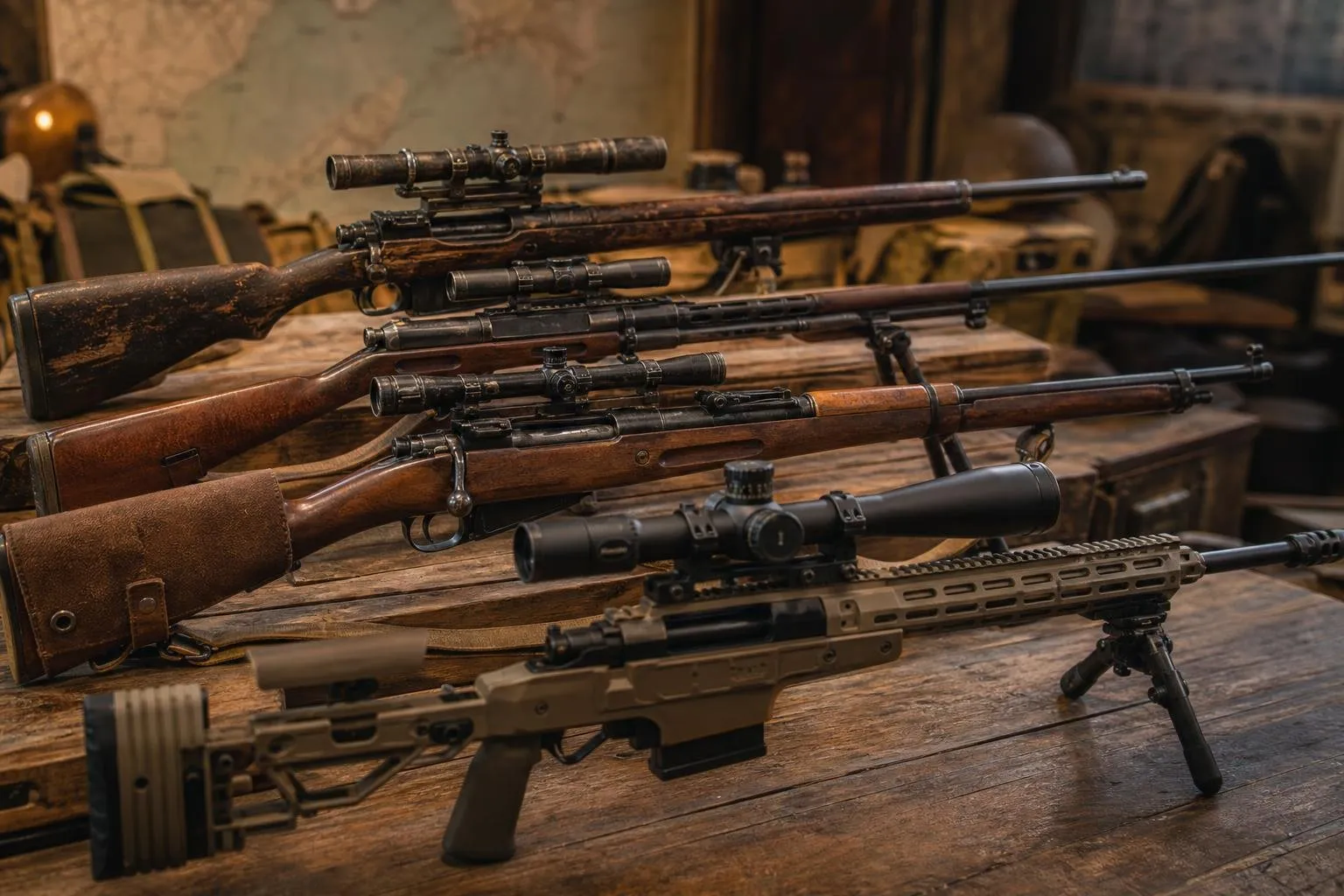
A History of Sniper Rifles: Evolution, Technology, and Impact
Sniper rifles represent one of warfare's most specialised weapons, designed for extreme accuracy at long distances.
These precision firearms have changed how battles are fought, allowing a single skilled marksman to influence outcomes from positions far removed from the main fighting.
The development of sniper rifles began in the 1850s with the Whitworth rifle, which could hit targets at 2,000 yards, and evolved through major conflicts into today's advanced systems that routinely exceed 1,000 metres in effective range.
When you think of snipers, you might picture modern military operations, but the roots of precision marksmanship stretch back much further.
The journey from early sharpshooters using basic optical sights to contemporary sniper technology reveals constant innovation driven by tactical needs.
Each major conflict from the American Civil War through both World Wars to recent Middle Eastern operations pushed designers to create more reliable, accurate, and powerful rifles.
The weapons used by snipers today bear little resemblance to their predecessors, yet the core mission remains unchanged: delivering precise fire at extended range whilst remaining concealed from the enemy.
Key Takeaways
- Sniper rifles evolved from 19th-century designs like the Whitworth rifle to modern systems with ranges exceeding 1,000 metres
- Major conflicts including World War I and II established snipers as essential military units and drove rapid weapon development
- Modern sniper rifles serve both military and law enforcement roles with specialised designs for different tactical requirements
Origins of Precision Marksmanship
The concept of precision shooting emerged in the 18th century when European hunters and American frontiersmen realised that rifled barrels could deliver unprecedented accuracy at distance.
These early developments laid the groundwork for specialised marksman roles in warfare, transforming how battles were fought and won.
Early Marksmen and Jäger Rifles
German hunters developed Jäger rifles around 1730 for use in heavily forested regions where precise shots were essential.
These rifles featured shorter barrels than military muskets, typically around 30 inches, and smaller calibres ranging from .60 to .75.
The Jäger rifle's rifled barrel gave hunters remarkable accuracy compared to smoothbore muskets.
German states began issuing these weapons to specialised light infantry units called Jägers, meaning hunters.
These soldiers acted as scouts and skirmishers rather than fighting in traditional linear formations.
The rifles included practical features like brass or steel patchboxes built into the stock.
These boxes held greased cloth patches that wrapped around the ball, creating a tight seal in the barrel grooves for improved accuracy and velocity.
Development of Rifled Barrels
Rifling transformed firearms from area weapons into precision tools.
The spiral grooves cut inside the barrel caused the ball to spin, stabilising its flight path much like a thrown spiral in football.
The introduction of rifled barrels significantly improved accuracy, allowing skilled marksmen to engage targets at distances that seemed impossible with smoothbore muskets.
A smoothbore musket could barely hit a man-sized target beyond 80 yards, whilst a rifled barrel extended effective range to 200 yards or more.
Manufacturing rifled barrels required considerably more skill and time than smoothbores.
Gunsmiths had to carefully cut the grooves at a precise depth and twist rate.
This complexity made rifled weapons expensive and initially impractical for mass-produced military arms.
Kentucky and Baker Rifles in Combat
American gunsmiths adapted Jäger rifles into longer, lighter weapons better suited to frontier conditions.
The Kentucky rifle, as it became known, featured barrels extending to 40 inches and calibres between .45 and .60.
During the American Revolutionary War, riflemen like Timothy Murphy demonstrated the lethal potential of precision shooting.
Murphy famously killed British General Simon Fraser at approximately 300 yards during the Battle of Saratoga in 1777, helping halt a critical counterattack.
Morgan's Riflemen, a specialised unit of frontiersmen, used these rifles to deadly effect as skirmishers and scouts.
Britain responded by adopting the Baker rifle in 1803, issuing it to two rifle regiments including the famous 95th Rifles.
The Baker featured a 30-inch barrel in .625 calibre and represented Britain's first serious attempt at equipping regular troops with precision weapons for specialised roles.
The Birth of the Military Sniper
The military sniper emerged during the 19th century as armies recognised the tactical advantage of highly skilled marksmen who could engage targets at extended ranges.
American conflicts pioneered the concept of dedicated sharpshooters, whilst the British refined specialised training and equipment that transformed individual marksmen into organised sniper units.
American Civil War and the Whitworth Rifle
The American Civil War marked a turning point in military marksmanship.
Confederate forces employed the Whitworth rifle, a British-made weapon with a hexagonal bore that could accurately engage targets at 1,500 yards.
This rifle became infamous when Confederate sharpshooter units used it to eliminate Union officers from distances previously thought impossible.
Union Major General John Sedgwick was killed by a Whitworth-armed marksman at roughly 1,000 yards in 1864.
The weapon's price and limited availability meant only select Confederate marksmen received them.
Despite this scarcity, the Whitworth rifle demonstrated how a single skilled shooter with superior equipment could influence battlefield outcomes far beyond their individual presence.
Sharpshooters and the Role of Hiram Berdan
Hiram Berdan organised the Union's most effective response to Confederate sharpshooters by forming two regiments known as Berdan's Sharpshooters.
These units required recruits to place ten consecutive shots within a five-inch circle at 200 yards before acceptance.
Berdan's men used Sharps rifles and later Colt revolving rifles.
They pioneered tactics that modern snipers still employ today, including the use of concealment, camouflage, and patience.
You'll find historical accounts of these sharpshooters wearing green uniforms rather than standard blue, making them harder to spot in wooded terrain.
This early form of field craft represented a significant departure from conventional military thinking, where visibility and formation discipline were paramount.
Formation of Specialised Sniper Units
The concept of organised sniper training didn't fully develop until the First World War.
British Major Hesketh-Prichard, a big-game hunter and reportedly the world's best rifle shot, established the First Army School of Sniping, Observing and Scouting.
These early programmes taught map reading, observation, and field craft alongside marksmanship.
The term "sniper" itself originated from 19th-century hunters who shot snipe birds from long distances, a task requiring exceptional skill.
Hesketh-Prichard recognised that standard military rifles weren't suitable for precision work.
He sourced civilian hunting rifles, often paying for them himself, to equip his students properly.
By the Second World War, every major military power had established dedicated sniper programmes with purpose-built rifles and optics.
Rise of Optical Sights and Technological Progress
The development of sniper rifles accelerated dramatically with improvements to optical sights, transforming basic marksmanship into precision shooting.
During the Crimean War, early telescopic sights gave shooters their first clear advantage at distance, whilst later innovations in reticle design, night vision technology, and advanced optics pushed effective ranges beyond what 19th-century marksmen could have imagined.
Early Telescopic Sights and Reticles
The first optical sights were designed during the Crimean War in the 1850s, with much of the pioneering work led by Colonel D. Davidson using optical sights produced by Chance Brothers of Birmingham.
These early scopes were fixed and could not be adjusted, which severely limited their effective range.
The original telescopic sight allowed you to observe and target objects at greater distances than iron sights permitted.
However, by the 1870s, improvements in both optics and rifle mechanisms pushed effective accurate ranges up to a mile from the target.
Early reticles were simple crosshairs without the sophisticated ranging aids you see today.
German gunsmiths made a crucial advancement during World War I by mounting scopes above the barrel for optimal accuracy, rather than offset positions that complicated aiming calculations.
Optical Enhancements in the World Wars
World War I marked a turning point as the accuracy of the sniper rifle was greatly improved through better optical technology.
German snipers received rifles with telescopic sights that illuminated at night, giving them a distinct advantage in low-light conditions.
Initially, British military advisers believed telescopic sights were too fragile for combat use.
They soon realised these optics could be made sturdy enough to withstand the recoil and harsh conditions of warfare.
By the end of World War II, you could expect reasonable accuracy over 600 metres with optical sights, though anything beyond that range remained unpredictable.
The war years proved that properly mounted and protected optics were essential rather than optional equipment.
Night Vision Devices and Modern Advances
Technology has greatly improved the accuracy and effective range of sniper rifles through enhanced optics and thermal imaging.
Modern telescopic sights offer magnification ranging from 4× to 40× with objective lenses between 40 and 50 mm in diameter for brighter images.
Contemporary scopes feature special reticles that help you judge distance accurately, which is critical for compensating bullet trajectory.
These reticles often include rangefinding calculations built into the sight picture.
Night vision devices and thermal imaging have extended your operational capability into complete darkness.
The effective range of modern sniper rifles now exceeds 1,000 metres, making them vastly superior to their World War II predecessors in both accuracy and reliability under diverse environmental conditions.
Sniper Rifles in Major Conflicts
Major conflicts from World War I through the modern era transformed sniper rifles from modified infantry weapons into specialised precision instruments.
Each war period brought distinct advances in rifle design, optics technology, and deployment tactics that shaped how military snipers operate today.
World War I: Early Adoption and Innovation
World War I marked the first large-scale use of dedicated sniper rifles in trench warfare.
Both sides quickly recognised that skilled marksmen could dominate no-man's-land and eliminate enemy officers from protected positions.
The British Army initially equipped sharpshooters with Lee-Metford rifles and later the Enfield Pattern 1914, which became popular amongst snipers for its accuracy at range.
German forces deployed the Gewehr 98 with advanced optical sights, giving them an early advantage.
Germany distributed approximately 20,000 scoped rifles to its best marksmen, establishing dominance through superior optics technology.
The M1903 Springfield served American forces and proved reliable for precision shooting.
Dedicated sniper training programmes emerged during this period as armies realised that marksmanship alone wasn't enough.
You needed to understand fieldcraft, concealment, and ballistics.
Telescopic sights became standard equipment rather than rare additions.
This conflict established the sniper as a permanent fixture in modern warfare, forcing all major armies to develop counter-sniper tactics and training.
World War II: Standardisation and Mass Deployment
World War II saw sniper rifles become standardised equipment across all major fighting forces.
Armies deployed snipers in far greater numbers than the previous conflict, with some nations producing hundreds of thousands of scoped rifles.
The Karabiner 98k became Germany's primary sniper platform, building on the proven Gewehr 98 design.
Soviet forces fielded the Mosin-Nagant M1891/30 in massive quantities, training both male and female snipers who achieved remarkable success on the Eastern Front.
British and Commonwealth forces continued using the Enfield Pattern 1914 alongside the Lee-Enfield No. 4 (T).
American military snipers relied on the M1903 Springfield and later the semi-automatic M1 Garand in designated marksman roles.
Sniper training became more sophisticated during this period.
You learnt range estimation, wind reading, and target prioritisation as core skills.
The concept of the designated marksman emerged to bridge the gap between standard infantry and specialist snipers.
Mass production meant scoped rifles reached battalion and company levels rather than remaining at divisional reserve.
Cold War to Modern Era: Precision and Variety
The Cold War through to present day conflicts brought unprecedented advances in sniper rifle technology.
Engagement ranges exceeded 1,000 metres by 2001, with modern rifles maintaining accuracy far beyond what World War II weapons could achieve.
New calibres emerged to meet different mission requirements.
The .308 Winchester became standard for medium-range work, whilst .338 Lapua and .50 BMG pushed effective ranges beyond 1,500 metres.
Semi-automatic platforms joined traditional bolt-action designs, giving you faster follow-up shots.
Modern sniper rifles feature modular chassis systems, adjustable stocks, and mounting points for night vision and thermal optics.
Suppressors reduce your acoustic signature, making counter-sniper detection more difficult.
Conflicts in Korea, Vietnam, and the Middle East refined both equipment and tactics.
Military snipers now operate as part of combined arms teams, providing reconnaissance and precision fire support.
Designated marksman programmes expanded, equipping infantry squads with accurised rifles for medium-range engagements.
Precision rifle platforms evolved from wood-stocked designs to modular systems that you can customise for specific missions.
Smart optics and ballistic computers have begun appearing, though human skill remains essential for success.
Key Firearms and Innovations
The development of sniper rifles accelerated dramatically through the 20th century, producing weapons that could strike targets at distances previously thought impossible.
Breakthroughs in rifle design, optical technology, and ammunition chemistry transformed sniping from a skilled craft into a science of precision.
Iconic Sniper Rifles of the 20th Century
The Mosin-Nagant became one of history's most prolific sniper platforms, serving Soviet forces from World War I through the Cold War.
This bolt-action rifle earned its reputation in the hands of legendary marksmen during the Winter War and World War II.
The British Whitworth rifle pioneered hexagonal rifling during the American Civil War, establishing early standards for accuracy.
By World War II, the British Lee-Enfield and German Mauser Model 1898 dominated European battlefields as designated marksman weapons.
Post-war innovations brought the Remington 700 into prominence.
This bolt-action platform became the foundation for numerous military variants, including the M24 and M2010 Enhanced Sniper Rifle used by American forces.
Its modular design allowed for customisation across different calibres and mission profiles.
The Barrett M82, introduced in the 1980s, revolutionised anti-materiel shooting.
This semi-automatic rifle chambered in .50 BMG could disable vehicles and equipment at extreme distances, fundamentally changing tactical possibilities on the battlefield.
Birth of the Modern Sniper Rifle
Modern sniper rifles emerged during the Cold War, incorporating features that defined precision shooting for decades to come.
These weapons prioritised consistency over extended firing sequences, unlike their World War-era predecessors that degraded in accuracy after repeated use.
Accuracy International transformed the industry in the 1980s with their modular chassis systems.
Their rifles featured adjustable stocks, free-floating barrels, and precision-machined actions that maintained sub-minute of angle (MOA) accuracy across thousands of rounds.
The company's Arctic Warfare series became standard issue for military and police forces worldwide.
The McMillan TAC-50 pushed boundaries for long-range shooting, holding world records for confirmed kills beyond 3,500 metres.
Its bolt-action design combined rigidity with portability, whilst maintaining the ballistic performance necessary for ultra-long-range engagements.
Modern sniper rifles incorporate advanced materials like carbon fibre stocks and stainless steel barrels with specialized coatings.
These improvements ensure rifles maintain zero even under harsh environmental conditions that would have rendered earlier weapons ineffective.
Ammunition, Calibres, and Ballistics
Your choice of ammunition fundamentally determines your rifle's effectiveness at range.
The 7.62×51mm NATO (.308 Winchester) remains the most common calibre for general-purpose sniping, offering excellent accuracy to 800 metres whilst maintaining manageable recoil.
For extended ranges, the .300 Winchester Magnum provides superior ballistic performance with flatter trajectories and better wind resistance.
Military forces adopted this calibre for engagements between 800 and 1,200 metres where standard 7.62×51mm NATO loses effectiveness.
The .338 Lapua Magnum revolutionised long-range rifle capabilities when introduced in the 1980s.
This calibre bridges the gap between standard sniper rounds and anti-materiel cartridges, maintaining lethal energy and accuracy beyond 1,500 metres.
The .338 Lapua became the gold standard for modern sniper rifles operating at extreme distances.
Common Sniper Calibres and Effective Ranges:
CalibreEffective RangePrimary Use7.62×51mm NATO800mGeneral sniping.300 Winchester Magnum1,200mExtended range.338 Lapua Magnum1,500m+Long-range precision.50 BMG2,000m+Anti-materiel
The Barrett .50 cal and similar platforms firing .50 BMG achieve minute of angle accuracy at distances exceeding 2,000 metres.
This massive cartridge delivers sufficient energy to penetrate light armour and disable equipment, expanding your mission capabilities beyond traditional anti-personnel roles.
Modern Sniper Roles and Teams
Sniper teams operate as highly trained units that combine marksmanship with reconnaissance capabilities, whilst designated marksman rifles bridge the gap between standard infantry weapons and precision sniper rifles.
Structure and Tactics of the Sniper Team
Modern sniper teams typically operate in pairs, with one shooter and one spotter who work together to identify and engage targets.
The spotter uses tactical spotting scopes and laser rangefinders to calculate distance, wind speed, and other environmental factors that affect shot placement.
Both team members can switch roles as needed during extended operations.
British sniper teams use the Leupold Mark 4 spotting scope alongside their primary weapons.
The sniper team functions as a reconnaissance asset for ground commanders, gathering intelligence whilst moving through terrain.
You'll find that snipers undergo training at specialised sniper schools that emphasise tactical awareness beyond just marksmanship.
Teams operate independently with minimal support from parent units.
They maintain concealed positions or engage from distances that exceed enemy detection capabilities.
Designated Marksman Rifles (DMRs)
A designated marksman rifle fills the role between standard infantry rifles and precision sniper rifles.
These semi-automatic rifles extend your effective engagement range beyond typical assault rifles whilst maintaining faster follow-up shots than bolt-action systems.
The US Army's M21, converted from the M14 battle rifle, served as an early semi-automatic sniper rifle with an effective range of 690 metres using M118 special rounds.
Modern DMRs typically feature:
- Free-floating barrels for improved accuracy
- Picatinny rails for optics and accessories
- Bipods for stable shooting positions
- Muzzle brakes to reduce recoil
Semi-automatic rifles allow designated marksmen to engage multiple targets rapidly.
You can mount various optics and thermal sights to these platforms using standardised rail systems.
Integration of Technology and Equipment
Modern sniper rifles incorporate advanced equipment that enhances target acquisition and engagement capabilities. Sniper scopes now integrate with image intensification and thermal systems for operations in limited visibility conditions.
The British Army's L115A3 uses a Schmidt & Bender 5-25×56 scope that accepts both types of night vision equipment.
You'll find meteorological sensors and ballistic calculators included with many systems. Some platforms like the MK-22 incorporate modular designs with suppressors and monopods for enhanced stability.
AI-assisted targeting systems are emerging to help calculate complex ballistic solutions.
Equipment additions include:
Accuracy enhancements: Free-floating barrels, adjustable triggers, precision ammunition
Tactical accessories: Suppressors for reduced signature, bipods and monopods for support
Optical systems: Variable magnification scopes, laser rangefinders, thermal imaging
The Australian Defence Force selected the AI AX-SR, which converts between 7.62×51mm, .338 Norma Magnum, and .338 Lapua Magnum calibres for mission flexibility.
Legacy, Influence, and the Future
The development of sniper rifles has transformed military doctrine and popular culture alike. Ongoing innovations promise to extend their capabilities even further.
Precision warfare now depends heavily on these systems. Their psychological impact extends far beyond the battlefield.
Cultural and Psychological Impact
Sniper rifles occupy a unique position in military history and public consciousness. The solitary nature of the sniper's work creates both fear and fascination amongst adversaries and civilians.
Films, books, and media have elevated snipers to near-mythical status. This cultural representation influences how you perceive modern warfare and the role of individual skill in combat.
The psychological effect on enemy forces cannot be overstated—a single skilled sniper can deter movement across entire areas.
Counter-sniper operations have become essential in modern conflicts precisely because of this psychological impact. Knowing that a precision sniper rifle might be trained on any position forces troops to alter their behaviour entirely.
This mental burden affects morale and tactical planning.
The history of the sniper rifle demonstrates how technology and training combine to create weapons systems that influence battles through presence alone.
Snipers as Force Multipliers
Modern snipers deliver value far exceeding their numbers on the battlefield. A two-person sniper team can control terrain, gather intelligence, and eliminate high-value targets with minimal resources.
Your military gains several advantages from deploying snipers:
- Reconnaissance capabilities that provide detailed battlefield intelligence
- Precision strikes that minimise collateral damage
- Area denial across hundreds of metres with a single position
- Cost effectiveness compared to artillery or air support
The development of ammunition has enhanced this force multiplier effect significantly. A Canadian sniper's 3,540-metre engagement in Afghanistan with a McMillan TAC-50 rifle demonstrated how modern systems extend operational reach.
Long-range sniping allows you to influence battles from positions enemy forces cannot effectively counter. This asymmetric advantage makes precision warfare increasingly reliant on advanced sniper capabilities.
Trends and Innovations for the Next Generation
The future of sniper rifles centres on adaptability and technological integration. Multi-calibre systems like the Accuracy International AX-SR allow you to switch between 7.62×51mm, .338 Norma Magnum, and .338 Lapua Magnum configurations.
Smart technology is reshaping what snipers can achieve. Ballistic calculators, integrated meteorological sensors, and thermal optics now work together seamlessly.
These tools don't replace skill—they amplify it.
Emerging developments include:
- AI-assisted targeting systems for improved first-shot accuracy
- Advanced materials reducing weapon weight whilst maintaining rigidity
- Drone integration for reconnaissance and target verification
- Suppressor technology minimising acoustic signatures
The development of sniper rifles continues to focus on extending effective range and improving precision.
Future systems will likely emphasise information gathering and network integration as much as lethality.
Your understanding of modern sniper evolution must account for how these weapons systems function within broader battlefield networks.
They will share data and coordinate with other assets in real-time.
Frequently Asked Questions
The development of sniper rifles from their Civil War origins to today's precision systems involved specific technological breakthroughs and standardised cartridges.
Key advancements in optics, ammunition design, and rifle mechanics transformed these weapons from basic marksman tools into sophisticated long-range systems capable of engaging targets beyond 1,000 metres.
When were the first purpose-built sniper rifles developed, and what battlefield needs drove their design?
The Whitworth rifle, designed in 1854 by Sir Joseph Whitworth, was arguably the first long-range sniper rifle in the world. It used barrels with hexagonal polygonal rifling, which meant the projectile didn't have to bite into the rifling grooves like conventional designs.
At trials in 1857, the Whitworth outperformed the standard Pattern 1853 Enfield at a rate of about three to one.
The Whitworth could hit targets at 2,000 yards (around 1,830 metres), whilst the Enfield only managed 1,400 yards (around 1,280 metres).
During the American Civil War, Confederate sharpshooters equipped with Whitworth rifles killed Union artillery crews. These rifles were responsible for killing Major General John Sedgwick at the Battle of Spotsylvania Court House, one of the highest-ranking officers killed during that conflict.
The battlefield need for these weapons came from open terrain warfare and the requirement to eliminate key personnel and artillery crews from safe distances.
During the Crimean War, the first optical sights were designed for fitting onto rifles, allowing marksmen to observe and target objects at greater distances than ever before.
How did sniper rifle technology evolve from early bolt-action designs to modern precision systems?
Early sniper rifles used fixed telescopic sights that couldn't be adjusted, which limited their range. By the 1870s, breech-loading magazine rifles enabled sniper rifles to have effective accurate ranges of up to a mile from their target.
During World War I, German gunsmiths fitted scopes above the barrel for optimal accuracy. These trained snipers received rifles with telescopic sights that illuminated at night to improve accuracy.
By the end of World War II, snipers provided reasonable accuracy over 600 metres, with anything beyond this range being unpredictable.
Rifles like the Karabiner 98k and Mosin-Nagant Model 1891/30 proved highly effective on the battlefield.
Modern sniper rifles circa 2010 surpass anything in use even ten years prior and dwarf World War II capabilities.
Modern rifles fire repeatedly without losing accuracy, whilst earlier designs were more liable to lose accuracy due to wear and tear.
Today's sniper rifles are either bolt-action or semi-automatic, fitted with telescopic sights for extreme accuracy.
They're chambered for high-ballistic performance centrefire cartridges and designed for reliability under adverse environmental and combat conditions.
Which sniper rifles have been most influential in military history, and why?
The Mosin-Nagant Model 1891/30 became one of the most influential military sniper rifles due to its widespread use by Soviet forces during World War II. This bolt-action rifle chambered in 7.62×54mmR proved reliable and effective in harsh conditions.
The Karabiner 98k served as Germany's primary sniper rifle during World War II. Its accuracy and the quality of German optical sights made it a formidable weapon that influenced post-war sniper rifle development.
Both Russian sniper rifles of the modern era, the Mosin-Nagant and the SVD, are chambered for the 7.62×54mmR cartridge. This cartridge was introduced in 1891 and has slightly superior performance to the 7.62×51mm NATO round.
The development of rifles specifically for law enforcement occurred after the Munich massacre at the 1972 Summer Olympics.
The Heckler & Koch PSG1 was designed to meet police requirements and became an ideal example of a law enforcement sniper rifle.
What role have cartridge developments such as 7.62 mm played in the effectiveness of sniper rifles over time?
Before the 1950s, standard military cartridges included the .30-06 Springfield (United States), .303 British (United Kingdom), and 7.92×57 mm Mauser (Germany).
The .30-06 Springfield continued in service with U.S. Marine Corps snipers during the Vietnam War in the 1970s.
The introduction of the standard 7.62×51mm NATO (.308 Winchester) cartridge in the 1950s changed military sniping. This cartridge became the primary choice for military and police sniper rifles throughout NATO and the Western world.
In Russia, the preferred cartridge is the 7.62×54mmR, introduced in 1891. This round has slightly superior performance to the 7.62×51mm, though its rimmed design limits reliability compared to the rimless NATO cartridge.
Certain commercial cartridges gained popularity in the 1990s, including the 7mm Remington Magnum, .300 Winchester Magnum, and .338 Lapua Magnum.
These cartridges offer better ballistic performance and greater effective range than the 7.62×51mm without being as heavy as .50 calibre rifles.
Anti-materiel rifles use larger cartridges such as the .50 BMG (12.7×99mm), 12.7×108mm, 14.5×114mm, and 20mm.
These large cartridges fire projectiles containing explosives, armour-piercing cores, or incendiaries.
How have optics, rangefinding, and ballistic aids changed the practical engagement ranges of sniper rifles?
Telescopic sights on sniper rifles offer magnification between 4× and up to 40×.
They feature objective lenses between 40 and 50 mm in diameter for brighter images compared to smaller optical aiming devices on assault rifles.
Military and police telescopic lenses have special reticles to aid with judgement of distance.
This is important for accurate shot placement due to the bullet's trajectory over long ranges.