A History of the Galil Rifle: Evolution, Design, and Global Impact
Discover how the Galil rifle evolved from battlefield necessity into one of the world’s most respected military firearms, and why it’s still relevant today.
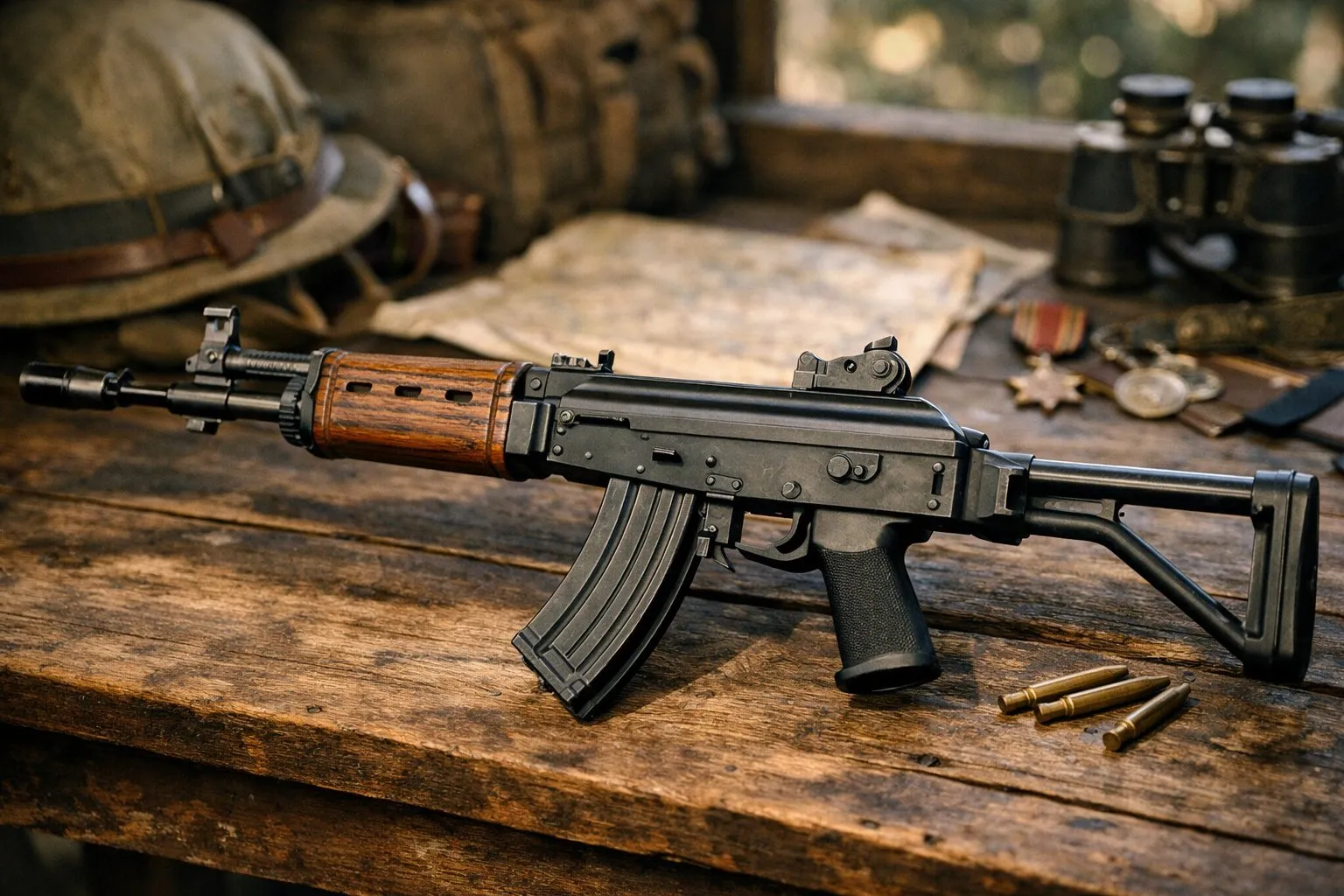
A History of the Galil Rifle: Evolution, Design, and Global Impact
The Israeli Defence Forces needed a rifle that could handle desert sand and still fire reliably under combat conditions. After seeing weapon failures with the FN FAL during the 1973 Yom Kippur War, Israeli soldiers sometimes picked up captured AK-47s or even carried Uzi submachine guns instead of their standard rifles.
The Galil rifle came about in the late 1960s thanks to designers Yisrael Galili and Yakov Lior. They wanted Israel's answer to a dependable assault rifle that blended the ruggedness of the AK-47 with the accuracy of Western rifles.
The Galil's development borrowed a lot from the Finnish Valmet RK 62, itself an AK-47 variant. Early Galil rifles even used Finnish receivers.
First introduced to service in 1972, the rifle was chambered in 5.56×45mm NATO to match American military standards. The United States had become Israel's main weapons supplier by then.
The rifle featured some practical additions—like a built-in bottle opener, wire cutter, and folding stock. These seemingly quirky features actually made a difference for soldiers in the field.
Though the Galil served as Israel's official service rifle from the mid-1970s to the early 1990s, it eventually gave way to lighter, more cost-effective M16 and M4 variants. Still, the Galil's legacy lives on through its modern successor, the Galil ACE, and through licence production in countries like Colombia, where it's still made today.
Key Takeaways
- The Galil was built to be more reliable than the FN FAL, aiming for the accuracy of Western rifles and the ruggedness of the AK-47.
- First manufactured in 1972, it served as Israel's main service rifle until American M16 and M4 carbines replaced it in the early 2000s.
- The design borrowed heavily from the Finnish Valmet RK 62 and included practical touches like a bottle opener and wire cutter for field use.
Origins and Historical Context
Israel's journey to the Galil rifle came from decades of combat experience and the limits of foreign-made weapons in Middle Eastern conditions. The country's military needs, shaped by desert warfare and the demand for reliable automatic weapons, pushed the search for a solution that could handle harsh environments without losing accuracy.
Israeli Defence Needs After Independence
The Israel Defense Forces faced unique challenges after the nation's founding in 1948. Desert sand, extreme heat, and the constant threat of conflict meant weapons had to work reliably under tough conditions.
Early Israeli forces used whatever weapons they could get internationally. That made logistics a nightmare, since keeping multiple systems running—each with different ammo and spare parts—was difficult.
The IDF wanted a standardised rifle for all branches. The harsh Middle Eastern environment demanded more from rifles than European climates. Sand, dust, and temperature swings regularly caused malfunctions in weapons designed for milder places.
Israeli soldiers needed a rifle that didn't require constant attention but still delivered consistent performance. Maintenance in the field wasn't always possible, so simplicity and reliability mattered a lot.
Lessons from the Six-Day War
The Six-Day War in 1967 gave Israeli planners a close look at how weapons performed under fire. Israeli forces captured thousands of Egyptian AK-47s, and these rifles proved incredibly reliable in desert combat.
The AK-47 was easy to control and barely needed maintenance compared to what Israeli troops were used to. Even conscripted soldiers found it simple to handle and keep running, which was a big deal during long operations with little time for cleaning.
Military planners saw that the AK-47's focus on reliability over pinpoint precision made sense for their needs. But since Israel aligned with the West, getting Soviet-designed rifles in large numbers wasn't really an option.
Shortcomings of Previous Service Rifles
The Belgian FN FAL battle rifle was Israel's main weapon from the late 1950s, chambered in 7.62×51mm NATO. While capable, the FAL didn't perform well in Israeli service due to its length and how it handled the environment.
Sand and dust often caused the FN FAL to jam during operations. At first, soldiers blamed the design, but later it became clear that poor maintenance played a role too. Either way, the weapon's unreliability in the field hurt morale.
The rifle's size made things worse in close-quarters fighting and inside vehicles. During the 1973 Yom Kippur War, some soldiers ditched their FALs for the smaller Uzi submachine gun. That move really highlighted the need for a practical service rifle that was both compact and powerful.
Development and Design Process
The Galil rifle came together through a mix of Finnish engineering and Israeli creativity. The design team led by Yisrael Galili and Yakov Lior built on the proven Kalashnikov mechanism while tweaking it for the IDF's specific needs.
Yisrael Galili and the Team
Yisrael Galili, born Yisrael Balashnikov in 1923, took the lead as the main designer of the rifle that would carry his name. He worked with Yakov Lior to create a weapon that could really meet the IDF's tough demands.
The military almost called the weapon the Balashnikov—after Galili's original surname, which oddly sounded a lot like Kalashnikov—before he changed it to the more Hebrew-sounding Galili. Uziel Gal, who created the famous Uzi submachine gun, also entered a design, but his was too complicated and unreliable. In the end, Galili and Lior's practical approach won out.
Adaptation from the AK-47 and Rk 62
The Galil's roots are in the Finnish Valmet Rk 62, itself a refined AK-47 offshoot. The first Galil prototypes even used Rk 62 receivers made in Finland, letting the team build on proven tech while adapting it for Israeli needs.
The design used the Kalashnikov's gas-operated, rotating bolt system, which had already shown it could handle desert conditions during the Six-Day War. Unlike the AK-47's stamped receiver, the Galil used a milled forging to handle the higher pressures of the 5.56×45mm NATO round. Early test batches even used some Rk 62 parts to speed things up.
Key Design Innovations
The Galil introduced several practical tweaks. Designers added a dual thumb-selector on the left side of the receiver above the pistol grip, so you could switch fire modes without letting go. This worked alongside the standard AK-style selector on the right.
The trigger mechanism came from the American M1 Garand, not the Kalashnikov. The ARM variant even had a built-in bottle opener on the front handguard, plus a wire-cutter, bipod, and carrying handle. These little details showed the team really thought about what soldiers actually needed in the field.
The Galil Series and Innovations
The Galil series went through a bunch of versions to fit different roles, from standard infantry rifles to compact carbines. Each variant tweaked barrel length, weight, and accessories, but kept the Kalashnikov-based action at its core.
Galil AR and Standard Features
The Galil AR was the standard automatic rifle issued mainly to support troops and military police. It weighed 3.95 kg and used a 460 mm barrel—striking a balance between portability and punch.
The AR skipped the bipod, wire-cutter, and carrying handle found on other models. You could shoot in semi-auto or full-auto, thanks to dual selector switches on both sides of the receiver. The left-side thumb selector made it easier to switch modes without shifting your grip.
Muzzle velocity matched its heavier cousin at 950 m/s. The AR took 35-, 50-, or even 65-round box magazines, plus standard 30-round STANAG mags. Flip-up tritium night sights and a hooded front post helped with aiming in tough lighting.
Galil ARM and Squad Automatic Capabilities
The Galil ARM was the automatic rifle machine-gun variant, serving as the main service rifle for front-line infantry. It weighed a bit more at 4.35 kg and came with a bipod, wire-cutter, and carrying handle for squad-level firepower.
The ARM's standout feature was its built-in bottle opener on the front handguard. Soldiers had been using magazines to open bottles, which damaged the lips and hurt reliability—so this little addition actually mattered.
The bipod let you use the ARM as a light support weapon. You could set it up for sustained fire, with the bipod soaking up recoil and helping steady your aim. The wire-cutter in the bipod legs let you get through obstacles without extra gear.
This version kept the same 460 mm barrel and could hit targets effectively at 410 metres. The carrying handle made it easier to haul around during long operations, especially when the gun was hot from firing.
The Galil SAR and Compact Variants
The Galil SAR (short automatic rifle) used a 332 mm barrel for better maneuverability in tight spots. This compact model weighed just 3.75 kg and measured 850 mm with the stock out, or 614 mm folded up.
The IDF gave the SAR to vehicle crews, staff, and specialists who needed something smaller. Called the G'lilon in Hebrew, it traded some velocity and range for easier handling. Muzzle velocity dropped to 900 m/s versus the longer-barrel versions.
The SAR stuck around with rear-line units like the Knesset Guard, Artillery Corps, and Armoured Corps until about 2004. Even with its smaller size, it kept the same fire modes and magazine compatibility as the bigger Galils.
The Micro Galil and Modern Derivatives
The Micro Galil pushed the compact design idea even further, targeting specialized users. It gave personnel a way to stay concealed and effective in close quarters, all while keeping that classic Galil reliability.
The Magal popped up as another compact offshoot, but chambered in .30 Carbine instead of the usual 5.56×45mm NATO. It could take 15- or 30-round box magazines from the M1 Carbine, or use the proprietary 27-round mags.
Modern updates brought us the Galil ACE, which landed in 2008 as a revamped, modernized take. Colombia’s Indumil builds both the classic Galil and their own Galil Córdova. In the US, companies like Galeo and Golani started selling Galil-style rifles rebuilt from surplus Israeli kits, paired with newly-made American receivers.
Technical Features and Performance
The Galil draws heavily on the AK-47 and Finnish Rk 62—tried-and-true mechanics, tweaked for Israel’s needs. It runs a gas-operated system with a rotating bolt, boasts chrome-lined barrels for longer life, and can handle various magazines and calibers.
Operating Mechanism and Reliability
The Galil uses a gas-operated, rotating bolt system, straight from the AK-47 family. When you pull the trigger, gas from the barrel drives the bolt carrier back, pulling out and tossing the spent case.
This setup just works. It keeps the rifle running even in the worst desert grit.
The chrome-lined barrel shrugs off corrosion and wear, so you get more years out of the gun. During the 1973 Yom Kippur War, infantry units hit over 90% of their targets in certain situations. The beefed-up receiver stands up to sand and dirt that would jam up flimsier rifles.
Automatic fire clocks in at about 650 rounds per minute. That’s fast enough for serious firepower, but not so fast you lose control or chew through ammo too quickly.
Magazine, Calibres, and Ammunition
The Galil comes in two main NATO flavors:
- 5.56×45mm NATO – Standard for AR and ARM models
- 7.62×51mm NATO – Used in the Galatz sniper rifle and some ACE versions
The regular Galil takes a 35-round magazine, but you can also stick in STANAG magazines or even 50-rounders if you need more sustained fire. Swapping mags is quick, which matters when things get hectic.
It shoots NATO SS109 ammo without fuss, holding up in all kinds of weather. Since it works with M16 and M4 mags (for the 5.56 versions), logistics get a lot easier for mixed units.
Ergonomics and Usability Enhancements
The Galil’s folding stock makes it easier to stash in vehicles or use in tight spaces. Flip it out, and you’ve got a solid platform for accurate shots at distance.
Tritium night sights glow on their own—no batteries, no nonsense. You can see your sights in the dark or inside buildings, which is pretty handy.
The safety lever and charging handle work for both righties and lefties. The charging handle folds and sits on the right, but it doesn’t get in the way of optics or your grip.
Accessories and Attachments
Newer Galils come with a Picatinny rail for optics, lights, and lasers. Older ones had a bayonet lug for close-in fighting, sticking with infantry tradition.
The ARM version includes a built-in bipod on the gas block. It’s there when you need it for steady fire, but folds out of the way when you don’t.
A flash hider cuts down muzzle flash, keeping your night vision intact and your position less obvious. The threaded barrel lets you add a suppressor (silencer) for quieter ops. Short-barrel carbine variants work for special forces, while the Galatz sniper rifle stretches your reach for long shots.
Combat Employment and Operational History
The Galil entered Israeli service during a period of big changes and got used in several Middle Eastern conflicts. Israeli troops took it into all sorts of environments, from classic battles to counter-insurgency, getting plenty of real-world feedback along the way.
Adoption in the Israel Defence Forces
The IDF made the Galil official in 1972, but the Yom Kippur War in 1973 slowed down its rollout. There were three main versions: the ARM with a bipod and carrying handle for regular infantry, the AR for support troops (no bipod), and the SAR with a shorter barrel for vehicle crews and specialists.
Even though the IDF adopted it, the Galil never became the main rifle in terms of numbers. About 60,000 M16A1s came in thanks to US aid starting in 1975, and high production costs made it tough to give every soldier a Galil. Most troops liked the lighter, more accurate M16, but the Galil was tougher. By 2000, the Galil ARM and AR were out, replaced by the M4 and M16.
Role in Major Conflicts
The Galil got its baptism in Operation Litani and the 1982 Lebanon War, working in everything from rocky hills to open desert. Israeli paratroopers and infantry carried it during missions in southern Lebanon and the Golan Heights. It handled the desert just fine and didn’t need as much upkeep as the FN FAL it replaced.
Other countries picked up the Galil too. It showed up in the Salvadoran Civil War, the South African Border War, and plenty of other conflicts in Asia and Africa. The AK-47 roots made it familiar for many troops, and its ruggedness won over armies in some pretty tough places.
Feedback and Revisions from Field Use
Combat use taught soldiers a lot about the Galil’s strengths and weak spots. Durability and low maintenance made it a favorite in sandy, dirty conditions. The solid receiver didn’t quit, but the gun’s weight was a common gripe—especially compared to the M16 or M4.
Spent cases flew out hard, sometimes getting dented or landing 40 feet away. Mounting optics or a grenade launcher was easier on the M16 and M4, which nudged Israel toward those platforms. The SAR stuck around with rear-line units until about 2004.
Variants, Sniper and Designated Marksman Models
The Galil family didn’t stop at regular rifles. Precision versions came along to fill the need for accurate fire at longer ranges—something beyond what a basic assault rifle could do.
The Galil Sniper Rifle and Galatz
The Galil Sniper (Galatz) appeared in 1983, built for precision and chambered in 7.62×51mm NATO instead of the usual 5.56. That bigger round gave it more reach and punch for long-range work.
The Galatz kept the Galil’s gas-operated, rotating bolt, but got a heavy barrel, adjustable folding bipod in front of the mag well, and a Nimrod 6×40 scope as standard. It also had a combo muzzle brake/compensator and kept backup iron sights just in case.
A two-stage trigger and semi-auto-only mode helped with accuracy. The folding stock offered an adjustable cheekpiece and a recoil pad, making longer sessions less punishing.
The SR-99 variant updated the Galatz, swapping in a lighter skeletal stock, synthetic pistol grip, and handguard. This designated marksman rifle aimed to bridge the gap between regular rifles and full-on sniper setups.
Specialist and International Derivatives
Other countries tweaked the Galil to fit their needs. South Africa’s R4 is probably the best-known foreign version, serving as their main rifle for decades.
The SAR gave users a shorter, lighter option, while the Micro Galil shrunk things down even more for special units. Despite the changes, they all stuck with the basic Kalashnikov-inspired guts, just with different barrel lengths and sizes for particular jobs.
Transition to Subsequent Service Rifles
The Israeli Defence Forces eventually moved on from the Galil series. The Tavor bullpup took over as the standard, bringing a shorter overall package.
Over its career, the Galil competed with the M16A1, M4, and HK33. Even after Israel replaced it, Galil variants kept working with militaries and police around the globe. Its reputation for reliability and versatility stuck, long after its official days ended.
Global Adoption and Legacy
The Galil’s tough design meant it spread far and wide—over 25 countries put it in their military arsenals. Licensed production in places like South Africa, Colombia, and Myanmar showed just how adaptable it could be.
International Users and Licensed Production
South Africa built the R4 through Lyttleton Engineering Works, making it a backbone of their military. That version stands out as one of the most successful Galil spin-offs.
Colombia’s Indumil produces several Galil types, including the newer Galil ACE. These rifles see action with Colombia’s armed forces, especially during the Colombian armed conflict. The Galil Córdova is another local take, tweaked for their needs.
Myanmar’s Fritz Werner Industries built the MA line, with the MA-1 and MA-2 covering different calibers. Estonia picked up both the SAR and AR for their Defence Forces and Defence League.
Italy’s Vincenzo Bernardelli made two versions in the 1980s. The Mod.377 VB-STD mirrored the Galil AR/ARM, while the Mod.378 VB-SR carbine was set up for STANAG mags.
Comparisons with Influential Assault Rifles
The Galil combined features from the AK-47 and FN FAL, creating a hybrid design that tackled the weak points of both platforms. The rifle's design took a lot from the Finnish Valmet Rk 62, which is basically an AK-47 variant.
The Galil borrowed the Valmet M62's gas operating system and receiver design. Engineers tweaked it for Israel's harsh desert conditions, making it tougher than its predecessors.
The design won the IDF competition in 1973. Actual adoption, however, got pushed back because of the Yom Kippur War.
The rifle fires intermediate-powered cartridges like 5.56×45mm NATO and 7.62×51mm NATO. This versatility really set it apart from other assault rifles that stuck with just one calibre.
Influence on Modern Firearms Design
The Galil stands out as one of the finest AK-type rifles ever made, and its influence shows up in later firearm designs worldwide. Over the years, several Galil variants appeared—from the original AR and ARM models to the compact SAR version.
Modern versions like the Galil ACE keep the spirit alive. The ACE brings updated ergonomics and modular features, but still hangs onto the reliability that made the original a hit.
The Galil Sniper variant pushed the platform into new territory. India's Punj Lloyd Raksha Systems and Vietnam's Z111 Factory both make this precision model under licence, which says a lot about its adaptability.
Frequently Asked Questions
The Galil rifle's development came from a collaboration between Israeli designers. Modern variants have drifted pretty far from the originals, with fresh materials and updated ergonomics.
Who is credited with the design and development of the Galil rifle?
Yisrael Galili and Yakov Lior designed the Galil rifle in the late 1960s. They developed it after the Israel Defence Forces ran into reliability issues with the FN FAL during the 1967 Six Day War.
Galili leaned heavily on the Finnish Rk 62 design, itself based on the Soviet AK-47. This let him use proven features while tailoring the rifle for Israel's environment.
In what ways does the Galil ACE differ from the original Galil models?
The Galil ACE is basically a modern reimagining of the classic Galil. It's got updated materials, improved ergonomics, and better accuracy than the old AR and ARM models.
The ACE benefits from modern manufacturing and comes in several calibres. It's lighter, more modular, and you can add accessories or attachments with way less hassle.
What are the distinguishing features of the Galil Sniper rifle?
The Galatz (Galil Sniper) rifle uses the 7.62×51mm NATO cartridge, giving it longer reach and more stopping power than standard Galils. It has a longer barrel, which boosts accuracy and stability for long shots.
The Galatz includes advanced sighting systems made for precision. It fills the gap between a regular infantry rifle and a full-blown sniper system—kind of a sweet spot for marksmen.
How has the Galil rifle been integrated into the Philippine National Police (PNP) armament?
There's not a ton of public info about the Philippine National Police's use of Galil rifles. Still, the Galil shows up in the arsenals of over 20 countries, military and police alike, mostly because of its reliability.
What technological advancements are presented in the Galil SAR?
The SAR (Short Assault Rifle) variant popped up in the 1980s with a shorter barrel and a more compact frame. It's lighter and just plain easier to handle than the standard AR, which makes it perfect for close-quarters fights.
The SAR keeps the Galil's gas-operated action and legendary reliability but trims down the overall length. By 1985, more than 60% of Israeli elite units picked the SAR for urban missions because it simply made moving around way easier.
Can you outline the technical specifications of the GALIL Sniper rifle?
The Galatz sniper rifle fires the 7.62×51mm NATO cartridge. This choice gives it more range and penetration than you’d get from standard rounds.
It comes with a longer barrel, which helps with accuracy at distance. Compared to typical infantry models, you’ll notice the difference if you’re shooting farther out.
The rifle sticks with the gas-operated action found in the rest of the Galil family. There are mounting points for optical sights, and some thoughtful features to boost stability when you’re trying to make those precise shots.