A History of the Mauser Kar98: Evolution, Service, and Legacy
From battlefield service to collector favourite, explore the evolution of the Mauser Kar98 and why it remains one of history’s most influential bolt-action rifles.
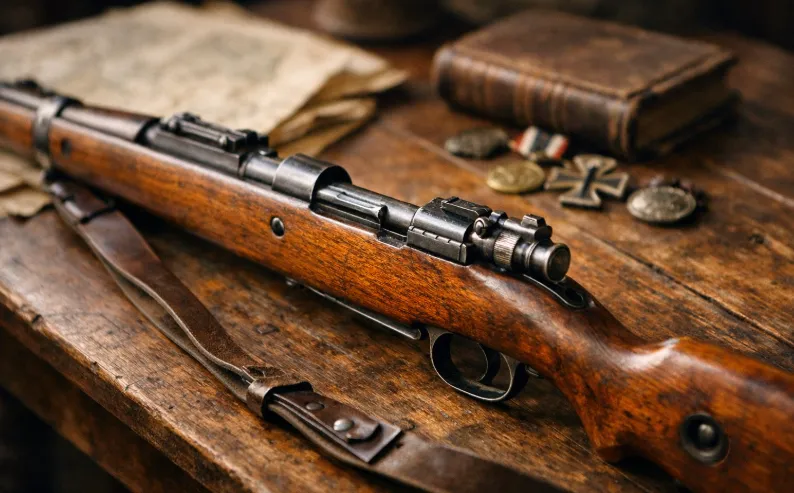
A History of the Mauser Kar98: Evolution, Service, and Legacy
The Mauser Kar98k became the standard German infantry rifle when Germany adopted it on 21 June 1935. It served throughout World War 2 and even stuck around in some places long after.
This bolt-action rifle, chambered for the 7.92×57mm Mauser cartridge, traces its lineage back to the Gewehr 98 rifle of 1898. It's really the culmination of decades of German rifle development.
The "k" in its name stands for "kurz," or "short" in German. That carbine length made it way more practical than the old full-length rifles.
The Kar98k was developed in the early 1930s to replace older, clunkier rifles in German service. Its design included a recessed forward grip for better handling and a turned-down bolt handle that didn't snag on your jacket or brush.
With a 5-round internal box magazine and iron sights, the rifle measured 1,110mm in length. It weighed 3.90kg, which made it pretty balanced for infantrymen trudging across Europe.
This rifle's story doesn't just stop with Germany. The Kar98k saw service with loads of other countries—France, the Soviet Union, Israel, and plenty more, whether through licensed production or captured stockpiles.
Its proven bolt-action system kept it competitive with rifles like the British Lee-Enfield. It even kept popping up in conflicts into the 21st century. US forces found Iraqi insurgents using them in the early 2000s, believe it or not.
Key Takeaways
- The Kar98k served as Germany's standard infantry rifle from 1935 throughout World War 2 and influenced bolt-action rifle designs worldwide
- The rifle featured a shortened carbine length, 5-round magazine, and 7.92×57mm chambering that made it practical and effective in combat
- Dozens of countries used the Kar98k during and after the war, with the rifle remaining in service in some regions into the 21st century
Origins and Development of the Mauser Kar98
The Mauser Kar98's development spans decades of German firearms innovation. It all started with Paul Mauser's bolt-action designs in the late 19th century and led to the refined Karabiner 98k that would become Germany's standard service rifle.
Early Mauser Bolt-Action Innovations
Paul Mauser changed military firearms forever with his turn-bolt system in the 1890s. Born on 27 June 1838 in Oberndorf, Germany, Paul Mauser worked as a master gunsmith with his father Andreas.
The Mauser bolt-action system introduced a controlled-feed mechanism that just worked better than the competition. His Model 98 action had a claw extractor that grabbed the cartridge rim as soon as it left the magazine.
This design stopped double-feeding and made sure extraction stayed reliable even in rough conditions. The original Gewehr 98 entered German military service in 1898, chambered for the 7.92×57mm Mauser cartridge.
You could spot it by its long barrel, straight bolt handle, and beefy receiver. The Mauser 98 action became such a hit that it shaped rifle designs all over the world for the next hundred years.
Design Evolution from Gewehr 98 to Karabiner 98k
The Karabiner 98 kurz, adopted on 21 June 1935, was really just a smart update of the Gewehr 98. Germany wanted a rifle that kept the Gewehr 98's reliability but handled better for modern combat.
The name "Karabiner 98 kurz" literally means "Carbine 98 Short." The shorter 23.6-inch barrel made it way easier to maneuver. The shorter length didn't sacrifice much in terms of accuracy at normal combat ranges.
Key upgrades included a turned-down bolt handle for easier carry, improved sights, and a simplified barrel band system. The rifle used five-round clips of ammo and kept an effective firing range of about 550 yards.
Technical Advancements and Controlled-Feed System
The Mauser bolt's controlled-feed system was the Kar98k's standout technical feature. When you worked the bolt, the claw extractor grabbed each cartridge and guided it right into the chamber.
This positive control got rid of feeding failures that push-feed designs struggled with. The action had a non-rotating extractor keeping steady tension on the cartridge case, and a blade ejector in the receiver flung spent cases clear of the action.
Dual-opposed locking lugs at the bolt head gave it real strength. The trigger had a two-stage military pull, which made accidental discharge less likely but still allowed for deliberate, aimed shots.
You could flip on a wing safety mounted on the bolt shroud, locking the firing pin and bolt at once—handy for field use.
Standard Features and Technical Specifications
The Kar98k came with a controlled-feed bolt-action system and a 5-round internal magazine loaded by stripper clips. It was chambered for the 7.92×57mm Mauser cartridge.
The rifle had a turned-down bolt handle for easier operation, iron sights graduated to 2,000 metres, and several stock types—including those classic laminated wood ones.
Action and Operation Mechanism
The Kar98k used a controlled-feed bolt-action rifle mechanism based on the proven Mauser M98 system. This design made sure feeding and extraction stayed reliable, even in battlefield mud and grime.
The bolt handle was turned down instead of sticking straight out like the old Gewehr 98. You could run the bolt faster, and it didn't poke out as much.
This also made it easier to mount optics right above the action. To use the rifle, you'd lift the bolt handle, pull it back to eject the spent case, then push it forward and down to chamber the next round. When you closed it, the bolt locked up tight for solid accuracy.
Magazine, Stripper Clips, and Ammunition
The rifle had a 5-round internal magazine that sat flush with the stock. You'd load it with stripper clips through the open action, and when you closed the bolt, the empty clip popped out automatically.
The 7.92×57mm Mauser cartridge was standard. Early rifles shot the s.S. Patrone with 12.8-gram pointed bullets, but during the war, Germany switched to S.m.E. ammo with mild steel cores to save on lead.
The rifle had a muzzle velocity of 760 metres per second. If you had to, you could load rounds one at a time, but that was slower than using clips.
Barrel, Sights, and Accessories
The Kar98k had a 600-millimetre barrel and a 500-millimetre sight radius. Iron sights included a hooded barleycorn front post (from 1939 onward) and a tangent-type rear sight with a V-notch.
The rear sight was marked from 100 to 2,000 metres in 100-metre steps. Effective firing range was about 500 metres with iron sights, or up to 1,000 metres with an 8× scope. The sight line was zeroed at the factory when the rifle passed inspection.
Each rifle came with a cleaning rod section that fit through the bayonet stud. You needed three rods from three rifles to make one full-length rod. Accessories included a sling, muzzle cover, and the Reinigungsgerät 34 cleaning kit with an oiler, take-down tool, pull-through chain, and brushes.
Stock Designs and Variants
Early Kar98k rifles had solid one-piece walnut stocks. From 1937 on, laminated stocks became the norm after plenty of testing in the 1930s.
Laminated stocks used layers of walnut, beech, or elm glued together. This method made them resist warping better, didn't need the wood to season forever, and cost less to make. The trade-off? They were a bit heavier than single-piece stocks.
Stock butts changed over time. Until early 1940, rifles had flat buttplates, but later versions switched to cupped buttplates to stop the butt stock from splitting. All versions had steel buttplates for toughness. The semi-pistol grip design stayed the same through production.
Adoption as the Standard German Infantry Rifle
The Karabiner 98k became Germany's main infantry weapon in 1935. It capped off decades of Mauser rifle evolution and set the standard for Wehrmacht rifles in World War 2.
Karabiner 98k and Its Predecessors
The Karabiner 98k traces its lineage straight back to the Gewehr 98, which the German military adopted in 1898. That original design laid the groundwork for one of the most iconic bolt-action rifles ever.
After World War I, German engineers came up with the Karabiner 98b in 1924 as a stepping stone. The Heereswaffenamt, Germany's army weapons office, then worked on a shorter version that kept the Mauser action's reliability but handled better for new infantry tactics.
The result was the Karabiner 98 kurz, or "short carbine 98," which kept what worked from its predecessors but was easier to use in the field. When Hitler expanded the Wehrmacht to 600,000 troops after leaving the League of Nations, the army needed a standard rifle for all those new soldiers.
The K98k was officially adopted on 21 June 1935 as the standard service rifle, chambered in 7.92×57mm Mauser.
Production and Manufacturing Efforts
Kar98k production pulled in a surprising number of manufacturers across Germany and the occupied territories. The main factories? Mauser’s Oberndorf facility, Erfurt, and contractors like Steyr-Daimler-Puch, Gustloff Werke, Sauer, and Erma Werke all played a part.
As wartime demands ramped up, manufacturers rolled out the simpler Kriegsmodell (war model) variants. These rifles came with less polish, more stamped parts, and streamlined stocks to speed things up but still worked just fine.
By 1945, German forces had received millions of these rifles for use across all theatres. The design itself allowed for plenty of tweaks depending on the mission.
You could slap on a telescopic sight for marksmen, add a HUB-23 suppressor for snipers, or fit a grenade launcher (from 1942) that could lob grenades out to 300 yards. And of course, a standard bayonet fit right under the barrel for close-quarters fights.
Service in the Wehrmacht and Beyond
Every German soldier trained on the Mauser Kar98k during the war, making it the backbone of Wehrmacht infantry. The five-round stripper-clip reload system held up in all sorts of conditions, whether you were in North Africa’s heat or the Eastern Front’s brutal cold.
Early in the war, the rifle did its job well enough. But as things progressed, its bolt-action design started to feel outdated against the Allies’ semi-automatic weapons like the M1 Garand.
Still, German forces stuck with the Kar98k for its reliability and accuracy—and, frankly, because they could crank them out in huge numbers. After 1945, Soviet allies got their hands on captured rifles, too.
The Red Army refurbished millions of 98ks and shipped them off to communist forces in the Korean War and later to the Viet Cong in Vietnam. Israel also scooped up large numbers through Operation Balak in 1948, stamping Hebrew codes over the old German markings.
Combat Performance and Battlefield Use
The Kar98k earned a reputation as a dependable weapon throughout World War II. German forces used it as their main infantry rifle in almost every theatre of combat.
Its bolt-action design was tough and reliable, even in miserable weather, but it couldn’t keep up with Allied semi-automatic rifles when it came to sheer rate of fire. That’s just how it went.
Role in World War II
The Kar98k became the standard service rifle for the German Wehrmacht after its adoption on 21 June 1935. They built more than 14.6 million between 1934 and 1945, making it the most widely issued German infantry weapon of the war.
You’d have seen the Kar98k in action everywhere—from North Africa to the Eastern Front and Western Europe. German infantry leaned on it heavily, especially in massive battles like the Battle of Kursk, where its firepower and reliability got put to the test.
Even when newer semi-automatic and automatic rifles popped up, the Kar98k stayed the main service rifle. The STG44 assault rifle showed up late but never really replaced it.
Soviet forces captured millions of Kar98ks at the end of the war and handed them out as military aid for years after. The rifle kept popping up in conflicts long past 1945.
Accuracy, Reliability, and Limitations
The Kar98k could hit targets up to 500 metres away with iron sights, and up to 1,000 metres with an 8× scope. Its 600mm barrel pushed the 7.92×57mm Mauser cartridge out at about 760 metres per second.
The Mauser M98 system’s controlled-feed bolt-action design made the rifle exceptionally reliable. You could reload the five-round internal magazine fast using stripper clips.
The turned-down bolt handle sped up cycling compared to older designs and made it possible to mount optics right above the receiver. Here’s a quick look at the specs:
- Sight radius: 500mm with tangent leaf rear sight
- Magazine capacity: 5 rounds
- Weight: 3.7-4.1 kg
- Overall length: 1,110mm
Starting in 1941, some rifles got the ZF41 telescopic sight—a 1.5× magnification optic fitted over the rear iron sight for designated marksmen. By 1945, over 100,000 ZF41 sights had rolled off the line.
Sniper variants used better 4× scopes like the ZF39, Zeiss Zielvier, Hensoldt Dialytan, and Kahles Heliavier. The rifle took the S84/98 III bayonet with its 252mm blade, and in 1942, the Schiessbecher rifle grenade launcher gave it a 280-metre punch for grenades.
A HUB-23 suppressor also showed up, though only in small numbers for special ops. The main drawback? That bolt-action. It worked, but needing to cycle the bolt after every shot meant you were always a step behind anyone with a semi-auto rifle.
Comparisons to Contemporary Infantry Rifles
Facing off with a bolt-action Kar98k against semi-automatic rifles like the American M1 Garand or Soviet SVT-40? That was tough. Those rifles let your opponents keep firing without stopping to cycle the action.
The M1 Garand’s eight-round en-bloc clip beat your five-round magazine, giving American infantry a serious edge in drawn-out firefights. And the Garand’s semi-auto action nearly doubled the practical rate of fire compared to your Kar98k.
British troops mostly carried the Lee-Enfield No. 4, another bolt-action. It had a ten-round magazine and a slightly faster bolt cycle, thanks to its rear-locking design. Still, at longer ranges, the Kar98k usually edged out the Lee-Enfield for accuracy.
Soviet Mosin-Nagant rifles were your Eastern Front counterpart—both bolt-action, both with similar range and capacity. The Kar98k generally had the upper hand in build quality and accuracy, but not by a huge margin.
Even so, the Mauser 98 system’s toughness and reliability earned it respect everywhere. After the war, captured Kar98ks saw use in all sorts of conflicts. Israeli forces used them in 1948’s Operation Balak, and the Model 1948 variant stuck around in different militaries for decades.
Postwar Use, International Service, and Surplus Market
The Kar98k’s story didn’t end in 1945. Refurbished and redistributed, these rifles turned up in armies all over Europe, the Middle East, and beyond. Eventually, collectors and shooters got their hands on them through surplus sales.
Global Proliferation after World War II
Soviet forces captured huge numbers of Kar98ks during World War II. They refurbished the rifles in the late 1940s and early 1950s, then sent them off to allied nations and client states.
Czechoslovakia even made postwar variants using leftover German tooling and machinery. Eastern Bloc countries like Yugoslavia used them heavily in their military forces.
The rifles spread to Africa, Asia, and Latin America as military aid throughout the Cold War. Western countries also handed out captured stocks—France, Norway, and others issued Kar98ks to their own troops just after the war, sometimes converting them to different calibres to fit local ammo.
Role in Israel and Other Conflicts
Israel picked up Mauser Karabiner 98k rifles from Czechoslovakia for the 1948 Arab-Israeli War. These rifles became a crucial part of Israel’s fight for independence.
Some of them later got rebuilt into 7.62mm NATO using mixed parts from all over. In the 1970s and 1980s, Israel passed on retired Kar98ks as military aid to several Third World countries.
Both sides used the rifle during the Yugoslav Wars, and US troops even spotted Iraqi insurgents with them in the early 2000s. The 98 pattern still shows up in conflicts in less-developed countries now and then.
Civilian, Collectors, and Military Surplus
Soviet-refurbished Kar98k rifles hit the surplus market in big numbers around 2010. Collectors, hunters, and shooting fans snapped them up, drawn by their history and ruggedness.
You can find postwar variants from Czech factories and Israeli conversions, too. The last stockpiles of surplus Karabiner 98k rifles are dwindling while demand keeps climbing.
Collectors love them for the history and all the little manufacturing quirks. Hunters trust them for their reliability and accuracy in the field. Prices have gone up as availability drops, and you’ll see rifles ranging from battered old service pieces to surprisingly well-preserved examples.
Each one has its own story from postwar military service somewhere in the world.
Legacy and Influence on Modern Firearms
The Mauser 98 action set the bar for sporting and military rifles for over a century. Its tough construction and safety features still serve as benchmarks in modern firearm design. The rifle itself has become a collector’s favorite worldwide.
Enduring Impact of the Mauser 98 Action
The Mauser 98 action really did set the standard for bolt-action rifles. Its influence shows up everywhere, from budget hunting rifles to high-end custom builds.
The controlled-round feed system and big claw extractor keep things running smoothly, even when conditions get ugly. Peter Paul Mauser built in multiple safety features—two fixed lugs up front on the bolt, a third safety lug at the root, plus a gas escape port and flared striker shield to keep hot gases away if a cartridge fails.
Modern rifle makers still use these features because, well, they just work. The three-position safety became an industry default. You can trace the Mauser bolt-action design straight through to Winchester Model 70s, Remington 700s, and Ruger M77s.
Gunsmiths keep building custom rifles on surplus Mauser 98 actions. The action’s strength means you can rebarrel it for all sorts of modern cartridges, from .22-250 up to .375 H&H Magnum. Not bad for a design that’s been around this long, right?
Role in Firearm Collecting and Cultural Memory
Military rifle collectors see the Kar98k as essential for any collection of turn-of-the-century military rifles. The rifle connects you directly to a pivotal period in military history—there’s nothing quite like holding one yourself.
You'll spot Kar98k specimens from a bunch of different manufacturers, each with their own proof marks and quirks. German Mauser rifles made between 1934 and 1945 used three coding systems for manufacturers and dates.
Early rifles got an 'S' prefix with manufacturer numbers. Wartime rifles switched to letter codes, which honestly makes tracking them a bit of a puzzle sometimes.
Russian-capture rifles give collectors an affordable way in. The Soviets rebuilt these after the war, mixing parts from all over—different years, different factories, you name it.
Yugoslavian M98s and Norwegian or Israeli conversions pop up too, offering even more directions for a collection to go.
The rifles still show up at shooting ranges. Whether you're using old 8mm Mauser ammo or modern sporting loads, you get a real sense of what soldiers experienced decades ago.
Frequently Asked Questions
The Mauser Kar98k came out of decades of German rifle development and stands as one of the most recognizable firearms of the 20th century. Its influence runs from World War II battlefields to modern sporting rifles—kind of wild how far its reach goes.
What are the origins and historical significance of the Mauser Kar98k?
The Karabiner 98k was adopted on 21 June 1935 as the standard service rifle by the German military. Mauser's development program kicked off in 1934 after the German Army Weapons Office pushed for a standard rifle for all branches.
The name translates to "carbine 98 short" in German. It was meant to replace the older, bulkier rifles that just weren't practical anymore.
The Kar98k became a symbol of German military capability during World War II. Its reliability and accuracy made it the primary infantry weapon for German forces throughout the war.
How did the Mauser Kar98k evolve from earlier Mauser models?
The Kar98k traces its roots back to the Gewehr 98, Germany’s go-to rifle in World War I. The Gewehr 98 had a strong bolt-action system—honestly, it set a standard for reliability back then.
Next came the Karabiner 98b, a shorter Gewehr 98 meant to give troops a bit more maneuverability in combat. It kept the solid bolt-action mechanism but trimmed the length.
The 98k improved on its predecessors with a shorter barrel, making it more practical for modern warfare. The bolt got an upgrade, and production became more streamlined—faster, more efficient, just what wartime demanded.
What role did the Mauser Kar98k play during World War II?
The Kar98k served as the German Army's main rifle during the war, with an effective firing range of about 550 yards. It quickly became standard issue for both the Wehrmacht and Waffen-SS after its 1935 introduction.
German soldiers leaned on the rifle for its precision and stopping power at distance. The bolt-action system kept working in all sorts of conditions—from the Eastern Front’s brutal cold to the heat of North Africa.
The rifle's battlefield reputation stuck around long after World War II. Both sides used it in later conflicts, like the Yugoslav Wars, and even US and Allied troops spotted it with Iraqi insurgents in the early 2000s.
What are the distinguishing features of the Mauser Kar98k's design and construction?
The Kar98k is a bolt-action rifle chambered for the 7.92×57mm Mauser cartridge. It uses a controlled-feed bolt-action system, which keeps rounds feeding and extracting smoothly.
Loading is pretty straightforward: five rounds from a stripper clip into an internal magazine. That setup lets you reload quickly and keeps the rifle slim—definitely handy in combat.
The 98k’s construction focused on durability and simplicity. Stamped parts and simpler machining made it faster to produce and tough enough for wartime use.
It’s got a staggered-column box magazine for better capacity. The extractor is especially robust, so the rifle keeps running even in lousy conditions—no wonder it earned a reputation for reliability.
How has the Mauser Kar98k influenced modern bolt-action rifles?
The Kar98k inspired a ton of bolt-action rifle designs after the war. Its design principles still get studied and respected today.
Mauser’s controlled-feed bolt action became a must-have in many sporting and hunting rifles. That smooth, reliable action set the bar for what shooters expect.
The rifle’s balance of accuracy, reliability, and ease of manufacture still feels relevant. You’ll find elements of the Kar98k’s engineering in plenty of modern bolt-action rifles—its influence just keeps going.
What are the variations and derivatives of the Mauser Kar98k?
Lots of countries came up with their own takes on the Kar98k during and after World War II. Factories outside Germany, like Steyr-Daimler-Puch in Austria and Gustloff-Werke, cranked out the rifle to keep up with wartime needs.
People sometimes call the K98 a variant, but honestly, it's more of a Polish copy of the older Kar98a model. It's not really a direct 98k derivative, which matters if you're into collecting or history.
After the war, countries like Yugoslavia and Czechoslovakia scooped up captured Kar98k rifles and put their own spin on them. They refurbished and tweaked these rifles, ending up with national versions that stuck around for years—sometimes way longer than you'd expect.