A Walk Through the History of British Rifles
Explore the evolution of British rifles through history — from early military service rifles to the legendary Lee-Enfield and beyond.
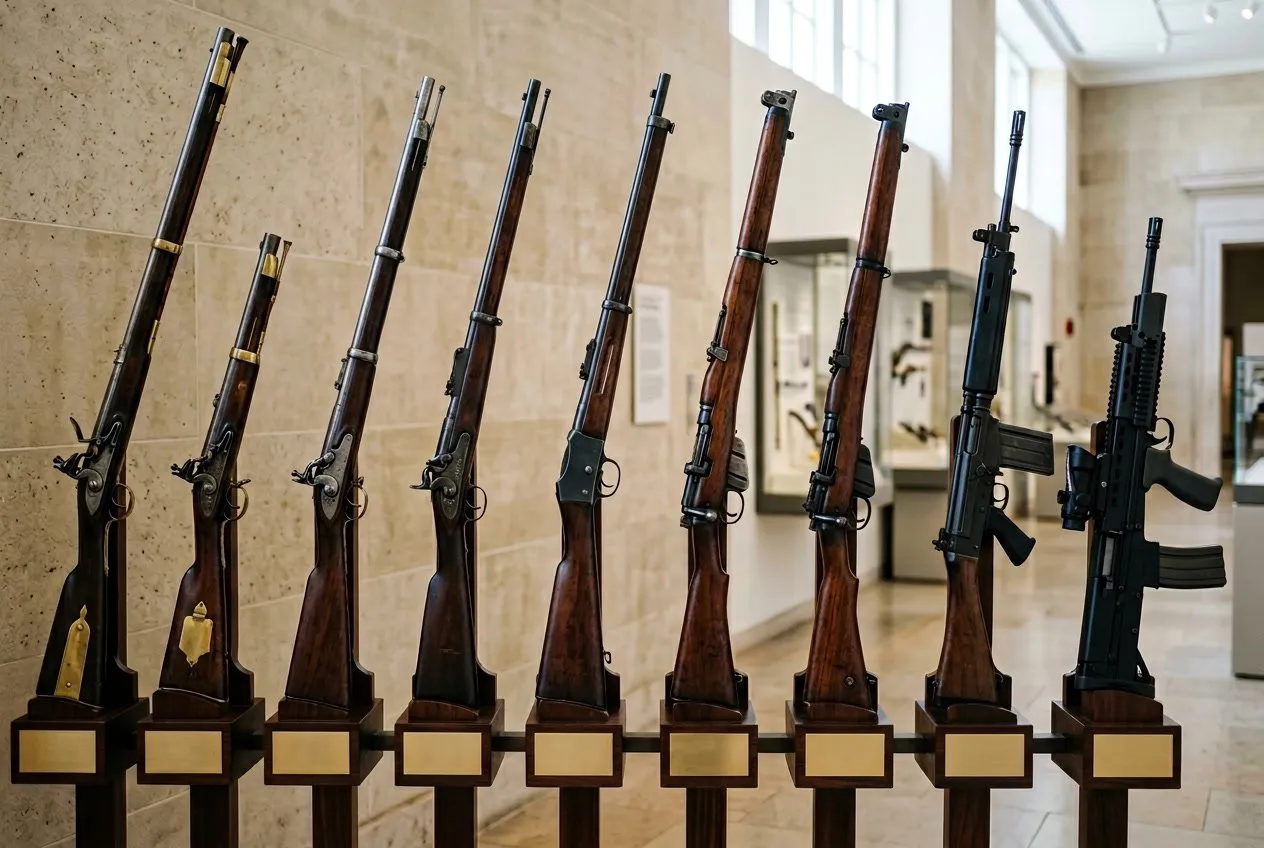
A Walk Through the History of British Rifles: Evolution, Innovations, and Legacy
The story of British rifles stretches back more than 250 years, starting with simple muskets and ending with modern precision weapons. British military rifles evolved from the inaccurate Brown Bess musket in the 1700s to sophisticated breech-loading and magazine-fed designs that gave the British Army a significant advantage in conflicts worldwide.
It's wild to think how much these changes shaped military tactics everywhere. Technology in firearms really did change warfare forever.
The journey kicked off with early rifle designs during the American Revolution, like the Pattern 1776 Infantry Rifle. These guns hit targets more accurately than muskets, but soldiers had to spend extra time loading them.
By the time the Napoleonic Wars rolled around, the Baker rifle had made a name for itself. Skilled riflemen could hit targets at 300 yards, which was a big deal back then.
Things really shifted in the 1800s, when breech-loading mechanisms replaced old muzzle-loaders. The Snider-Enfield showed up in 1866, then came the Martini-Henry, and eventually the famous Lee-Enfield series.
These upgrades made British infantry faster and deadlier in battle. The patterns set by these rifles influenced gun design for decades.
Key Takeaways
- British rifles went from slow-loading muskets to rapid-fire breech-loaders over 250 years
- The Lee-Enfield became one of the most successful military rifles in history and stayed in service well into the 20th century
- The Rifles regiment formed in 2007 by merging four famous regiments while keeping centuries of military tradition alive
Origins of British Rifles
The British Army's move from smoothbore muskets to rifled firearms spanned more than a century. They needed better accuracy on the battlefield, plain and simple.
The Brown Bess musket was the starting point for this whole process. Experimental rifle units popped up and showed everyone just how valuable rifling was in real combat.
Early Use of Muskets and the Shift to Rifled Firearms
The Brown Bess musket served as the predecessor to British military rifles, dominating British infantry tactics all through the 18th century. This smoothbore flintlock weapon didn’t have rifling, so it was mostly useless past 80 yards.
The musket’s loose fit meant soldiers could load quickly, which worked well for volley fire. British commanders cared more about firing fast than hitting a bullseye, so they relied on big lines of troops to make up for inaccuracy.
Even with its flaws, the Brown Bess was cheap to make and easy to fix. Soldiers could fire off a few rounds a minute, which made for some pretty nasty volleys in line formations.
But as battles in North America proved, being able to shoot accurately from far away was a real game-changer.
Adoption of Rifling and Early Innovations
Rifling put spiral grooves inside gun barrels, spinning the bullet for way better accuracy and range. This was a huge leap forward, but the first rifled weapons took longer to load than smoothbore muskets.
The British Army started tinkering with rifled firearms in the late 1700s. In 1800, they set up the Experimental Corps of Riflemen, which turned into the 95th (Rifle) Regiment of Foot in 1803.
These units showed that, even though loading was slower, rifled guns gave a big tactical edge.
Along with new weapons came new tactics. Riflemen worked as skirmishers, using cover and aiming carefully instead of standing in lines like musket troops.
First Issued Rifles in the British Army
The 95th Rifles fought in the Napoleonic Wars and really proved how good rifled firearms could be in big battles. They carried the Baker rifle, which was the first standard-issue rifle for British infantry.
The Baker rifle had a shorter barrel than the Brown Bess, so it was easier to handle in skirmishes. Its rifled bore made it accurate up to 200 yards—four times farther than smoothbore muskets.
The 60th Royal Americans (later 60th Rifles) also stood out at the Heights of Quebec. These regiments set the stage for British rifle tactics that stuck around for generations.
Success with these units led to carbine variants for cavalry and special troops. That’s how the British Army started to get creative with its rifles.
Iconic Rifles from the Napoleonic to Victorian Eras
British military firearms changed a lot between the early 1800s and late 1800s. The Baker rifle was Britain's first standard-issue rifled weapon, and then percussion systems and new designs like the Brunswick came along, replacing old flintlocks.
Baker Rifle and the Birth of Riflemen
The Pattern 1800 Infantry Rifle, or Baker rifle, was a muzzle-loading flintlock that saw heavy use in the Napoleonic Wars. The 95th Rifles and 5th Battalion, 60th Regiment of Foot carried it into battle, and it could hit targets at 100 to 300 yards.
This rifle led to a new kind of soldier. Riflemen started working as skirmishers and sharpshooters, instead of just firing in big groups.
There’s that story from Cacabelos in 1809—Rifleman Tom Plunkett supposedly shot French General Colbert-Chabanais from 400 yards away. The Baker rifle stuck around in the British Army until the 1840s, which is a pretty long run for any military weapon.
Percussion Rifles and Technological Advancements
Percussion rifles replaced flintlocks during the 1830s and 1840s. The new percussion cap system worked better in wet weather and cut down on misfires.
This change touched all British military firearms. The Brunswick rifle adopted percussion ignition, and they even converted some older guns.
Soldiers could now fire more reliably, no matter the weather. The percussion system also made the firing mechanism simpler, so guns were easier to keep running in the field.
Brunswick and Other Muzzle-loading Rifles
The Brunswick rifle started production in 1836 as a .704 calibre muzzle-loading percussion rifle built at Enfield. It took over from the Baker rifle and weighed over 9 to 10 pounds—without a bayonet.
The Brunswick had a unique two-groove barrel made for a "belted" round ball. There were four main types, including the Pattern 1836, Pattern 1841, Pattern 1848, and Pattern 1840 Variant, built in both .654 and .704 calibre.
This rifle was tough to load, but they kept making it for about 50 years, from 1836 to 1885. British and colonial troops used Brunswick rifles all over the Empire during that time.
The Era of Breech-Loading and Magazine Rifles
The British Army made a huge leap in rifle tech in the late 19th century, ditching muzzle-loaders for advanced breech-loading systems with magazines. This era saw the Snider-Enfield conversion and then purpose-built magazine rifles like the Lee-Metford and Lee-Enfield.
Snider-Enfield and the Introduction of Breech-Loading
The Snider-Enfield was a breech-loading conversion of the old Pattern 1853 Enfield muzzle-loaders. The British Army started using it in 1866, and it let soldiers load metallic cartridges from the back instead of ramming powder and ball down the barrel.
This conversion saved the military a ton of money. They could just upgrade old rifles instead of buying new ones.
The Snider had a hinged breechblock that swung to the right, opening up the chamber for .577 calibre cartridges. Soldiers could now fire multiple rounds per minute and stay low to the ground. The Snider stuck around through colonial wars in the 1860s and 1870s, until even better designs came along.
The Lee-Metford: Innovations in Rifling and Magazine Design
The British Army moved to a .303-inch calibre rifle after development and trials starting in 1879. The Magazine Rifle Mark I entered service in 1888, blending James Paris Lee’s detachable box magazine with William Ellis Metford’s shallow rifling.
The Lee-Metford had an eight-round magazine and worked with a bolt-action system. Soldiers loaded it by pulling back and pushing forward the bolt.
Metford’s rifling had seven rounded grooves, which helped keep the barrel cleaner. The rifle’s magazine sat under the breech, and the rifling spun the bullets for more accurate shots.
This combo made the Lee-Metford a big step up from earlier single-shot breech-loaders. It’s hard not to be impressed by how quickly things changed in just a few decades.
Transition to Lee-Enfield and Adoption of Smokeless Powder
In the 1890s, the arrival of smokeless powder forced changes to the Lee-Metford rifle. Cordite, this new propellant, created different barrel wear than black powder ever did.
The Metford’s shallow rifling just couldn’t handle the heat and pressure of smokeless ammo. So, designers went back to the drawing board.
The Lee-Enfield came out with deeper, square-cut rifling that worked much better with cordite cartridges. It kept Lee's magazine system but added a stronger action and barrel.
Royal Small Arms Factory Enfield rolled out different marks and variants, and these rifles stuck around with British forces well into the 20th century.
British bolt-action rifles maintained exceptional reliability and smooth cycling, even though some folks grumbled about the rear-locking design. The Lee-Enfield’s ten-round magazine and its quick bolt made British infantrymen surprisingly fast in sustained fire—most of their rivals just couldn’t keep up.
The Lee-Enfield and Its Legacy
The Lee-Enfield served as the standard service rifle for British and Commonwealth troops from 1895 to 1957. The Short Magazine Lee-Enfield (SMLE) became the most iconic version.
It had a 10-round magazine and a bolt action that was honestly ahead of its time. Specialised versions cropped up to fit all sorts of military needs.
Short Magazine Lee-Enfield (SMLE) and the Great Wars
The SMLE was adopted as the basic infantry weapon in 1902. It measured 44.5 inches—shorter than the older Magazine Lee-Enfield that started production in 1895.
Then in 1907, the SMLE Mk III showed up with a sword bayonet, tweaked rear sight, and a fixed charger guide. It was chambered for the Mk VII High Velocity Spitzer .303 cartridge, which definitely boosted its punch.
When World War I hit, the SMLE Mk III* came out in 1915 as a simplified, mass-producible version. With proper training, British troops could fire off 20 to 30 aimed rounds per minute—try matching that with most bolt-actions of the era.
The Lee-Enfield’s mix of accuracy, toughness, and sheer speed made a real difference in both world wars. It’s no stretch to call it one of the most successful bolt-action rifles ever.
Carbine Variants and Specialised Models
The Lee-Enfield Cavalry Carbine Mk I hit production in 1896 with a shorter 538mm barrel for mounted troops. Later, the Rifle No. 4 Mk I arrived in 1941 with a beefier barrel and a redesigned spike bayonet.
By 1944, the Rifle No. 5 Mk I—nicknamed the "Jungle Carbine"—was in production. It had a cut-down stock and a built-in flash suppressor for fighting in thick jungle. Sniper models like the Rifle No. 4 Mk I (T) got a wooden cheek-piece and a No. 32 3.5x telescopic sight mount.
The De Lisle Commando Carbine is probably the oddest of the bunch, firing .45 ACP and sporting a suppressor for covert ops. Australia even made the Rifle No. 6 Mk I Jungle Carbine from SMLE Mk III rifles, but honestly, not many were built.
The Royal Small Arms Factory and Mass Production
The Royal Small Arms Factory at Enfield took charge of Lee-Enfield production from start to finish. Between 1895 and 1957, they churned out up to 17 million rifles to meet military needs.
During wars, production ramped up in factories all over the British Empire and Commonwealth. Canada, Australia, and India all built Lee-Enfields to standard specs.
The Ishapore factory in India kept making variants after 1957. In 1964, they started the 7.62mm 2A, then the 2A1 in 1965, both using 7.62×51mm NATO rounds.
Standardised parts and simpler manufacturing let them really crank out rifles during wartime. The Mk III* was stripped down specifically to speed up production, but it still held up in the field.
Modernisation: Automatic and Self-Loading Rifles
After World War II, British infantry weapons changed in a big way. The move to semi-automatic rifles reflected NATO’s push for standardisation and the realities of modern combat.
L1A1 SLR and the Cold War Era
The L1A1 Self-Loading Rifle entered British service in 1954 as a tweaked version of the Belgian FN FAL. This was Britain’s break from the Lee-Enfield system that had seen them through two world wars.
The L1A1 fired 7.62×51mm NATO instead of the .280 British cartridge the UK actually wanted. America’s influence in NATO really pushed that change.
Enfield made most of these rifles, with Birmingham Small Arms Company helping out. British forces tweaked the FAL design to suit their own needs.
The L1A1 only fired semi-auto, unlike the full-auto FALs other countries used. That choice put the focus on accuracy and saving ammo instead of spraying bullets.
Troops carried the L1A1 through the Malayan Emergency, Indonesian Confrontation, and the Falklands War. It was tough, worked well in nasty conditions, and had solid range. Australia and Canada made their own versions, and by the late ‘80s, production numbers hit the hundreds of thousands.
L42A1 Sniper Rifle and Specialist Developments
The L42A1 was Britain’s answer for precision shooting during the Cold War. They built it from modified Lee-Enfield No. 4 Mk I actions, bridging the old-school bolt-action world with newer semi-auto rifles.
In the 1970s, the L42A1 arrived, chambered for 7.62×51mm NATO to match the L1A1. They fitted new barrels, woodwork, and optics to existing Lee-Enfield receivers.
This rifle had a shortened forestock and could take a suppressor for certain missions. Bolt-actions still mattered for snipers—the L42A1’s action just delivered better accuracy than most semi-autos. It stayed in service alongside the L1A1 until the 1990s, showing that manual rifles still had a place with modern forces in specialist roles.
The Introduction of the SA80
The SA80 family, called L85A1, took over from the L1A1 in the mid-1980s. This bullpup rifle was a total rethink: it put the action behind the trigger, giving a shorter overall length without chopping barrel length.
It used 5.56×45mm NATO, following the worldwide shift to lighter, intermediate cartridges. Soldiers could carry more rounds and deal with less recoil.
By the early 1990s, the L85A1 had replaced the L1A1 across the British Army. But its early years were rough—reliability issues cropped up, especially in sand or dust.
Later, the L85A2 came out with redesigned components and better build quality, and that finally sorted out most of the headaches.
Specialist Rifles: Sniper and Carbine Evolution
British forces developed two main rifle types for different battlefield jobs. Sniper rifles grew from quick fixes in 1915 into seriously advanced precision tools, while carbines were all about mobility for mounted troops or vehicle crews.
Development and Role of Sniper Rifles
The British Army didn’t love the idea of sniping at first—some thought it wasn’t exactly gentlemanly. But German snipers in World War I forced a rethink, and by 1915, the first British sniper rifles appeared, basically Lee-Enfields with scopes bolted on.
Early gear was pretty basic: some magnifying scopes, wooden cases, and a bit of camouflage. Training manuals popped up alongside the rifles.
World War II brought better optics and mounts for British snipers. Post-war, improvements just kept coming.
Things really changed in the 1980s with the Accuracy International L96A1. This was the first purpose-built British sniper rifle, not just a modified service gun. Arctic Warfare versions came next, built to handle brutal conditions.
Today’s British snipers use rifles with advanced scopes, spotting gear, and serious camouflage. They’d barely recognize the old gear from the trenches.
Evolution of Carbines in British Service
Carbines were shorter, lighter versions of standard rifles, meant for cavalry, artillery, and anyone who needed a compact weapon. The Lee-Enfield series had several carbine models over the years.
The Magazine Lee-Enfield Carbine came out in 1896 for mounted troops. It kept the .303 calibre but had a shorter barrel—handy on horseback or in tight quarters.
The No. 5 Mk I, the "Jungle Carbine," showed up in World War II for Southeast Asia. It had a cut-down barrel, flash hider, and lighter build. Some complained about its recoil and accuracy, though—there’s always a trade-off.
Modern British forces use the L22A2 carbine, a stubby SA80 variant for vehicle crews, helicopter pilots, and anyone working in cramped spaces. Sometimes, shorter really is better.
The Rifles Regiment: Tradition and Heritage Today
The Rifles is the British Army's largest infantry regiment. It carries forward centuries of heritage with a mix of old traditions and modern roles.
Formed in 2007, the regiment unified several historic units into a single force. It somehow manages to balance modern effectiveness with deep historical roots—no small feat, honestly.
Regimental Lineage and the Formation of The Rifles
The Rifles was formed on 1 February 2007 by merging four regiments: The Light Infantry, the Devonshire and Dorset Regiment, the Royal Gloucestershire, Berkshire and Wiltshire Regiment, and the Royal Green Jackets.
This merger stands out as one of the trickiest and most complex in British Army history. The new regiment carries the heritage of over 20 regiments from the 19th century.
Choosing which traditions to keep or drop wasn’t easy, but it had to be done.
The bugle became the cap badge, with simple strings and St Edward's Crown perched on top. Battle honours? That was a headache—437 of them from the forming regiments, all jostling for space.
A selection team whittled them down to 34, inscribing just those on The Rifles' belt badge. They picked based on history, exclusivity, time period, and the spirit of the regiment.
Rifle regiment traditions took precedence over light infantry practices at times. Instead of carrying Colours, each rifleman now carries the battle honours through the cap and belt badge.
Current Roles and Legacy within the British Army
The Rifles is the British Army's biggest infantry regiment, with four Regular battalions and three Reserve battalions. They stay busy on overseas operations, so soldiers get a real mix of roles and locations.
The regiment clings to traditions that make it unique. Riflemen march at a brisk 140 paces per minute—faster than the usual 120—keeping up the light infantry’s old tempo.
They’ve got this thing for the 'thinking soldier.' No one ever needs to tell a Rifleman to stand to attention; apparently, they’re always ready anyway.
Uniforms, symbols, music, customs, and traditions all blend bits from the four regiments that came together. Some personnel wear the French War Cross (Croix de Guerre) on certain uniforms, a nod to awards earned by former battalions in the First World War.
Frequently Asked Questions
British rifle development covers nearly three centuries, from clunky smoothbore muskets to sharp bolt-action rifles. Every generation reflects battlefield lessons, new tech, and whatever ammunition was in vogue.
How did British military rifle design evolve from the flintlock era to the early bolt-action period?
The Brown Bess musket kicked things off, but it didn’t have rifling and couldn’t hit much past 100 yards. Still, it was cheap, fast to load, and perfect for volley fire by the masses.
The Snider-Enfield was a leap forward after its adoption in 1866, chambered in .577 Snider. It converted old muzzle-loaders into breech-loaders—much faster in action.
The Snider’s punch was so notorious that Rudyard Kipling wrote about its sheer impact in battle. Then came the Martini-Henry in 1874, introducing a lever-action breech block and the .577/450 cartridge.
This rifle saw heavy use in the Zulu War and First Boer War.
What were the key differences between the Martini–Henry, Lee–Metford and Lee–Enfield, and why did each replace the last?
The Martini-Henry fired one shot at a time and needed the soldier to load each round into the breech. Four main marks existed, from I to IV, and carbine versions appeared in 1877 for cavalry and artillery.
The Lee-Metford changed the game with a bolt-action and a magazine, officially showing up in 1888 as the Magazine Rifle Mark I. It fired the .303 cartridge and could hold several rounds in its internal magazine.
The Metford rifling worked with black powder but wore out fast once smokeless powder arrived. The Lee-Enfield, introduced in 1895, handled the new smokeless powder better thanks to a stronger action and fresh rifling from the Enfield factory.
This new barrel could survive over 5,000 rounds without being ruined.
How did changes in ammunition, including the move to smokeless powder and the .303 cartridge, shape British rifle development?
The earliest Martini-Henry cartridges were made from thin brass sheets rolled around a mandrel, soldered to an iron base. These rolled cases were a headache until solid brass took over.
When smokeless powder came along during the Lee-Metford era, everything shifted. France rolled out the 8mm Lebel in 1886, Germany brought in the 7.92mm Gewehr 88 in 1888—both smokeless, both smaller bullets.
Britain followed suit with the .303, though the Lee-Metford wasn’t built for it at first. Smokeless powder forced barrel changes since Metford barrels wore out after fewer than 5,000 rounds.
The flatter trajectory and longer range also meant new sights were needed on the Lee-Enfield.
What roles did British service rifles play in major conflicts such as the Boer War, the First World War and the Second World War?
The Martini-Henry saw colonial action and even stuck around until 1918, when troops used it to shoot down observation balloons in World War I. That’s some staying power.
After the Boer War, the Short Magazine Lee-Enfield (SMLE) arrived. It was a middle ground between full rifles and carbines, measuring 44.5 inches, and fixed a bunch of issues found in South Africa.
The SMLE became the main rifle for British troops in World War I. The No. 4 Mk I took over just as World War II started in 1939, with a heavier barrel, tougher steel, and aperture sights on the receiver.
The No. 4 turned into the backbone of British forces during that war.
How did manufacturing methods and standardisation affect the performance and availability of British rifles over time?
Between 1903 and 1909, British armouries converted a lot of Metford and Enfield rifles to the SMLE setup. They shortened barrels and changed the furniture, letting old guns serve alongside new ones.
The SMLE Mk III came out in 1907 with tweaks that became the standard. When the No. 4 rifle appeared, it had different screw threads, so its parts didn’t fit the SMLE—almost nothing was interchangeable.
After 1957, Britain built the L1A1 SLR at RSAF Enfield and BSA factories. Making it at home meant a steady supply and tweaks to fit British needs.
A real M4 carbine, as authentic as it gets—no airsoft here.
What are the most reliable ways to identify, date and authenticate common British rifles using markings and proof stamps?
British military rifles usually carry factory markings that tell you where and when they were made. If you see Enfield stamps, that means the Royal Small Arms Factory put them there.
Mark numbers and pattern designations often sit right on the receiver or barrel. These show exactly which variant you're looking at.
The SMLE, for example, went through several marks—each one with its own set of features and production years.
Proof stamps tell you a rifle passed military inspection and testing. These marks confirm the rifle met British military standards when it left the factory.