Historical Weapons Used in Budapest’s History Through the Centuries
Explore the weapons that shaped Budapest’s past — from medieval swords to modern firearms used during historic battles across the centuries.
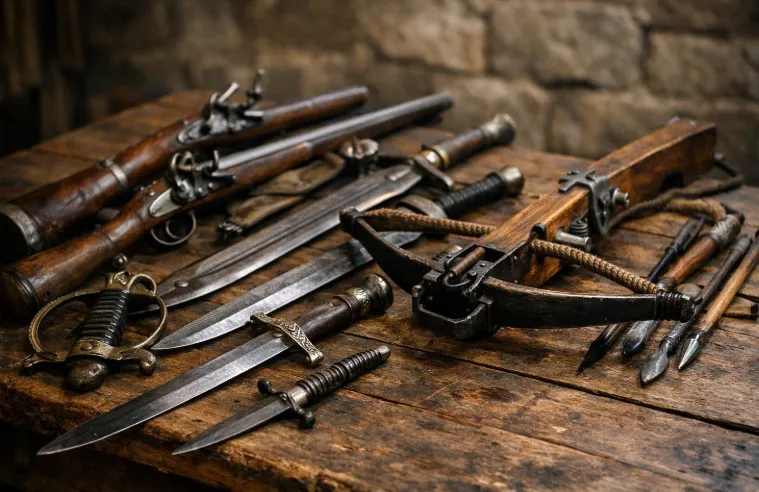
Historical Weapons Used in Budapest’s History Through the Centuries
Budapest's military history stretches back over two millennia. From Roman gladius swords in Aquincum to the firearms that echoed through its streets during the 1956 Revolution, the city’s arsenal tells a wild, tangled story.The weapons used throughout Budapest's history reflect the city's strategic position at the crossroads of empires. Celtic warriors, Roman legions, Magyar horsemen, Ottoman janissaries, and Habsburg forces all left their mark on the landscape you can explore today.
The origins of Budapest began with Celtic settlements before Romans established Aquincum in 89 AD. Each era brought distinctive arms that shaped the region's fate.
From the curved sabres of Hungarian knights to the cannons that still sit in the courtyard of the Museum of Military History in Buda Castle, these weapons tell the story of how Buda and Pest evolved from separate fortified towns into a unified capital. The historical weapons used during the Siege of Budapest in World War II represent just one chapter in centuries of conflict that transformed the city's architecture and identity.
You'll discover how each weapon system influenced not just battles, but the very streets and buildings that define modern Budapest.
Key Takeaways
- Budapest's weapons evolved from Roman swords through medieval siege engines to modern firearms across 2,000 years of history
- The city's strategic location made it a battleground where Eastern and Western military technologies repeatedly clashed
- Many historical weapons from Budapest's past are preserved in museums and visible remnants around the city today
Ancient and Roman Weaponry in Aquincum
The weapons found at Aquincum reveal centuries of military evolution along the Danube frontier. Early Celtic tribal conflicts, Roman occupation, and later barbarian invasions all left their mark.
Archaeological discoveries in Óbuda show how defensive strategies and armaments changed as different cultures clashed along this strategic river crossing.
Celtic Tribal Arms and Warfare
Before the Romans arrived, Celtic tribes controlled the territory around what would become Aquincum. These warriors favoured long iron swords designed for slashing attacks from horseback or in open combat.
You'll find evidence that Celtic blacksmiths also produced spearheads with distinctive leaf-shaped blades. Their shields had metal bosses at the centre for extra strength.
Celtic warriors along the Danube wore chainmail armour when they could afford it. Wealthier fighters carried ornately decorated bronze helmets and wore torcs as symbols of status.
The tribes used throwing spears called javelins alongside their longer thrusting spears for battlefield versatility. Their weaponry reflected a warrior culture that valued individual combat prowess.
Celtic metalworking techniques were surprisingly advanced, with pattern-welded blades showing deep knowledge of iron and steel manipulation.
Roman Fortifications and Military Equipment
Aquincum grew from a Danube crossing into a major Roman legionary base that required extensive military infrastructure. The Romans stationed legions here, equipping them with standardised weapons like the gladius short sword and pilum throwing spear.
These weapons proved highly effective in the disciplined formations Roman soldiers used. Roman military success relied on their weapons combined with organised tactics that dominated adversaries for centuries.
Soldiers at Aquincum wore segmented armour called lorica segmentata and carried large rectangular shields known as scutum. The fortifications included watchtowers, defensive walls, and an aqueduct system supporting the military presence.
Auxiliary units supplemented the legions with cavalry and archers. These forces used different equipment suited to their specialised roles, including composite bows and longer spatha swords for mounted combat.
Aquincum Museum Artefacts
The Aquincum Museum houses Roman-era archaeological artefacts from the ancient provincial capital. You can view weapon fragments, armour pieces, and military equipment recovered from excavation sites across Óbuda.
The collection includes spearheads, sword fragments, and bronze fittings from military belts and harnesses. Archaeological research continues to uncover new discoveries at this site that once supported up to 40,000 inhabitants.
Military workshop areas have yielded tools used for weapon repair and production. The museum displays arrowheads, shield bosses, and decorative elements from officers' equipment that demonstrate the sophistication of Roman military manufacturing.
Influence of Migration and Barbarian Tribes
As Roman power weakened, migration period tribes brought new weaponry styles to the Danube region. Germanic warriors carried single-edged swords called seaxes and battle axes, which looked nothing like Roman designs.
These groups favoured lighter armour and relied more on mobility than the heavily equipped Roman legions. The strategic location along the Danube River made Aquincum a target for successive waves of invaders.
Hunnic, Gothic, and later Avar tribes all left traces of their military equipment in the archaeological record. You'll notice that migration period weapons often mixed Roman techniques with traditional barbarian designs, creating hybrid styles.
The transition from Roman to barbarian control marked a shift in warfare tactics and weaponry throughout the region.
Medieval Defence: Kingdom of Hungary and Siegecraft
The Kingdom of Hungary developed sophisticated military capabilities during the medieval period. Magyar cavalry traditions blended with European castle-building techniques, creating a unique military culture.
Budapest's Castle Hill became a focal point for defensive innovation under kings like Béla IV and Sigismund of Luxembourg. Hungarian forces constantly adapted their tactics to face both Mongol raiders and Ottoman expansion.
Weapons and Strategies During the Magyar Conquest
The Magyars arrived in the Carpathian Basin during the late 9th century wielding composite bows as their primary weapon. You would have witnessed these horsemen firing arrows whilst riding at full gallop—a terrifying sight for European armies back then.
Their curved sabres served as secondary weapons for close combat. Magyar warriors favoured light armour made from leather and metal scales, letting them move quickly during raids across the continent.
They employed false retreat tactics to lure enemies into ambushes, then surrounded them with rapid cavalry charges. The early Magyars avoided siege warfare and preferred raiding settlements, withdrawing before defenders could organise.
After settling permanently around Buda and establishing the Kingdom of Hungary under Stephen I, you saw them gradually adopt European military practices, including fortification construction.
Castle Hill Fortifications: From Béla IV to Sigismund
King Béla IV transformed Budapest's defences after the devastating Mongol invasion of 1241–1242 nearly destroyed the kingdom. He ordered the construction of stone fortifications on Castle Hill, replacing earlier earthwork defences.
You can trace Buda Castle's origins to this period of rebuilding. The fortress grew substantially under successive rulers.
Sigismund of Luxembourg expanded the castle complex between 1387 and 1437 as Ottoman expansion reached the kingdom's borders. The hilltop position provided clear sightlines across the Danube, whilst steep slopes hindered attacking forces.
Matthias Corvinus further strengthened Buda Castle during his reign from 1458 to 1490. King Matthias transformed it into a Renaissance palace whilst keeping its defensive capabilities intact.
The fortifications included thick stone walls, multiple gates, and towers positioned at strategic intervals.
Knights, Armaments, and Castle Defence
Hungarian knights adopted European heavy cavalry tactics during the 14th century. You would have seen them wearing plate armour and carrying lances, swords, and shields.
The Kingdom of Hungary's military forces combined these mounted knights with infantry and crossbowmen.
Castle defenders employed various weapons for protection:
- Crossbows for accurate long-range defence
- Polearms like halberds for close-quarters fighting
- Boiling oil and pitch poured from battlements
- Stone missiles dropped through murder holes
Siege tactics and defensive features became increasingly sophisticated throughout the medieval period. Buda's fortifications included crenellated walls, letting defenders shoot whilst staying protected.
The castle's water supply and storage facilities enabled prolonged resistance during sieges.
Hungarian Military Innovations of the Age
Hungary's abundant gold and silver mines, which produced over 30 per cent of the world's output until the 1490s, funded military innovations. King Matthias used these resources to maintain a standing army, which was pretty unusual for medieval Europe.
John Hunyadi developed effective tactics against Ottoman forces in the 15th century. His victory at the Siege of Belgrade in 1456 demonstrated Hungarian defensive capabilities.
The battle combined artillery, crossbowmen, and infantry in coordinated defensive positions. Hungarian forces began adopting early firearms during Matthias Corvinus's reign.
You saw handguns and primitive cannons supplementing traditional weapons. However, these innovations came too late to prevent the catastrophic Battle of Mohács in 1526, when Ottoman forces defeated the Hungarian army and killed King Louis II.
This defeat effectively ended medieval Hungarian independence.
Ottoman Conquest and the Transformation of Warfare
The Ottoman siege campaigns against Buda and Pest in the 16th century introduced advanced gunpowder artillery and siege tactics. These military innovations left lasting marks on Budapest's fortifications and urban landscape.
Sieges of Buda and Pest: Ottoman Military Tactics
The Ottomans captured Buda in 1541 after employing sophisticated siege warfare techniques that combined traditional methods with new artillery technology. Their forces surrounded Buda Castle on Castle Hill, cutting off supply routes along the Danube and positioning heavy cannons at strategic points around the fortifications.
The Ottoman military used massive bronze bombards during the siege that could fire stone projectiles weighing up to 400 kilograms. These weapons required 70 oxen and 1,000 men to transport, which is just wild to imagine.
The siege tactics also involved constructing earthworks and trenches to protect advancing troops from defensive fire. Pest, located across the Danube from Buda, fell more quickly to Ottoman forces due to its weaker fortifications.
The Ottomans established military control over both settlements, transforming them into key strategic positions within their European territories.
Firearms, Cannons, and Turkish Innovations
Ottoman artillery and firearms really pushed the boundaries of military tech in the 16th and 17th centuries. During their Hungarian campaigns, the Ottomans rolled out several types of cannons, including the darbzen battering guns, which fired shots from 0.15 to 2.5 kilograms. The heavier balyemez cannons hurled projectiles weighing 31 to 74 kilograms—impressive, honestly.
Ottoman infantry carried the shishane, a musket that gradually evolved from matchlock to miquelet mechanisms. The Janissaries, those famous elite troops, wielded the yatağan, a curved sabre that became almost iconic for them. Cavalry units preferred the kilij, a sabre designed for fighting on horseback.
Ottoman forces adapted weapons technology instead of just copying European models. They set up foundries in newly conquered lands to make ammunition and keep their artillery in working order right on site.
Legacy of Turkish Baths and Fortifications
The Ottoman occupation of Buda and Pest from 1541 to 1686 left some lasting marks, especially when it comes to architecture. The thermal baths they built—still up and running—tap into Budapest's natural hot springs, like the Rudas, Király, and Veli Bej baths.
Ottoman engineers reinforced Buda Castle with new bastions and gun emplacements to handle artillery attacks. They also tweaked Castle Hill's defenses, making sure their own cannons could cover the Danube. These changes didn't just strengthen the castle—they altered its whole look and feel.
The Turkish baths weren't just for civilians; Ottoman troops stationed in the garrison used them, too. The domed architecture and those octagonal pools? Classic Ottoman engineering, but tailored to Budapest's unique hot springs.
Habsburgs, Revolution, and the Austro-Hungarian Era
The Habsburg period shook things up in Budapest, from the weapons of the 1848 revolution to major projects like the Chain Bridge, which totally changed how the city could defend itself.
Weapons of Resistance: 1848–49 Revolution
The Hungarian Revolution of 1848 really changed Budapest's military history. Lajos Kossuth and his revolutionary forces grabbed whatever weapons they could find to fight against Habsburg rule.
Hungarian fighters used smoothbore muskets and flintlock pistols from local armouries. Many carried sabres and cavalry swords, which fits Hungary's riding tradition. The National Guard set up workshops around Budapest to make ammo and fix guns.
Rebels fortified Castle Hill, stockpiling artillery and placing cannons of all shapes and sizes along the Buda defenses. They also got their hands on percussion cap rifles, which worked better than the old flintlocks.
Despite some early wins, Habsburg forces eventually took back control in 1849. The weapons from this era really bridge the gap between old Napoleonic firearms and the newer, rifled guns that came after.
Count Széchenyi and Military Modernisation
Count István Széchenyi pushed for Hungary to modernise in the years leading up to the revolution. He focused on military infrastructure and how Hungary's weak economy made it hard to defend itself.
Széchenyi pushed for new foundries and metalworks to make weapons and equipment locally. This move meant Hungary didn't have to rely so much on imports. His push for industrial growth set the stage for better artillery production.
He also wanted improved transport networks for both civilians and the military. Moving troops and supplies got a lot easier thanks to his ideas.
Construction of Chain Bridge: Strategic Importance
The Chain Bridge, finished in 1849 thanks to Széchenyi, completely changed Budapest's strategic setup. Before that, people had to use pontoon bridges or ferries to cross the Danube between Buda and Pest.
Military advantages of the Chain Bridge:
- Permanent crossing for troop movement
- No more seasonal problems from ice or floods
- Faster deployment between Buda and Pest
- Artillery could cross the river any time of year
The bridge's iron frame made it much tougher than wood. During the dual monarchy period after 1867, the Chain Bridge proved its worth for military coordination and city defense.
The bridge also helped shape development along Andrássy Avenue, eventually connecting central Pest to what became Heroes' Square. This network really cemented Budapest's spot as a military and administrative hub in the Austro-Hungarian Empire.
World Wars and Twentieth-Century Conflicts
The 20th century hit Budapest hard, with wars bringing everything from bolt-action rifles to tanks. The city went through occupation, sieges, and persecution that changed its population and landscape forever.
World War I: Weapons and Military Engagements
Hungarian troops under the Austro-Hungarian Empire mostly used the Mannlicher M1895 rifle, a straight-pull bolt-action design. Budapest's garrisons also fielded Schwarzlose M.07/12 machine guns.
Military factories in Budapest produced artillery and ammo for the front lines. Skoda howitzers and field guns became standard for Hungarian units fighting in the east and in Italy.
World War I didn't bring much direct fighting to Budapest, but the city played a huge role as a logistics and manufacturing center. Places like the Csepel Works kept churning out military equipment right up until the Empire collapsed in 1918.
World War II: Siege of Budapest and Armaments
The Siege of Budapest from December 1944 to February 1945 was among the bloodiest battles of World War II. German and Hungarian troops dug in to defend Buda and Pest, facing off against Soviet and Romanian attackers with a brutal arsenal.
German forces brought in Panther and Tiger tanks, while the Hungarians fielded their Turán mediums. Soviet troops countered with T-34s and heavy IS-2 tanks, both built for city fighting. Around 80% of the city ended up in ruins.
Infantry weapons included:
- Hungarian: Mannlicher M1935 rifles, Danuvia 43M submachine guns
- German: Kar98k rifles, MP40 submachine guns, Panzerfaust anti-tank weapons
- Soviet: Mosin-Nagant rifles, PPSh-41 submachine guns
Artillery barrages from both sides turned much of Pest into rubble. Walk around today and you'll still spot bullet holes and shrapnel scars on some buildings—hard to miss, really.
Holocaust, Arrow Cross, and the Jewish Community
The Arrow Cross Party took power in October 1944 and immediately ramped up violence against Budapest's Jewish community. Armed with rifles and pistols, Arrow Cross militia carried out mass executions along the Danube, shooting victims who fell into the river.
Jewish residents got crammed into a ghetto in Pest, where about 70,000 people suffered from starvation and disease. Arrow Cross forces openly used small arms to murder thousands right in the streets.
Deportations to Auschwitz and other camps had already claimed over 400,000 Hungarian Jews. Raoul Wallenberg and other diplomats handed out protective documents that saved many, but the Arrow Cross often ignored these papers.
The Shoes on the Danube Bank memorial now marks where victims had to remove their shoes before being shot. These horrors happened with ordinary firearms—no need for special equipment for such cruelty.
Treaty of Trianon and Its Aftermath
The Treaty of Trianon in 1920 carved up Hungary, cutting away two-thirds of its territory and slashing its military. The army shrank to only 35,000 men, with no heavy artillery, tanks, or air force allowed.
Budapest's arms industry got hit hard by these restrictions. The treaty banned modern weapon production, so Hungary's military development had to go underground between the wars.
Hungary clawed back some territory by siding with Nazi Germany before World War II. That alliance kick-started rearmament and expanded Budapest's military industry, but it also dragged the city into another devastating conflict.
Cold War, Revolution, and Modern Day Budapest
Budapest became a real hotspot during the Cold War, especially in 1956 when locals grabbed whatever weapons they could to rise up against Soviet control. Revolutionaries used everything from Soviet rifles to captured gear, and in later decades, Hungary built up its own military industry under the Warsaw Pact before switching gears to meet modern EU standards.
1956 Hungarian Revolution: Weapons of Uprising
The 1956 Hungarian Revolution began on 23 October when university students gathered at the Hungarian Parliament Building to protest Soviet domination.
As the uprising spread, revolutionaries scrambled to get firearms fast. Supplies were scarce, but necessity breeds creativity.
Hungarian fighters mostly used Mosin Nagant Model 1948 carbines and rifles, built locally at the Fémáru Fegyver és Gépgyár factory in Budapest between 1949 and 1955. These sturdy bolt-actions fired 7.62x54mm ammo and held five shots—simple but effective.
Revolutionaries grabbed Soviet M1944 carbines from troops stationed in Hungary. Some captured weapons got special markings during the chaos, like the Kossuth Coat of Arms crest stamped above factory codes.
Serial numbers were sometimes ground off and replaced with "FR" prefixes, probably for "Forradalmi Regiment" (Revolutionary Army), though nobody can say for sure.
The PPSh-41 submachine gun, made in Budapest as the Model 48, became a favorite for close-quarters fighting. It blasted 7.62x25mm rounds at a wild 700-900 rounds per minute, fed by either chunky 40-round boxes or 71-round drum magazines.
Hungarian forces also used older Mannlicher M1943 rifles in 7.92x57mm, with about 91,500 produced from 1944 to 1950. Not exactly cutting-edge, but they got the job done.
Warsaw Pact, Iron Curtain, and Military Technologies
After the uprising, János Kádár's government locked Hungary into the Warsaw Pact's military machine. Budapest's factories started cranking out licensed Soviet designs through the 1960s and 1980s, and you couldn't miss the influence.
The Fémáru Fegyver és Gépgyár kicked off production of the AK-55 in 1955, Hungary's own take on the AK-47. This rifle used 7.62x39mm rounds and 30-round magazines, and honestly, the Hungarian build quality was a cut above most Warsaw Pact clones.
Hungary also turned out the Tokarev TT Model 48 pistol, stamped with the Hungarian '02' code and the socialist Rákosi Crest on the grips. These 7.62x25mm pistols held eight rounds and had a certain utilitarian charm.
Behind the Iron Curtain, Budapest's gun factories supplied the Hungarian forces and shipped weapons to allied countries. Hungarian-made firearms often earned a reputation for better quality than most Eastern Bloc products—something to be a little proud of, maybe.
Goulash Communism and János Kádár Era
János Kádár's "Goulash Communism" allowed a little bit of economic flexibility while keeping politics tightly locked down. Military production kept going, but factories started to shift toward dual-use tech—civilian and military.
Budapest's arms makers adapted, turning out civilian firearms alongside military contracts. The Walam 48M pistol, a slick copy of the German Walther PP, is a good example. Chambered in 9mm Short or 7.65mm, these pistols were first meant for Egyptian export but ended up on the commercial market too.
Military museums began collecting Hungary's martial heritage during these years. Collections grew to include medieval armor, Ottoman-era weapons, and modern firearms—quite the mix.
Contemporary Military Heritage and the Budapest Military History Museum
Modern Budapest keeps its military history alive through a handful of institutions. The Museum of Military History sits in old army barracks in the Buda Castle district, with collections that stretch from medieval times to recent wars.
You can wander through weaponry, uniforms, flags, and about 28,000 coins in the permanent exhibitions. The medieval armor and weapon displays capture Hungary's early defensive struggles, while the 18th and 19th-century galleries highlight Habsburg-era gear.
Since joining the EU, Hungary has been updating its armed forces with NATO-standard equipment. The Cold War Park Exhibition near Budapest lets you get up close with real military vehicles and weapons from the Soviet era, even offering hands-on experiences with some Cold War tech.
Every August 20, Hungary's national day, Budapest marks its military past with displays of historical weapons and official ceremonies. If you're in town, it's hard to miss.
Frequently Asked Questions
Medieval Budapest's defenders relied on crossbows, pikes, and early cannons. Ottoman occupation brought Turkish firearms and siege tech that really shook up local military practices.
Later centuries saw muskets, pistols, and heavy artillery shaping major conflicts—including the brutal Siege of Budapest in 1945.
Which weapons were commonly used to defend Buda and Pest during medieval sieges?
Medieval defenders of Buda and Pest mostly used crossbows as their main ranged weapon. These could punch through armor and let soldiers hold their ground from castle walls.
Pikes and halberds were the go-to for close combat. Defenders used these long poles to keep attackers off the walls or out of the gates.
Early cannons showed up in the 14th and 15th centuries, but they were rare and tricky to use. Stone fortifications still gave pretty solid protection against these early artillery pieces.
How did Ottoman rule influence the weapons and military equipment used in Budapest?
Ottoman occupation from 1541 to 1686 brought Turkish weapons and tech to Budapest. The Ottomans rolled in with their tüfek firearms, which had evolved from arquebuses by the 15th century.
Turkish troops used bigger cannons and mortars for sieges, and these were way ahead of what local Hungarians usually had at the time. The Ottomans also brought curved sabres and composite bows, both of which left their mark on local weapon design.
Hungarian forces gradually picked up some of these new technologies, but they still clung to their cavalry roots.
What role did cavalry weapons such as sabres and lances play in Hungary's warfare around Buda and Pest?
Hungarian cavalry really shaped warfare around Buda and Pest for ages. The light cavalry hussars gained fame across Europe for their speed and battle prowess.
Sabres were the main weapon for Hungarian horsemen. These curved swords made it easier to slash from horseback without losing control of the horse.
Lances gave cavalry extra reach during charges against infantry. With their riding skills and these weapons, Hungarian cavalry became a force to be reckoned with.
Which firearms became widespread in Budapest from the 16th to the 19th century, and how did they change combat?
Muskets started appearing in the 15th and 16th centuries, giving infantry much better accuracy and punch. These replaced crossbows as the standard firearm around Budapest and beyond.
Flintlock pistols became common sidearms for officers and cavalry in the 17th and 18th centuries. Infantry tactics changed too, moving away from old pike-and-shot formations.
The 19th-century industrial revolution really changed the game for firearms. Rifled barrels and better ignition systems made guns more accurate and reliable, totally shifting how battles played out in and around Budapest.
What types of artillery were deployed during major battles and sieges involving Budapest across different centuries?
Early bronze and iron cannons showed up during the Ottoman sieges of the 16th century. These fired stone or iron balls at fortifications, but metallurgy limited their power.
By the 18th and 19th centuries, armies started using more mobile field artillery. Lighter cannons could be moved during battles, not just left in fixed positions.
Soviet forces brought massive artillery firepower during the 1944-1945 Siege of Budapest. Heavy guns and mortars battered German and Hungarian positions for 50 days, and the city took a serious beating.
What weapons did Hungarian forces associated with Budapest use during the Second World War?
Hungarian troops defending Budapest in 1944 and 1945 relied on a mix of domestic and German-supplied weapons. They carried the Hungarian-made 35M Mannlicher rifle and also used German Karabiner 98k carbines.
If you want to see some of these historical weapons up close, the Museum of Military History in Budapest has a pretty remarkable collection. You’ll find over 50,000 objects—handguns, machine guns, and all sorts of military gear.
The museum’s displays actually stretch from the Turkish wars in the 16th century all the way to more recent times. It’s a lot to take in, honestly.
German Panzers rolled through the streets while Soviet artillery pounded the city during the siege. On the ground, soldiers fought with basic rifles and built makeshift barricades—anything to survive the chaos of urban combat.