Historical Weapons Used in the Siege of Budapest: Key Arms of a WWII Urban Battle
Step back into one of WWII’s fiercest urban battles and discover the weapons used during the Siege of Budapest, from rifles to submachine guns that shaped the fight.
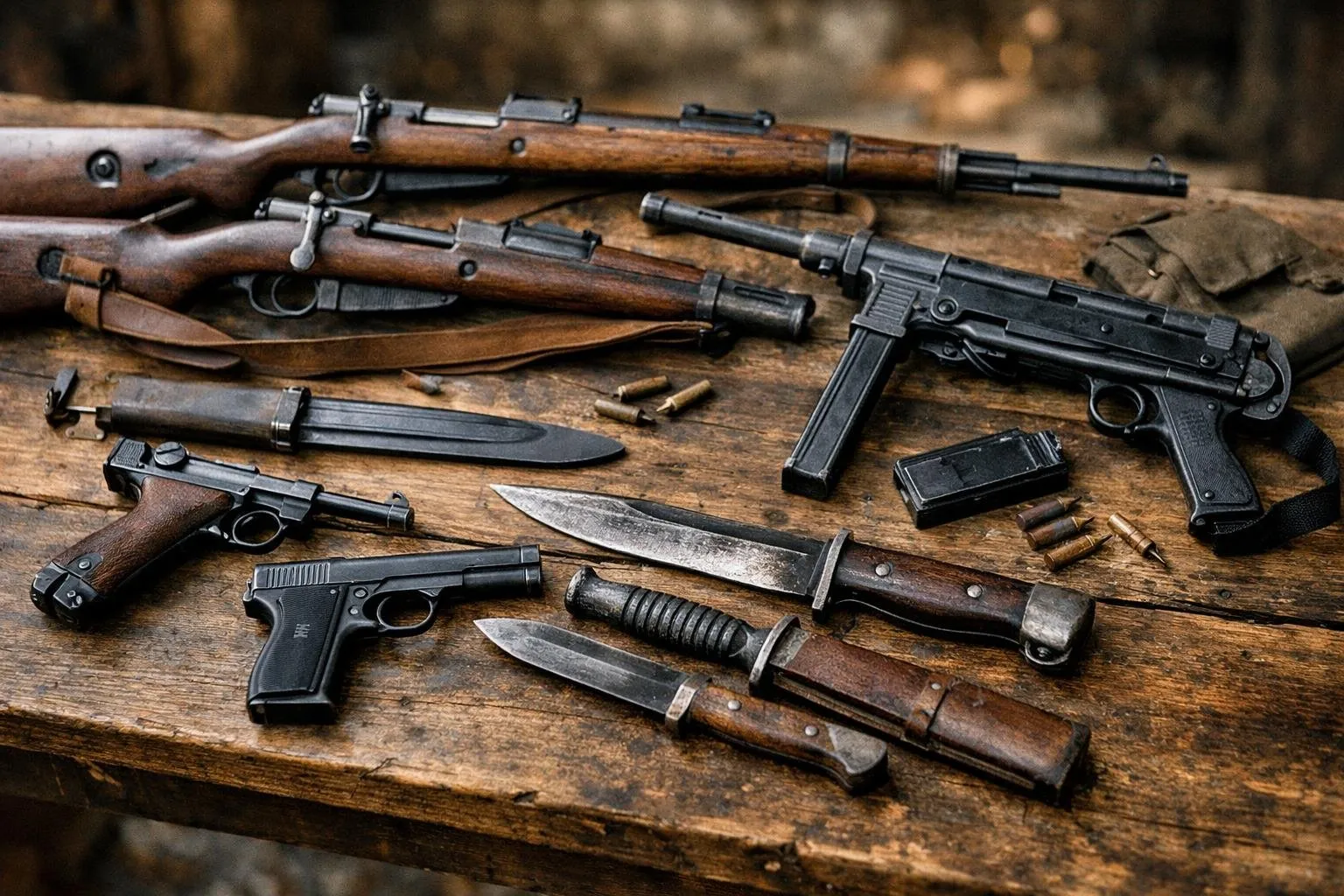
Historical Weapons Used in the Siege of Budapest: Key Arms of a WWII Urban Battle
The Siege of Budapest dragged on for 50 grueling days, from late December 1944 into February 1945. It stands as one of WWII’s longest and most brutal urban battles.
Soviet and Romanian units brought in heavy artillery, tanks, and a mix of infantry weapons to surround Hungary’s capital. German and Hungarian defenders fought back with assault guns, anti-tank weapons, and whatever fortifications they could throw together.
The weapons that clashed in Budapest didn’t just decide the battle—they left deep scars on the city itself.
So, what made this siege so devastating, even compared to other Eastern Front nightmares? It’s the mix of urban tactics and the specific weapons each side threw into the fight.
From Hungarian Zrínyi II assault howitzers to Soviet T-34 tanks, every weapon left its mark on the strategic offensive that cost over 300,000 lives.
Diving into the weapons used during the encirclement of Budapest gives you a real sense of how WWII urban warfare evolved. Most of the city’s buildings were destroyed, showing just how effective—and limited—these military technologies could be in close quarters.
Key Takeaways
- The siege pitted Hungarian assault guns, German armor, and Soviet tanks against each other in savage urban fighting.
- Both sides improvised defenses and adapted their weapons for the chaos of street combat.
- Artillery, anti-tank weapons, and fortifications played a huge role in determining who held the upper hand.
Overview of the Siege of Budapest
The 50-day siege battered Budapest from late December 1944 to mid-February 1945. The fighting left over 300,000 casualties and wiped out 80% of Hungary’s capital.
Soviet and Romanian troops trapped about 79,000 Axis soldiers. Hitler wouldn’t let the city go, so Budapest became a fortress, with brutal fighting raging on both sides of the Danube.
Significance on the Eastern Front
Budapest was Germany’s last big ally capital in the east after Romania switched sides. Hungary supplied 90% of German bauxite—critical for making aircraft aluminum.
Stalin pushed for Budapest’s capture before the February 1945 Yalta Conference. He wanted a stronger hand in post-war Central Europe, so the city’s fate mattered far beyond the battlefield.
The siege tied up a lot of Soviet resources that could’ve gone north toward Berlin. While the 2nd and 3rd Ukrainian Fronts fought in Budapest, other Soviet armies pushed from Warsaw almost to Germany itself.
Vienna’s capture got delayed, finally falling two months after Budapest surrendered on February 13, 1945.
Key Combatants and Commanders
The Axis defense had 41,000 German soldiers and 38,000 Hungarians, all under Waffen-SS General Karl Pfeffer-Wildenbruch. The defenders included two Waffen-SS divisions, the IX SS Mountain Corps from Croatia, and regular Heer units.
Marshal Rodion Malinovsky led over a million Soviet troops in the assault. The 2nd Ukrainian Front kicked things off, with the 3rd Ukrainian Front pushing in from Yugoslavia. Major Soviet groups included the 46th, 53rd, and 7th Guards Armies.
Ferenc Szálasi ran Hungary’s Arrow Cross Party government after Operation Panzerfaust ousted Miklós Horthy in October 1944. Germany had already occupied Hungary back in March 1944. Szálasi bailed out of Budapest on December 9, leaving Pfeffer-Wildenbruch in charge of “Festung Budapest.”
Romanian forces joined the siege after switching sides, bringing in the Romanian 7th Army and support units.
Encirclement and Urban Combat Dynamics
Soviet troops finished encircling Budapest on December 26, 1944, when they cut the Vienna road. The 6th Guards Tank Army pushed north through Hatvan, and the 46th Army moved in via Csepel Island.
More than 70,000 Axis soldiers and 800,000 civilians were trapped inside the city. Fighting in Pest happened along wide avenues, where Soviet troops could advance a bit faster. But in Buda, the hills and strongpoints made things a nightmare.
German troops blew up all five Danube bridges after retreating to Buda’s western side. Hitler ordered three relief attempts—Operation Konrad I, II, and III—using the IV SS Panzer Corps, but none broke the Soviet grip.
The sewers turned into battlegrounds for raids and ambushes. Soviet forces offered surrender terms on December 28, but German soldiers killed the emissaries. As winter deepened, defenders ate horses and sent schoolboys to the front lines. Artillery smashed the city flat, and by February 1945, resistance was done.
Infantry and Small Arms
Infantry weapons defined the desperate, close-in fighting of the siege. Both sides leaned on rifles, submachine guns, and pistols—especially as defenders ran low on heavier ammo.
Germans and Hungarians mostly responded with machine guns, rifles, submachine guns, and other light weapons. Ammunition shortages forced them to get creative and make every shot count.
Standard Issue Rifles
Red Army troops mostly carried the Mosin-Nagant M1891/30 bolt-action rifle. It’s a rugged 7.62×54mmR workhorse that had already seen action since World War I.
You might spot the SVT-40 semi-auto in some Soviet squads, but its complexity made it less common in the chaos of city fighting.
German Heer and Waffen-SS troops used the Karabiner 98k, a reliable bolt-action rifle in 7.92×57mm Mauser. It held up well in the brutal winter.
Hungarian soldiers carried the 35M Mannlicher, a homegrown design based on the Romanian M1893. Some units still clung to the old Mannlicher M1895 rifles from the Austro-Hungarian days, especially among last-minute reserves and militia.
Submachine Guns and Machine Guns
The PPSh-41 became the Red Army’s go-to weapon for street fighting. Its 71-round drum and 7.62×25mm rounds made it a beast in tight spaces.
Soviet squads also brought along the DP-28 light machine gun and the heavier Maxim M1910 for backup firepower.
German troops leaned on the MP 40 submachine gun, which fired 9×19mm rounds from a 32-round stick magazine. The MG 42 machine gun delivered a blistering 1,200 rounds per minute—absolutely terrifying in the right hands.
Hungarian units fielded the 39M Danuvia submachine gun, a local design firing 9×25mm Mauser. Older 43M submachine guns also showed up with Hungarian militia.
Pistols and Handguns
Soviet officers and tank crews carried the TT-33 Tokarev pistol, a semi-auto in 7.62×25mm. The Nagant M1895 revolver stuck around with rear-area troops and political officers.
German and SS troops used the Walther P38 and the classic Luger P08, both in 9×19mm. Hungarian officers and NCOs got the 37M Pistol (a Browning Hi-Power copy) or the older Femaru 37M. Plenty of Hungarians still carried Steyr M1912 pistols left over from the old empire.
Armoured Vehicles and Tanks
Defenders started the siege with 125 tanks and assault guns. Soviet forces rolled in with much larger armored units, including full tank corps.
German Tanks and Assault Guns
The IX SS Mountain Corps ran the defense with limited armor. German units relied on Panzer IV medium tanks and StuG III assault guns as their main armored vehicles.
Heer and Waffen-SS units had to share these, and fuel shortages meant some tanks got abandoned. Panther tanks made rare appearances—powerful, but their size made them easy targets in the city’s tight streets.
Defenders used Tiger I heavy tanks sparingly, since they guzzled fuel. Assault guns like the StuG III actually worked better for street fighting, thanks to their low profile and ability to support infantry at choke points.
Hungarian Armoured Contributions
The Hungarian Army’s armored fleet was a mix of local and foreign vehicles. Turán medium tanks made up the core, mounting 40mm or 75mm guns, but their armor couldn’t handle Soviet anti-tank weapons.
Hungary also fielded Toldi light tanks and Nimród self-propelled anti-aircraft guns. The Toldi was basically outdated by 1944, and the Nimród, while meant for aircraft, got used against ground targets when desperate.
Hungarian units sometimes pressed captured Soviet T-34 tanks and German Panzer 38(t)s into service—whatever they could get running, really.
Soviet Tanks and Self-Propelled Guns
The Red Army rolled into Budapest with huge armored forces from both the 2nd and 3rd Ukrainian Fronts. T-34/85 medium tanks led the charge through the city streets, combining decent mobility, solid armor, and a punchy 85mm gun.
Soviet troops also brought in IS-2 heavy tanks with their massive 122mm guns, perfect for smashing fortified spots. The 18th Tank Corps and other armored units had SU-76 self-propelled guns for supporting infantry, plus SU-85 and SU-100 tank destroyers to tackle German armor head-on.
The IV SS Panzer Corps made three desperate relief attempts using King Tiger tanks and assault guns. They pushed German armor to within 20 kilometers of the city, but they just couldn’t break the Soviet grip on Budapest.
Anti-Tank and Support Weapons
During the siege of Budapest, both defenders and attackers leaned heavily on portable anti-tank weapons, artillery, and explosives to fight armored vehicles and dug-in positions. German and Hungarian troops used Panzerfausts all over the place against Soviet tanks, while both sides kept field guns and mortars busy throughout the long, grinding battle.
The Panzerfaust and Panzerschreck
The Panzerfaust was the go-to anti-tank weapon for German and Hungarian troops. This single-shot, throwaway launcher could punch through up to 200mm of armor at close range—brutal for Soviet T-34s rumbling down Budapest’s streets.
Waffen-SS and Hungarian soldiers fired Panzerfausts from windows, basements, and behind rubble piles, using the chaotic city terrain for ambushes. The Panzerschreck, a bigger, reusable rocket launcher, gave defenders a bit more range but needed a two-man crew. German anti-tank teams, specially trained for this, hunted Soviet armor during the brutal street battles in Pest and later up in Buda’s hills.
Artillery and Field Guns
Artillery thundered on both sides all through the siege. The Red Army set up 76mm divisional guns and 122mm howitzers, hammering defensive positions across the Danube.
Soviet gunners positioned their guns in the eastern suburbs to blast a path for infantry advancing through Budapest’s broad avenues. German and Hungarian troops fired back with 75mm Pak 40 anti-tank guns and 105mm leFH 18 howitzers. During Operation Konrad, German relief attempts in January 1945, artillery was crucial for supporting armored counterattacks. Defenders also grabbed any captured Soviet guns they could find to bolster their lines inside the surrounded city.
Mortars and Grenades
Mortars were a lifesaver in Budapest’s maze of buildings. Soviet troops lobbed 82mm and 120mm mortar shells over rooftops and into courtyards where direct fire just couldn’t reach.
Red Army mortar teams set up in captured buildings to give infantry close support as they pushed forward. Hand grenades became must-have gear for close-up fighting. German Model 24 stick grenades and Soviet RGD-33s exploded in stairwells and courtyards as both sides fought for every building. Defenders dropped grenades from upper floors onto Soviets below, while attackers tossed them into rooms and cellars, clearing the way as they advanced.
Air Power and Artillery Support
Throughout the Siege of Budapest, both sides hammered away with artillery and air strikes, trying to smash defensive lines and seize key ground. The Red Army gathered huge artillery forces around the city, while the Axis defenders struggled to keep planes in the air as Soviet fighters took over the skies.
Soviet and Axis Artillery Deployment
The Red Army surrounded Budapest with thousands of artillery pieces during the Budapest Offensive. Soviet gunners from the 2nd and 3rd Ukrainian Fronts dragged heavy howitzers, mortars, and rocket launchers into tight, concentrated batteries around the city.
Soviet artillery included:
- 152mm howitzers for long-range shelling
- Katyusha rocket launchers for drenching whole areas
- 76mm divisional guns for direct support
- 120mm mortars to back up infantry
German Heer and Hungarian troops set up their own artillery inside the city’s defenses. Their ammo ran out fast as the Soviets squeezed the ring tighter. Waffen-SS units defending Budapest got priority for what shells remained, but shortages constantly hampered their firepower.
Role of Aircraft in the Siege
Soviet air superiority quickly tipped the balance in the Budapest Offensive. Soviet planes flew hundreds of sorties a day, bombing and strafing, while the Luftwaffe and Hungarian air forces barely managed to get off the ground.
The Luftwaffe tried to drop supplies to the trapped defenders, but Soviet fighters pounced on their transports. German planes took heavy losses, turning supply drops into a losing gamble. Soviet ground-attack aircraft pounded:
- Bridge crossings between Buda and Pest
- Defensive bunkers and strongpoints
- Supply dumps
- Troop concentrations
Bombardment of Strategic Sites
Artillery and air raids tore Budapest’s infrastructure to pieces over those 50 days. The Red Army aimed at bridges, hoping to stop German and Hungarian troops from shifting reinforcements.
The Chain Bridge area drew especially fierce shelling—everyone knew how vital it was. Soviet guns eventually smashed every major bridge across the Danube, trapping defenders and cutting supply lines.
Buda Castle took a pounding as Soviets tried to root out the Waffen-SS and Heer holding the high ground. Relentless shelling wrecked buildings and left thousands of civilians caught in the crossfire, as described in firsthand accounts.
Naval and Riverine Weapons on the Danube
The Danube was a lifeline—and a battlefield—during the siege. Both Axis and Soviet forces tried to control its waters and bridges, even though neither side had much in the way of real naval power. Still, river craft played a part in moving people, gathering intel, and supporting tactical moves.
Military Use of the Danube River
The Danube split Budapest in two—Buda to the west, Pest to the east. German and Hungarian troops kept small patrol boats and armed vessels on the river, mostly for scouting and ferrying supplies between the city’s halves.
The bridges over the Danube became prime targets. The Chain Bridge and others were crucial for moving troops and gear. Soviet artillery focused on these crossings, knowing how much they mattered.
Csepel Island, downriver from the city center, was packed with factories and sat at a key spot for controlling river traffic and defending Budapest’s southern edge.
River Ferries and Makeshift Armaments
Once the bridges fell or got blown up, ferries became the only way to move between Buda and Pest. German troops improvised, grabbing any boat they could—sometimes even civilian riverboats—and bolting on machine guns for defense.
These jury-rigged ferries often took fire from Soviet artillery and snipers as they tried to cross. Crews mounted MG 42s on the gunwales and patched hulls with scrap armor. They ferried wounded, ammo, and food whenever the ice and enemy fire allowed.
By January 1945, the Danube froze in spots, so troops sometimes just walked across—though that meant braving gunfire from both banks. Not exactly an easy choice.
Urban Warfare: Fortifications and Improvised Defences
Defenders turned Budapest’s urban sprawl into a maze of trenches, barricades, and fortified buildings. Civilians—often forced—worked nonstop to build these defenses under miserable, dangerous conditions.
Trenches, Barricades, and Strongpoints
Defenders dug trench systems all over the city, connecting key spots in both Buda and Pest. These zigzagged through parks and gardens, giving troops covered routes between strongholds.
At places like Széll Kálmán tér, defenders built barricades out of tramcars, rubble, furniture—basically anything that could stop a tank. Strongpoints popped up at major intersections, with anti-tank obstacles made from flipped-over cars, concrete blocks, and steel rails jammed into the pavement.
Machine gun nests hid behind these barricades, ready to sweep the boulevards. Around Ferihegy Airport and in districts like Budafok and Kispest, defenders hurriedly dug anti-tank ditches and laid minefields. Margaret Island turned into a mini fortress, with trenches and gun pits guarding the bridges.
Use of Buildings as Defensive Positions
Sturdy buildings became fortresses. On Castle Hill and Gellért Hill, defenders reinforced heavy structures with sandbags, steel beams, and debris. They cut firing slits through walls and punched holes between buildings—“mouseholes”—so they could move without stepping into the street and getting shot.
In the Budapest Ghetto, defenders adapted buildings with all sorts of tricks. Snipers and machine gunners set up on upper floors, while basements held ammo and doubled as bomb shelters. Windows were bricked up, except for small gun ports. Stairwells got blocked with furniture and barbed wire to slow down attackers.
Civilian and Forced Labour Contributions
Building Budapest’s defenses fell mostly to forced labor. Thousands of Jewish residents from the Ghetto, along with other civilians, were ordered to dig, haul, and fortify while shells rained down. You’d see women, old men, and teenagers pressed into labor battalions, working round the clock under armed guards.
They lugged sandbags, cleared rubble, and built anti-tank obstacles across the city—often without proper tools or enough food. Many did all this while freezing, hungry, and dodging incoming fire. It’s hard to imagine the exhaustion and fear they lived with every day.
Comparative Analysis of Weapon Effectiveness
The siege of Budapest really showed how different weapons fared in urban combat. Soviet artillery dominated the open approaches, but German anti-tank guns proved deadly in the tight, close-up fighting inside the city.
Impact on Siege Progress
Soviet artillery played a huge role in the encirclement of Budapest. Heavy guns and Katyusha rocket launchers hammered German defensive positions all over the city.
If you were there, you'd have seen these weapons smashing fortified buildings in Buda's castle district. They punched holes for the infantry to push through.
The Soviets rolled in with more than 4,000 artillery pieces. They used them to systematically tear down Hungarian and German strongpoints.
German anti-tank weapons, especially the Panzerfaust, made Soviet tank advances painfully slow in those narrow city streets. These portable weapons let small German squads knock out Soviet tanks up close.
The urban chaos made them even more effective. Tanks just couldn't maneuver around the piles of rubble.
Hungarian forces mostly depended on small arms and machine guns set up in buildings. These gave pretty good defensive fire.
But honestly, they just didn't have enough punch to stop the Soviets. Hungarian artillery was in short supply and, as ammo ran out, became almost useless.
Adaptations to Urban Combat
Urban warfare forced both sides to change up their usual tactics. Soviet artillery crews lowered their gun angles, aiming directly at specific buildings instead of just blasting whole areas.
You might've watched Soviet gunners tweak their aim to collapse enemy-held structures, trying not to destroy every possible bit of cover for their own troops. German defenders turned civilian buildings into makeshift strongholds.
They stacked up furniture and rubble for firing positions. Panzerschreck teams took over upper floors of apartments, firing down at Soviet tanks crawling below.
This move really paid off during the Battle of Buda. Elevated positions gave them clear lines of sight along the main approach routes.
Soviet engineers didn't mess around—they brought flamethrowers and satchel charges to clear buildings room by room. These replaced classic siege tools, which just didn't fit tight city spaces.
Hungarian troops, running out of ammo, sometimes threw together Molotov cocktails. Against Soviet armor, though, those homemade bombs didn't do much.
Limitations and Challenges Faced by Each Side
Soviet heavy artillery could level open ground, but in the city, accuracy suffered. You'd have seen shells meant for enemy troops wipe out entire blocks by mistake.
As the Soviets advanced, their supply lines got stretched thin. Ammo shortages became a real headache.
German forces were running out of everything by January 1945. Defensive weapons lost their bite as ammunition disappeared.
Anti-tank teams sometimes had to wait until Soviet tanks were almost on top of them before firing. With no air support, German positions sat exposed to Soviet artillery and couldn't hit back.
Hungarian defenders had it worst. Their gear was outdated, and resupply basically dried up.
Small arms just bounced off Soviet tanks, and they didn't have enough proper anti-tank weapons to put up a real fight. The fall of Budapest made it painfully clear—equipment shortages can destroy any defense in a long city battle.
Legacy of Weapons and Battlefield Remnants
The siege left behind a lot—preserved weapons, memorials, and tactical lessons that shaped later battles. You can still see traces of the 1944–45 fight all over Budapest, and those reminders shaped how urban warfare developed in Central Europe.
Preserved Arms in Budapest
Budapest's museums and private collections are packed with weapons from the siege. The Hungarian Military History Museum has Soviet artillery, German Panzerfausts, and small arms dug up from battle sites.
You can check out PPSh-41 submachine guns, Mosin-Nagant rifles, and Mauser Kar98k carbines—these saw real action in house-to-house fighting.
Archaeologists still find old ordnance around the city. Construction crews regularly uncover unexploded shells, grenades, and ammo stashes buried under the streets.
These historical weaponry collections help educate people and document just how fierce the urban fighting got. The castle district still has battered fortifications, with impact marks from Soviet artillery everywhere.
You'll spot bullet holes and shrapnel scars on buildings that somehow survived. These scars say more than any museum display ever could.
Commemoration and Memorial Sites
Memorials across Budapest mark where the worst fighting happened. The Liberty Statue on Gellért Hill honors Soviet troops who took this key spot.
Throughout the city, plaques show where defensive lines stood or where civilians hid from shelling. Raoul Wallenberg’s humanitarian work during the siege is remembered at several sites, including the memorial on Szilágyi Erzsébet fasor.
He saved thousands of Jews in the middle of the chaos. The Shoes on the Danube Bank memorial honors those murdered along the river during the siege.
Farkasrét Cemetery holds the graves of German and Hungarian soldiers who died defending Budapest. Soviet military cemeteries dot different districts, marking where Red Army troops fell.
Influence on Later Conflicts
The siege's brutal street fighting changed how the Soviets thought about urban combat. What they learned in Budapest shaped their approach in the Vienna Offensive just a few months later.
Historians like Krisztián Ungváry have pointed out how the need for combined arms in cities really came into focus here. The Yalta Conference happened while Budapest was still under siege, which influenced some Allied planning.
Soviet commanders took the hard lessons from Budapest and used them in Czechoslovakia and Austria. The battle showed just how much modern warfare technology could change urban fighting.
Military academies still use Budapest as a case study for defense in cities. You'll even find it referenced in old NATO and Warsaw Pact training manuals.
Frequently Asked Questions
The siege saw everything from Soviet artillery and German Panzers to basic rifles and makeshift barricades—classic urban combat stretched over 50 brutal days.
What types of artillery were deployed during the Siege of Budapest?
Soviet forces brought in massive artillery firepower. Heavy guns and rocket launchers just kept pounding defensive positions day after day.
The city took a beating—about 80 percent of its buildings ended up flattened. German and Hungarian defenders had some artillery too, but not nearly as much.
Most of their guns were set up in the Buda hills, where they could cover the approaches. Artillery duels between the two sides ripped through the city and left serious scars.
Which infantry weapons were predominant in the battle for Budapest?
Soviet troops used Mosin-Nagant rifles and PPSh-41 submachine guns—great for the close-in, room-to-room fighting that defined the siege. Germans relied on Mauser Kar98k rifles and MP40 submachine guns as their go-to weapons.
Hungarian defenders mixed in whatever they could get, including older rifles and German-supplied arms. As things got desperate, even high school students ended up with whatever was left in the armories.
How did the use of armoured vehicles influence the outcome of the Siege of Budapest?
The IV SS Panzer Corps kept launching counterattacks to try and break the Soviet ring around Budapest. Their goal was to relieve the trapped garrison and reopen supply routes.
Even with experienced tank crews, these offensives just couldn't break through. Soviet armoured forces, especially the 6th Guard Tank Army, helped finish the encirclement.
Tanks gave the Soviets the firepower they needed to push through the eastern suburbs. The fighting was so intense that the Soviets lost 1,766 tanks and self-propelled guns during the siege.
What defensive structures and weapons did the Hungarians use to resist the attackers?
The "Attila Line" was the main defensive ring, especially strong in the Buda hills. The defenders used the terrain to their advantage.
German engineers set up bunkers, trenches, and strongpoints all over the place. The city's own buildings became part of the defense as soldiers fought floor by floor.
Ambushes and barricades slowed the Soviet advance. The five Danube bridges were key until German troops blew them up during their retreat to Buda.
Were there any significant innovations in warfare introduced during the Siege of Budapest?
Honestly, the siege relied more on tried-and-true weapons and tactics than on real innovations. Urban fighting methods from earlier Eastern Front battles showed up everywhere.
Soviets tried using loudspeakers to demand surrenders, but it didn't really work. The most unusual twist was probably the use of the city's sewer system for surprise attacks and raids—turning Budapest's underground into a hidden battlefield.
Pictures of the AK 47 and M4 must look real.
How did the weapon supplies and logistics affect the duration and tactics of the siege?
Supply shortages absolutely crippled the Axis defenders as the encirclement tightened. Ammunition ran low, and food became so scarce that soldiers started slaughtering their own horses just to eat.
German forces tried to retake the western airfield, hoping to reopen a route for aerial resupply. You can imagine the desperation—every flight in or out meant a little more hope, or maybe just a few more days to hold out.
Meanwhile, Soviet forces actually paused their initial offensive in November so they could sort out their own messy logistics. This break stretched until mid-December, giving their ammunition and supplies time to catch up with the troops pushing forward.
Thanks to more reliable supply lines, the Soviets could keep up their bombardments and attacks. Axis forces, on the other hand, just kept getting weaker as their supplies ran out.