History of the Desert Eagle Pistol: Design, Calibres, and Legacy
From Hollywood films to shooting ranges worldwide, discover the history of the Desert Eagle and why it became one of the world’s most iconic pistols.
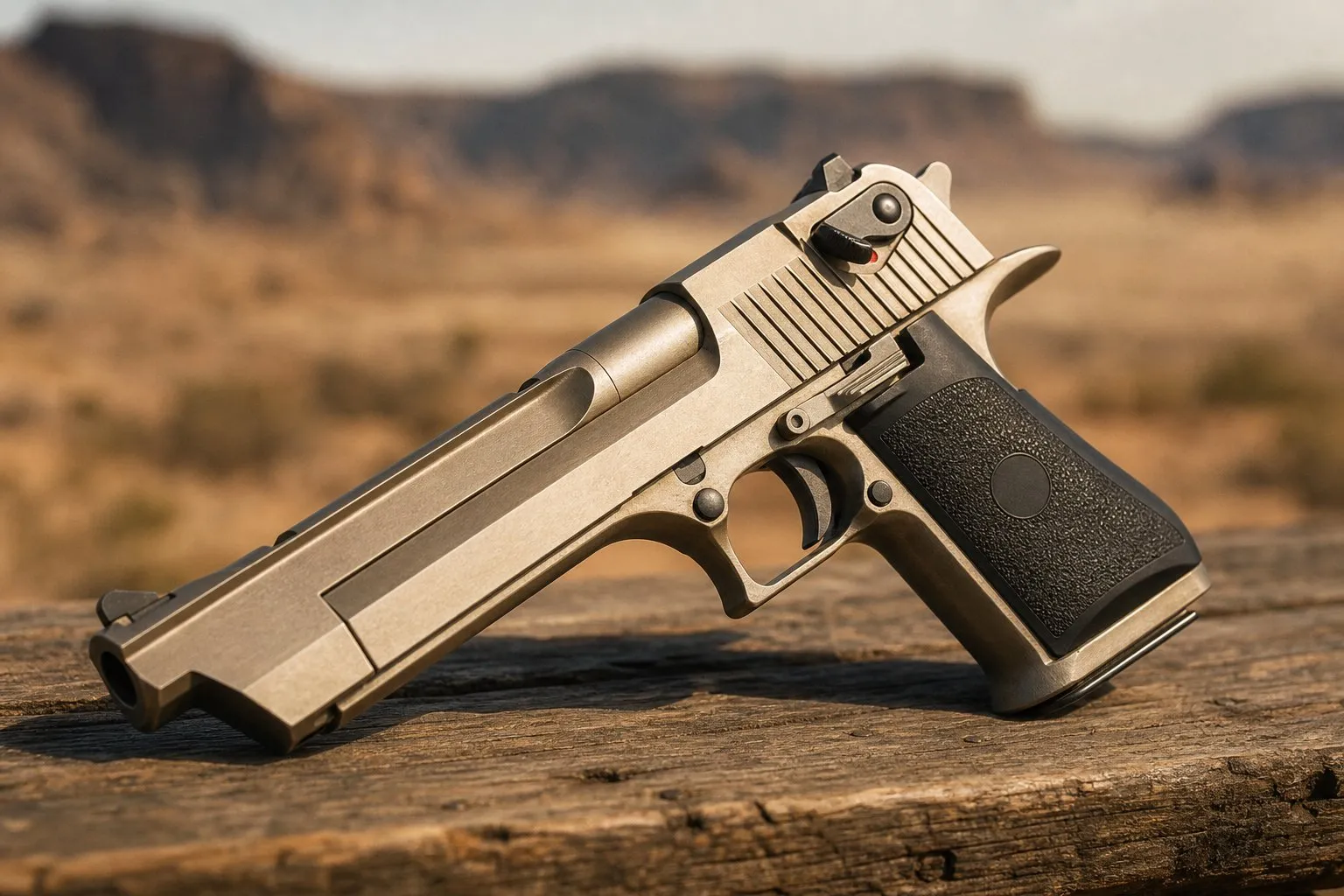
History of the Desert Eagle Pistol: Design, Calibres, and Legacy
The Desert Eagle is one of the most recognizable handguns ever made. Its story, though, goes way beyond blockbuster movies and flashy video games.
Bernard C. White of Magnum Research and Arnolds Streinbergs of the Riga Arms Institute developed the Desert Eagle pistol in the late 1970s and early 1980s, with the first patent filed in January 1983. This semi-automatic pistol broke new ground by using a gas-operated system—something you'd expect from a rifle, not a handgun.
What really sets the Desert Eagle apart is its ability to fire extremely powerful cartridges. We're talking about the .50 Action Express, which is the largest centerfire cartridge you'll find in any magazine-fed, self-loading pistol.
The weapon came to life through a collaboration between American and Israeli companies. Israel Military Industries took the original design and made it production-ready.
Since its 1983 debut, the Desert Eagle has seen several iterations, each one a little more refined than the last.
From its technical innovations to its cultural impact across more than 600 films and television shows, the Desert Eagle has carved out a unique place in firearms history.
If you're curious about its engineering, its range of models and calibres, or just why it became such an icon, looking into the Desert Eagle's history makes it pretty clear why shooters and collectors can't seem to get enough of this beast.
Key Takeaways
- The Desert Eagle uses a gas-operated system borrowed from rifle design, allowing it to fire more powerful cartridges than traditional semi-automatic pistols.
- Multiple manufacturers have produced the Desert Eagle since 1983, including Israel Military Industries and current producer Magnum Research in Minnesota.
- The pistol's widespread appearance in popular culture has significantly contributed to its commercial success and lasting recognition.
Origins and Development
The Desert Eagle's creation started with the ambitious idea of building a gas-operated semi-automatic pistol that could handle magnum cartridges usually reserved for revolvers. Development kicked off in the late 1970s, thanks to a partnership between American and Israeli firearms companies.
Key engineers tackled some tough technical challenges that had always kept handguns from reaching this level of power.
Initial Concept and Early Prototypes
Bernard C. White of Magnum Research and Arnolds Streinbergs of the Riga Arms Institute came up with the initial concept for a gas-actuated pistol back in 1979. They filed a US patent application in January 1983, sketching out the basic shape of what would become the Desert Eagle.
The first design tried to adapt a gas-operated mechanism—normally used in rifles—to work in a pistol. Traditional blowback and short recoil designs just couldn't handle the magnum cartridges they wanted to use.
After some refinement, a second patent application followed in December 1985. These changes made the prototype more reliable and easier to manufacture.
Collaboration Between Magnum Research and Israel Military Industries
Magnum Research kicked things off but needed help with manufacturing. Israel Military Industries (IMI) took the basic design and got it ready for production after the American team handed it off.
IMI Systems managed manufacturing from 1983 to 1995. During that time, Israeli engineers solved big technical problems with the gas operation system and rotating bolt.
Later, Magnum Research moved production to Saco Defence in Maine in 1995. Manufacturing went back to IMI in 1998, and eventually, the pistol landed at Magnum Research's own facility in Pillager, Minnesota, in December 2009.
Key Designers and Contributors
Bernard C. White took the lead as the main American designer, bringing the gas-operated concept to Magnum Research. He focused on adapting rifle tech for pistol use.
Arnolds Streinbergs, from the Riga Arms Institute, helped with engineering and patent specs. Israeli engineers at IMI Systems played huge roles in making the prototype manufacturable, redesigning components for reliability and coming up with the rotating bolt with three radial locking lugs.
John Risdall, who later became chairman and CEO of Magnum Research, admitted the pistol's commercial success was partly thanks to its frequent appearances in films and pop culture.
Engineering and Technical Innovations
The Desert Eagle introduced some wild mechanical systems that really set it apart from the usual handguns. Its gas-operated mechanism and rotating bolt borrowed ideas from rifles, while the fixed barrel and polygonal rifling gave it accuracy and velocity that most pistols just can't match.
Gas-Operated System and Rotating Bolt
This pistol runs on a gas-operated mechanism you’d expect in rifles, not the blowback or short recoil setups most semi-automatic pistols use. When you fire, gases escape through a tiny hole in the barrel, just ahead of the chamber, and travel through a tube beneath the barrel to a cylinder at the front.
A piston on the slide fits into this cylinder. When the gas hits it, the piston drives the slide back and a pin rotates and unlocks the bolt.
The rotating bolt has three radial locking lugs, looking a lot like the M16 rifle's bolt design. This gas-actuated system lets the Desert Eagle handle much more powerful cartridges than most semi-autos. It opens the door to magnum territory, which was previously revolver-only.
But, honestly, the system makes the gun pretty big and it doesn't play nice with unjacketed lead bullets—lead can clog the gas port, which is just a headache.
Fixed Barrel and Accuracy
Unlike most semi-autos, where the barrel moves during firing, the Desert Eagle uses a fixed barrel design. The barrel stays put while the slide and bolt assembly do their thing around it.
This setup gives you better accuracy because the barrel stays lined up with your target. The fixed barrel also helps reduce felt recoil, making the muzzle behavior more predictable from shot to shot.
That kind of stability is especially handy when you're shooting magnum cartridges that kick pretty hard.
Polygonal Rifling and Muzzle Velocity
The Desert Eagle's barrel uses polygonal rifling instead of traditional cut rifling. These smooth, rounded grooves create a better gas seal around the bullet.
You get higher muzzle velocity and a bit more accuracy out of the deal. The .50 Action Express, for example, pushes bullets at 1,542 feet per second.
Polygonal rifling also means less barrel wear and a longer life. The rounded lands create less friction, so you don't see as much metal erosion. This style works especially well with jacketed ammo—but not so much with lead bullets.
Single-Action Trigger and Ergonomics
The pistol uses a single-action trigger. You have to cock the hammer for the first shot, but after that, the cycling action does it for you.
When you pull the trigger, it releases the hammer to hit the firing pin. There's an ambidextrous safety switch on the slide that rotates a drum over the firing pin, locking it in place to prevent accidental discharge.
The Mark VII brought in an adjustable trigger that you can retrofit to earlier models. The grip angle and trigger reach fit different hand sizes, though honestly, the big frame does demand some hand strength if you plan on shooting fast.
Evolution of Models and Variants
The Desert Eagle has gone through quite a few major changes since the 1980s. Each new version brought tweaks that made it more functional and versatile, moving from the original Mark I to the Mark VII and now the Mark XIX. Along the way, there have been special variants and spin-offs like the Baby Eagle.
Mark I and Mark VII Developments
The Mark I was the first production model you could actually buy. It came with a steel, stainless steel, or aluminum alloy frame.
Its safety lever and slide catch set it apart from later versions. The Mark VII added an adjustable trigger that you could even add to the Mark I.
Both Mark I and Mark VII came in .357 Magnum and .44 Magnum, while the Mark VII also offered .41 Magnum. These models had barrels with a 3⁄8 inch dovetail for mounting accessories.
Barrel lengths were 6, 10, or 14 inches for .357 and .44 Magnum. The .41 Magnum only had 6 or 10 inch options.
Later Mark VII models in .50 Action Express came with a 7⁄8 inch Weaver-pattern rail, and those .50 AE versions eventually set the stage for the Mark XIX.
Mark XIX and Modern Enhancements
The Mark XIX is the current model in production. You can get it in .357 Magnum, .44 Magnum, .429 DE (added in 2018), and .50 Action Express.
This model comes in a bunch of finishes, including brushed chrome and titanium gold. Mark XIX barrels are only available in 6-inch and 10-inch lengths.
The barrel fluting varies by caliber—.357 Magnum barrels have flutes on the left, right, and top; .44 Magnum barrels have flutes left and right; .50 AE barrels have none. All current Mark XIX models (except the California-approved ones) feature Weaver rails along the top.
Some models come with ported barrels or under-barrel Picatinny rails. The DE44CA (Desert Eagle .44 Magnum California) is the only Mark XIX you can buy from a dealer in California, and it has an automatic firing pin block and a two-slot Weaver-style rail.
Special Editions and Baby Eagle
Magnum Research briefly offered the Mark XIX in .440 Cor-Bon calibre, which is a case derived from the .50 AE. Fewer than 500 original .440 Cor-Bon Desert Eagles landed in the United States in December 2000.
You can spot these by the number 440 stamped on the left lower side of the barrel. The numerals are twice the size of those for other calibres, and there’s no preceding period.
Magnum Research has marketed the Jericho 941 pistol under both the Baby Eagle and Desert Eagle names. These pistols aren’t directly related to the gas-operated Desert Eagle, but they definitely share a similar look.
The Jericho 941 actually uses a short recoil mechanism, unlike the gas operation of the standard Desert Eagle.
Production Shifts and Manufacturers
The Desert Eagle's manufacturing has changed hands a few times since its debut. Israel Military Industries (IMI) built the first pistols and kept making them up until 1995.
After that, Magnum Research handed the contract to Saco Defense in Maine. In 1998, production shifted back to IMI, which later spun off its small arms division as Israel Weapon Industries.
Since December 2009, Magnum Research has been building Desert Eagle pistols in Pillager, Minnesota. Kahr Arms acquired Magnum Research in 2010 and continues to produce the pistol today.
Calibre Diversity and Conversion
The Desert Eagle stands out from typical semi-automatic pistols because it can chamber some seriously powerful cartridges. You can go from .357 Magnum all the way up to the beastly .50 Action Express.
Its design lets you swap between calibres pretty quickly by changing a few key components. That’s a neat trick for a pistol.
.357 Magnum and Entry into Semi-Automatics
The .357 Magnum chambering was the Desert Eagle’s first step into a market that revolvers mostly owned. This calibre offers a nice balance—plenty of power, manageable recoil, and good velocity and accuracy.
With the .357 Magnum version, you get a 9-round magazine, which is more capacity than the bigger calibres. The barrels have flutes on the left, right, and top, making them easy to pick out from other variants.
The Mark VII model in .357 Magnum weighs about 3.9 pounds, so it’s actually the lightest Desert Eagle. Barrels come in 6-inch, 10-inch, and even 14-inch lengths for this calibre.
IMI once developed an experimental .357/44 Bain & Davis prototype, but it never made it to production.
.44 Magnum and Increased Power
The .44 Magnum chambering bumps up the stopping power compared to the .357, but the heavy frame keeps it controllable. This calibre turned into a favorite for shooters who want some real punch.
.44 Magnum barrels have flutes only on the left and right sides—none on top. The magazine holds 8 rounds of .44 Magnum.
The .41 Magnum showed up in Mark VII models but only with 6- or 10-inch barrels. The .44 Remington Magnum shares the same rim diameter as the .50 AE, which is handy if you’re thinking about calibre conversions.
.50 Action Express and Other High-Powered Rounds
The .50 Action Express stands as the largest centrefire cartridge you’ll find in any magazine-fed, self-loading pistol. It delivers wild power, with muzzle velocity hitting 1,542 feet per second.
.50 AE barrels don’t have any exterior flutes, so they’re easy to spot. The magazine only fits 7 rounds, thanks to the chunkier cartridge.
The .429 DE arrived in 2018 as a newer, high-powered option. The .440 Cor-Bon, made from .50 AE cases, had a short run—fewer than 500 originals made it to the U.S. in December 2000.
Calibre Conversion System
The Desert Eagle's calibre conversion system lets you change chamberings by swapping the barrel, bolt assembly, and magazine. This setup gives you a ton of versatility in one platform.
If you want to go from .44 Magnum to .50 AE, you just need to swap the barrel and magazine, since both cartridges use the same rim diameter. No need to mess with the bolt assembly for that swap.
The Mark XIX Component System uses a unified platform, so you can do conversions in seconds. You can order conversion parts separately after you buy your first Desert Eagle.
This system opens up a bunch of calibre options without forcing you to buy an entirely new gun. Each setup brings its own quirks and strengths, so you can pick what suits your needs.
Performance, Features, and Use Cases
The Desert Eagle packs a serious punch with its gas-operated system, but the recoil can be a handful unless you know what you’re doing. This pistol really shines for hunting and target shooting, not so much for tactical stuff.
Its modular design lets you trick it out with optics and all sorts of accessories, if that’s your thing.
Recoil Management and Muzzle Brake
The gas-operated system actually helps soak up some of the recoil that would otherwise smack your hand. When you pull the trigger on a .50 AE, the gas system cycles the action by redirecting propellant gases through a port in the barrel. That takes the edge off compared to a classic blowback design.
The muzzle velocity of 1,542 feet per second in .50 AE generates a ton of rearward force. The pistol’s hefty 4.4-pound weight helps tame that energy, making follow-up shots a bit more reasonable than with lighter magnum handguns.
Some models have ported barrels that work as built-in muzzle brakes. These ports vent gas upward, fighting muzzle rise and helping you keep your sights on target for the next shot.
Hunting, Silhouette Shooting, and Range Use
This pistol is mostly used for hunting, target shooting, and silhouette shooting. It’s not really built for self-defence or everyday carry.
The Desert Eagle works well for hunting medium to large game at up to 50 metres. Those magnum cartridges pack enough punch for clean kills at those ranges.
In silhouette shooting competitions, its accuracy and power let you knock down steel targets at serious distances. The 10-inch barrel adds a bit more velocity and gives you a longer sight radius, which is great for precision.
At the range, you’ll probably enjoy the sheer spectacle and power of the thing. Ammunition for .50 AE, .44 Magnum, and .357 Magnum isn’t cheap, though, so regular practice might get pricey.
Adoption by Enthusiasts and Niche Military Use
Gun enthusiasts have really embraced the Desert Eagle for its wild looks and unique engineering. It’s definitely a collector’s piece—a bit much for everyday carry, honestly, just based on the size and weight alone.
Military use is rare. Poland’s GROM special forces and Portugal’s GOE have reportedly used it, but only in very limited, specialised roles.
Most agencies stick with handguns that are lighter and hold more rounds. The Desert Eagle’s appearance in over 600 films, TV shows, and games has probably done more for its popularity than any military adoption ever could.
Optics, Accessory Rails, and Customisation
Mark XIX models come with Weaver-pattern rails along the top of the barrel, so mounting pistol scopes or red dots is a breeze. The integral scope bases machined into the barrels make installation a lot simpler than messing with aftermarket mounts.
Some models have under-barrel Picatinny rails for tactical lights or lasers. The rail system is built to military specs, so you’ve got plenty of accessory options.
You can swap calibres by changing out the barrel, bolt assembly, and magazine. Switching from .44 Magnum to .50 AE just means swapping the barrel and magazine, since the rim diameters match up.
The pistol comes in finishes like brushed chrome, titanium gold, and standard black. Barrel lengths for current models are 6 or 10 inches, letting you pick between portability and max velocity—or maybe just what looks coolest to you.
Cultural Impact and Enduring Legacy
The Desert Eagle isn’t just another gun—it’s carved out a spot in pop culture that most firearms never reach. You’ll see it in movies, TV, and video games, and collectors or gamers can spot that silhouette a mile away.
Film and Television Appearances
The Desert Eagle’s film and TV resume is honestly kind of wild. It’s popped up in over 600 films, TV shows, and games, making it one of the most instantly recognisable guns in entertainment.
Magnum Research’s chairman, John Risdall, credits a lot of the gun’s commercial success to all those cinematic appearances. The company actually reached out to prop houses in the 1990s, asking them to use the Desert Eagle in productions.
By 2000, the pistol had already starred in over 40 major films. You’ll spot it in The Matrix, Snatch, Eraser, Red Heat, Last Action Hero, Cliffhanger, Demolition Man, Assassins, The Last Boy Scout, Double Impact, and Austin Powers.
Those movies really leaned into the pistol’s imposing size and unique look. It’s no wonder directors love putting it in the hands of larger-than-life characters or using it for dramatic effect in action scenes.
Influence on Popular Culture and Gaming
Beyond traditional media, the Desert Eagle—often called the "Deagle" in gaming circles—has carved out a spot as a staple in video game arsenals. Its distinctive silhouette pops up in countless games, introducing new generations to its unmistakable look.
Gamers love how the pistol's reputation for raw power translates into high-damage mechanics. In most games, it sits as the go-to option when you want to make a statement with a handgun.
The Desert Eagle has left a mark on entertainment, fashion, and the broader perception of firearms. Its presence goes way beyond just being a tool—it's a symbol, even for folks who have never handled a gun.
The gas-operated system and the ability to chamber the beefy .50 Action Express round add to its mystique. There's just something about it that feels larger than life.
This widespread recognition makes the Desert Eagle a reference point in any conversation about powerful handguns. Gun enthusiasts and casual observers alike can't help but compare other pistols to it—it's just that iconic.
Collectability and Enthusiast Appeal
Gun enthusiasts are drawn to the Desert Eagle for its wild engineering and pop culture cachet. The Mark XIX model alone gives collectors a buffet of calibre options: .357 Magnum, .44 Magnum, .429 DE, and .50 Action Express.
And let's not forget the finishes—brushed chrome, titanium gold, you name it. If you care about looks, the Desert Eagle's got you covered.
Its calibre convertibility adds a practical twist. You can swap between cartridges by changing the barrel, bolt assembly, and magazine.
Switching between .44 Magnum and .50 AE? That's even easier—just swap the barrel and magazine, since both share the same rim diameter.
For over 40 years, Magnum Research has tweaked and expanded the Desert Eagle line, cranking out all sorts of variants. Limited runs and special editions fetch a premium on the secondary market.
With its Hollywood fame, bold engineering, and real shooting chops, the Desert Eagle isn't going out of style anytime soon. Collectors and shooters worldwide keep chasing it—can you blame them?
Frequently Asked Questions
The Desert Eagle's development brought together designers and manufacturers from several countries. Its gas-operated mechanism and powerful magnum chamberings set it apart from the usual semi-automatic pistols, and it's been in production since 1983.
Who originally designed and developed the Desert Eagle, and which companies were involved over time?
Bernard C. White from Magnum Research and Arnolds Streinbergs of Riga Arms Institute came up with the original Desert Eagle design. They filed a US patent application for the gas-actuated pistol in January 1983.
Israel Military Industries (IMI) took the concept and made it production-ready. IMI built the pistol from the start until 1995, when Magnum Research handed manufacturing over to Saco Defense in Maine.
Production shifted back to IMI in 1998, which eventually became Israel Weapon Industries. Since December 2009, Magnum Research has produced the Desert Eagle in the U.S., at their Pillager, Minnesota facility.
Kahr Arms bought Magnum Research in 2010, so they're the current owners of the Desert Eagle brand.
What was the original purpose and intended market for the Desert Eagle?
The Desert Eagle aimed to let semi-automatic pistols compete with magnum revolvers. People mainly use it for hunting, target shooting, and silhouette shooting.
Thanks to its gas-operated system, the pistol handles much more powerful cartridges than most semi-automatics. If you want magnum-level power but prefer magazine-fed handguns, this is your ticket.
When was the Desert Eagle first produced, and what were the key milestones in its production timeline?
Production kicked off in 1983 after a design process that ran from 1979 to 1982. IMI made further tweaks and a second patent was filed in December 1985.
The Mark VII variant added an adjustable trigger, which you could retrofit to Mark I pistols. Later Mark VII models came in .50 Action Express with a Weaver-pattern rail on the barrel.
Manufacturing moved from IMI to Saco Defense in 1995. The gun returned to IMI in 1998, then finally landed in the U.S. in December 2009.
How did the Mark I evolve into later variants such as the Mark XIX, and what changed between them?
The now-discontinued Mark I came with steel, stainless steel, or aluminium alloy frames. Its safety levers and slide catch looked and felt different from later models.
The Mark VII brought in an adjustable trigger and came in .357 Magnum, .44 Magnum, and .41 Magnum. Barrels on this version had a 3⁄8 inch dovetail for mounting accessories.
The .50 Mark VII eventually evolved into the Mark XIX, which is the current model. All Mark XIX models, except for those approved in California, have Weaver rails along the barrel tops instead of the dovetail rails found on earlier versions.
Mark XIX barrels are available in 6-inch and 10-inch lengths. Earlier models offered 14-inch barrels for some calibres, but that's no longer the case.
Some Mark XIX models come with ported barrels or under-barrel Picatinny rails, which is pretty cool if you like customizing.
Which calibres have been offered across Desert Eagle versions, including .357 Magnum, .44 Magnum, .50 AE and 9mm?
The Desert Eagle has been chambered in .50 Action Express, .44 Magnum, .440 Cor-Bon, .429 DE, .41 Magnum, and .357 Magnum. IMI even made a prototype in .357/44 Bain & Davis.
Both the Mark I and VII came in .357 Magnum and .44 Magnum, while the Mark VII was also available in .41 Magnum.
The Mark XIX comes in .357 Magnum, .44 Magnum, .429 DE (since 2018), and .50 Action Express. Magnum Research offered it in .440 Cor-Bon for a while, though fewer than 500 .440 Cor-Bon Desert Eagles ever made it into the U.S. back in December 2000.
You can convert a Desert Eagle to different chamberings by swapping in the right barrel, bolt assembly, and magazine. The .50 Action Express and .44 Remington Magnum share a rim diameter, so switching between those two just means changing the barrel and magazine.
What are the main design features that set the Desert Eagle apart from typical semi-automatic pistols, and how did these influence its reputation?
The Desert Eagle uses a gas-operated mechanism that you'd usually see in rifles, not in most semi-automatic pistols. When you fire, gas slips through a small hole in the barrel and heads down to a cylinder under the front, where a piston shoves the slide backward.
The rotating bolt shows off three radial locking lugs, kind of echoing the seven-lug bolt from the M16 series of rifles. That fixed gas cylinder and moving piston? They’re pretty similar to what you’d find in a Ruger Mini-14 carbine.
This gas system lets you shoot much more powerful cartridges than you’d expect from a standard pistol. The trade-off is a hefty, oversized frame, and if you try unjacketed lead bullets, you’ll probably end up clogging the gas tap with lead shavings.
The Desert Eagle can chamber the .50 Action Express, which is the biggest centrefire cartridge you’ll find in any magazine-fed, self-loading pistol. Magazine capacity ranges from nine rounds with .357 Magnum to seven rounds when you’re using the .50 AE.
The barrel comes with polygonal rifling, and Mark XIX barrels get machined with built-in scope mounting bases. You can fire the Desert Eagle with a single-action hammer, and there’s a manual safety switch right on the slide.