How to Shoot With Iron Sights Accurately: Mastering Sight Alignment and Precision
Improve your aim and tighten your grouping with this simple guide to iron sights. Learn sight alignment, focus control, and precision shooting techniques.
How to Shoot With Iron Sights Accurately: Mastering Sight Alignment and Precision
Iron sights are the most basic aiming system on firearms. Learning to use them properly builds a foundation for all shooting skills.
Unlike scopes or red dots, iron sights require no batteries and work in any condition. To shoot accurately with iron sights, focus on your front sight while keeping it aligned with the rear sight and your target—then control your breathing and squeeze the trigger smoothly.
Many shooters rush through the basics and then wonder why their shots miss the mark. Shooting with iron sights takes time, patience, and a good deal of practice to master.
Your eyes, body position, and trigger control all work together to place rounds on target. This guide unpacks what you need to know about shooting accurately with iron sights.
You'll get the scoop on the correct sight picture, how to adjust your sights, and which drills actually help you improve.
Key Takeaways
- Focus on your front sight while aligning it with the rear sight and keeping both centred on your target
- Control your breathing and squeeze the trigger smoothly to avoid pulling shots off target
- Regular practice with proper sight alignment and body position builds muscle memory for consistent accuracy
Understanding Iron Sights: Types and Components
Iron sights have two main components: a front sight near the muzzle and a rear sight closer to your eye. The differences between open notch systems and enclosed aperture setups definitely change your aiming speed and precision, depending on the situation.
Open Sights and Notch Designs
Open sights are the most common system on pistols, rifles, and shotguns. This setup features an unenclosed rear notch paired with a front sight post at the barrel's end.
Patridge sights use a square or rectangular front post with a flat-bottomed rear notch. You'll see these on most modern pistol sights—they're great for precise vertical alignment when target shooting.
V-notch and U-notch designs swap out the square notch for angled or curved profiles. These let you pick up the sights faster but, honestly, give up a little precision compared to Patridge setups.
Buckhorn sights have extensions sticking out from both sides of the rear sight, forming a big ring above the notch. The semi-buckhorn version has a wider, gently curving notch with a precise "V" at its centre—classic on old Winchester and Marlin lever-actions.
Express sights use a wide "V" rear notch with bold white lines and a big bead front sight. They're built for dangerous game rifles, where speed trumps pinpoint accuracy at close range.
Aperture (Peep) Sights Explained
Aperture sights use a circular hole in the rear sight instead of an open notch. You just naturally centre the front sight post in the circle, which makes for more consistent alignment than open sights.
Military rifles almost always use aperture sights because they're quicker than open notch designs. Your eye just wants to centre whatever you see through a small circle—it's kind of neat how well that works.
The rear aperture's size changes your field of view and accuracy. Small apertures help you shoot tighter groups but cut down on light and slow you down. Big apertures let you aim faster in tactical situations, but you might give up a hair of precision.
Lots of AR-15 iron sights have flip-up aperture designs with two different size holes. You can pick the small one for accuracy or the big one for speed—pretty handy.
Front Sight Posts and Rear Sight Notches
The front sight post's height and width need to match your rear sight notch for good alignment. Standard posts come in blades, beads, ramped shapes, and even fibre-optic inserts.
Blade posts are thin and vertical, perfect for precision shooting. Bead posts have a rounded top—faster to pick up, but not as precise for fine aiming.
Fibre-optic front sights grab ambient light, making a bright aiming point in low light. Tritium sights glow on their own in total darkness, which is why defensive pistols often use them.
The rear sight notch creates "light bars" on each side of the front post. If you see equal light bars, you're lined up horizontally. If not, your sight picture's off-centre, and your shots will drift left or right.
Specialised Sighting Systems
Backup iron sights (BUIS) mount alongside or right on top of optics on modern rifles. These flip-up designs snap up fast if your main optic fails or the battery dies.
AR-15 iron sights usually use low-profile folding styles that co-witness with red dot sights. You can use both at the same time or switch between them on the fly.
Shotgun bead sights ditch the rear sight altogether. Just a single brass or bright bead at the muzzle gives you a reference, and your head position acts as the rear "sight." Some shotguns add a mid-bead halfway down the rib to help you line things up.
Ghost ring sights mix a big rear aperture with a bold front post, blending aperture precision with open sight speed. The huge rear aperture seems to vanish when you aim, giving that "ghost ring" effect.
Sight Alignment and Sight Picture Fundamentals
Proper iron sight aiming comes down to two things: aligning your sights correctly and putting them on target with the right focus. These basics are the backbone of iron sight accuracy and control where your shots go.
Achieving Proper Sight Alignment
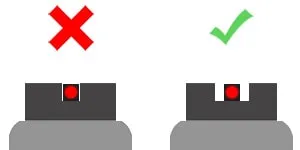
Sight alignment is your first big step in aiming with iron sights. Centre the front sight blade in the rear sight notch with equal space on both sides.
The top of the front sight should be level with the top of the rear sight. Most pistols use Patridge-style sights with a thick front blade and a square rear notch.
Common alignment errors include:
- Front sight too far left or right in the notch
- Front sight sitting too high or low compared to the rear sight
- Unequal spacing between the front sight and notch edges
Even a small alignment error can throw your shots off. A tiny tilt multiplies as distance increases.
Check your sight alignment before every shot. It's a habit worth building if you want consistency.
Establishing the Correct Sight Picture
The sight picture is what you see when your properly aligned sights are on the target. You place your aligned sights on your chosen point of aim to complete the visual reference.
A centre hold puts your front sight right on the centre of your target. This works if your sights are zeroed for the distance.
A combat hold places your front sight at the bottom edge of the target. Some shooters like this for faster target acquisition.
Your sight picture can change with different guns. Sights from different manufacturers vary in height, so you'll need to shoot some test groups to see where your shots land.
Set up targets at 10, 25, and 50 yards. Shoot from a steady rest and note where the bullets hit compared to your aim.
Front Sight Focus Techniques
Front sight focus is crucial for accurate iron sight shooting. Your eyes can only focus on one object at a time, and for this, it has to be the front sight as you press the trigger.
Hard front sight focus means you lock your attention on the front sight. The target and rear sight blur out in your peripheral vision—great for slow, careful shots.
Soft front sight focus lets your eyes bounce between the target and the front sight. It's fine when building your sight picture, but you need to snap your focus back to the front sight before breaking the shot.
The target should look a little fuzzy when you fire. Let your peripheral vision keep the front sight on target, while your central vision stays glued to the sight itself.
Focusing on the target instead of the front sight is a classic mistake. It usually leads to shots scattering around your intended point of impact.
Shooting Stance, Grip, and Eye Dominance
Your body position, hand placement, and knowing which eye takes the lead all come together to give you a stable base for accurate shots. These basics matter whether you're at the range or out in the field.
Correct Shooting Stance for Stability
A solid stance gives you balance and helps you handle recoil. Place your feet about shoulder-width apart and spread your weight evenly.
The isometric stance puts you square to the target with both arms extended. It's solid for precision shooting at still targets.
The Weaver stance sets your support-side foot forward and keeps your firing-side arm extended more than your support arm. Many shooters lean toward a modified Weaver or Chapman stance, putting your support-side foot forward about 30 centimetres and angling your body a bit toward your shooting side.
Bend your knees slightly to soak up recoil. Keep your upper body leaning forward at the waist.
This aggressive stance helps you control the gun, especially during rapid fire. It's not the only way, but it's a reliable starting point for most shooters.
Grip and Presentation
Your grip decides where the barrel points during recoil. Place your firing hand as high as you can on the backstrap, just shy of interfering with the slide or hammer.
Wrap your fingers firmly around the grip. Keep your trigger finger indexed along the frame.
Your support hand fills the remaining space on the grip. Press the palm of your support hand against the exposed portion of the grip.
Let your thumbs point forward along the frame. Apply firm pressure with both hands—about 60% with your support hand and 40% with your firing hand.
This high grip cuts muzzle rise and helps bring the sights back on target faster. When you present the firearm, bring it up to your eye level instead of lowering your head to meet the sights.
Extend your arms forward, but keep a slight bend at the elbows. That’s usually the sweet spot for control and comfort.
Determining Your Dominant Eye
Eye dominance affects how you align your sights with the target. Most folks have one eye that naturally takes over when both eyes are open.
To find your dominant eye, extend your arms and make a small triangle with your hands. Look at a distant object through this opening and slowly bring your hands back towards your face, keeping the object in view.
Your hands will drift toward your dominant eye almost without you thinking about it. You can also just point at something with both eyes open, then close each eye one at a time.
The eye that keeps your finger lined up with the object is your dominant eye. If you're cross-dominant—meaning your dominant eye is opposite your dominant hand—you’ve got options.
Try closing or squinting your non-dominant eye, turn your head slightly to bring your dominant eye behind the sights, or adjust your shooting stance to work with the mismatch. It’s awkward at first, but you’ll find what works.
Cheek Weld and Barrel Alignment
Cheek weld comes into play mostly with rifles and carbines. Rest your cheek in the same spot on the stock every time you shoot.
This repeatable anchor point lines up your eye and the sights. The barrel should naturally align with your line of sight if your cheek weld is right.
You shouldn’t have to crane your neck or tilt your head to see the sights. For pistols, keep your head upright and bring the gun up to eye level rather than dipping your head down.
Your eyes should sit roughly level with the top of the slide. Consistency in head position from shot to shot keeps your sight picture the same.
Even a small change in how you hold your head will shift your point of impact. It’s a detail that sneaks up on people sometimes.
Breath and Trigger Control for Consistent Accuracy
Mastering breath control and trigger squeeze really separates accurate shooters from those who just can’t seem to get consistent. The natural pause between breaths is the most stable moment to break a shot, and a smooth trigger press keeps your sight alignment steady.
Breath Control in Rifle and Pistol Shooting
Your breathing moves your whole body, which affects your sight picture. Take a normal breath, exhale naturally until your lungs are mostly empty, and in that brief pause before inhaling again, your body settles.
Timing your shots during the natural respiratory pause keeps muscle tension down and helps reduce tremors. Don’t hold your breath forcefully—it just builds strain and shakes.
Breathe normally as you prep your shot, then pause naturally when you’re ready to press the trigger. The trick is to develop a consistent rhythm: inhale, exhale, pause, shoot.
With repetition, this rhythm just becomes part of your process. It’s surprisingly calming, too.
Applying Proper Trigger Control
Squeezing the trigger in one smooth motion keeps your sight alignment steady. Jerking or slapping the trigger yanks your sights off target right as the round fires.
Rest the pad of your finger—not the joint—on the trigger. Apply steady, straight-back pressure until the shot breaks.
The shot should almost surprise you. If you know exactly when the gun will fire, you’re probably anticipating recoil and flinching.
Keep your grip solid but don’t choke the gun. Too much tension just creates tremors and kills your accuracy.
Focus on the trigger press and your sight picture at the same time. It’s a lot to juggle at first, but it gets easier.
Shooting Fundamentals and Follow-Through
Following through after each shot keeps your fundamentals tight and lets you spot mistakes. Hold the trigger to the rear for a moment after firing, then release it slowly and deliberately.
Stay in position and keep your sights on target. Don’t immediately lift your head or relax your stance—give it a second or two after firing.
Good follow-through also helps with recoil management. If you keep your grip and stance locked through the shot, you’ll get back on target quicker for follow-ups.
Calling the Shot
Calling the shot means knowing where your round will land based on your sight picture when the trigger breaks. As you follow through, pay attention to exactly where your front sight was at the moment of the shot.
This skill comes from practice and honest self-assessment. If your shot lands somewhere other than where you called it, you may need to adjust your sights.
If the impact matches your call but both are off-center, it’s time to revisit your fundamentals. Staying focused on the front sight when the shot breaks is key.
Adjusting and Zeroing Iron Sights
Getting your iron sights dialed in means lining up your point of aim with your point of impact. You’ll need to know how windage and elevation adjustments work, grab the right tools, and sometimes use holdover for longer distances.
How to Zero Iron Sights
Zeroing iron sights starts with a stable shooting position and solid fundamentals. Set up at your chosen distance—usually 25 yards for handguns or 50-100 yards for rifles, depending on what you’re planning to use them for.
Shoot a three-round group at your target, keeping your sight alignment and trigger control consistent. Check where your shots hit compared to your aiming point.
Your point of impact tells you what to adjust. Rear sight adjustments move the point of impact the same direction you move the sight—if you’re hitting low, raise the rear sight; hitting left, move it left.
Front sight adjustments work the opposite way. Move the front sight opposite of where you want the impact to go—if you’re hitting high, raise the front sight.
Make small tweaks between groups. Shoot another three rounds and check again. Repeat until your shots land right where you aim.
Iron Sight Adjustment Techniques
Different guns use different methods for adjusting iron sights. Some have fully adjustable sights, while others need drift adjustments or even swapping out sights.
Click-adjustable sights use dials or screws that move in tiny increments, often in minutes of angle (MOA). One MOA equals about an inch at 100 yards. Turn the dial in the direction shown by the markings.
Drift-adjustable sights need you to tap the rear sight left or right in its dovetail slot with a sight pusher or brass punch. Move slowly and check your progress often—easy to go too far.
Fixed-height front sights may need replacing if your elevation is way off. Taller front sights lower your point of impact, shorter ones raise it. Some folks file down front sights for minor tweaks, but that’s permanent, so think twice.
For windage, most rifles and pistols use the rear sight. AR-15 A2-style sights adjust windage at the rear drum, with each click moving the impact in the direction of the arrow.
Using Sight Adjustment Tools
The right tools save your sights and gun from damage during iron sight adjustment. A sight adjustment tool designed for your firearm makes everything easier and more accurate.
Sight pushers are a must for drift-adjustable handgun sights. They clamp onto the slide and use a screw to move the sight without scratching the finish. Never hit your sights directly with a metal punch—it’s just asking for trouble.
Armourer's wrenches fit AR-15 front sight posts and other adjustable rifle sights. The right size wrench keeps you from stripping adjustment screws. Sometimes a drop of oil helps with stubborn sights.
Bore sighting tools get you close before you even fire a shot. Pop a laser bore sighter into your chamber or barrel, then adjust your sights to line up with the laser dot at your target distance.
Bore sighting saves ammo but doesn’t replace live-fire zeroing. A small screwdriver set covers most click-adjustable sights—just use the right size to avoid chewing up the screws.
Managing Windage, Elevation, and Holdover
Once you’ve zeroed your sights at a set distance, you’ll have to compensate for bullet drop at longer ranges. Understanding holdover lets you hit targets past your zero without fiddling with your sights.
Holdover means aiming higher than your target to make up for bullet drop. Learn your ammo’s trajectory so you know how much to hold over at different distances.
A 25-yard zero on a pistol, for example, might mean aiming at the head to hit center mass at 50 yards. Kentucky windage is just holding left or right to compensate for wind instead of adjusting your sights.
Guess the wind speed and direction, then aim off as needed. It’s handy for quick shots when you don’t have time to dial in windage.
Sight height changes your trajectory, too. Higher sights create more offset between the bore and your line of sight, which affects where your bullet crosses the line of sight.
Most defensive rifle zeros take this into account with a 50/200-yard zero, so the bullet crosses your line of sight at 50 and again at 200 yards. During practice, track your point of impact at different ranges.
Mark how many inches high or low you hit at 10-yard intervals. A little notebook with this info makes quick holdover calculations way easier in the field.
Practice Drills and Applications
Structured practice builds the muscle memory and visual habits you need for real accuracy with iron sights. Specific drills prep you for everything from precision shooting at the range to high-pressure defensive situations.
Dry Fire Practice for Muscle Memory
Dry fire practice lets you work on fundamentals without burning through ammo or needing range time. You can drill trigger control, sight alignment, and breathing techniques right at home, building muscle memory that carries over to live fire.
Start with five minutes focused just on front sight clarity. Mount your firearm, line up the sights, and stare at the front sight for 30 seconds at a time.
This trains your eye to focus on the front sight, not the target. Give your eyes a quick rest between holds to avoid fatigue.
The wall drill is great for trigger control. Aim at a small mark on a blank wall and press the trigger while watching the front sight.
If the sight moves, your trigger press needs work. Do this 10 to 15 times per session.
Try balancing a coin on your front sight or barrel while dry firing. The coin should stay put through the trigger press—if it falls, you’re moving the gun.
Most people find this drill tough at first, but you’ll see real improvement after a week or so of daily practice. Stick with it, and your live fire results will show it.
Accuracy in Precision and Defensive Shooting
Precision shooting with iron sights calls for a different approach than defensive shooting. Precision work is all about slow, careful sight alignment, putting your focus hard on the front sight.
You’ve got time to line things up before each shot. For precision drills, try five-shot groups at 25 yards with a rifle or 15 yards with a pistol.
Measure your group size and see how you improve. Forget about speed for these—just concentrate on perfect sight alignment and let each shot surprise you.
Defensive shooting is a different animal. Here, you’re after good-enough accuracy as fast as you can get it.
The flash sight picture technique is great for close-range defensive work. Practice snapping your sights up and firing as soon as you get just enough alignment for a center-mass hit.
At seven yards, that may mean shooting as soon as the front sight pops up in your vision and lines up with the target. Transition drills are handy for building speed without losing too much accuracy.
Start with a slow, precise technique, then shave time off shot by shot while keeping an eye on your group size. The trick is finding the fastest pace where your accuracy is still good enough for your needs.
Hunting and Field Techniques
Hunting with iron sights is a different beast than bench shooting. Most hunting shots don’t happen from a bench—they’re from standing, kneeling, or some improvised rest.
Practice those field positions often so you’re stable without artificial support. The hasty sling technique can really help with stability.
Wrap your sling around your support arm and pull it tight. That tension steadies your rifle for offhand shots.
Work on mounting your rifle with the sling already engaged until it feels automatic. Moving target drills are worth your time, too.
Get a swinging target going, or have a buddy move something across your field of view. Practice tracking the target smoothly and keeping your sights aligned.
Lead the target a bit and press the trigger during a natural pause in your breathing. Honestly, that’s about as close to real hunting as you can get in practice.
Improving With BUIS and Modern Backups
Backup iron sights (BUIS) need their own training since they don’t work quite like primary sights. Most BUIS setups sit lower, so your sight picture and head position change a bit.
Practice switching over to your backup irons after a pretend optic failure. Co-witness drills help you get used to seeing your red dot and iron sights at the same time.
With absolute co-witness, your irons and red dot line up at the same height. Lower third co-witness puts your irons down in the bottom third of your optic window.
Practice picking up your iron sights through your optic quickly. Flip-up BUIS deserve some attention, too.
Work on flipping up both the front and rear sights fast, then getting your sight picture. Try to make that transition in under two seconds.
Some shooters just leave the rear sight up all the time for quicker transitions, but keep the front folded to avoid snagging. Spend time training with your BUIS folded down and your optic covered.
That’s the only way to know if you can actually hit anything with your backups, rather than just carrying them for peace of mind. Maybe take a quarter of your normal optic practice time and dedicate it to iron sight work—it’s worth it.
Advanced Tips: Fine-Tuning and Overcoming Common Issues
Getting truly accurate with iron sights means understanding sight radius, managing recoil, handling low-light with tritium sights, and fixing alignment mistakes. There’s a lot to juggle, honestly.
Sight Radius and Its Effect on Precision
Sight radius—distance between front and rear sights—matters more than you’d think. A longer sight radius makes it way easier to catch alignment mistakes because even tiny errors stick out.
Pistols usually have shorter sight radii than rifles, which is a big reason handguns are just plain harder to shoot well. If you want precision, go with a longer barrel.
The extra distance between sights gives you better feedback on your alignment. Here’s a quick breakdown:
- Longer radius = easier to spot mistakes, more precise shots
- Shorter radius = less forgiving, demands more attention
On pistols, every millimeter you’re off at the rear sight turns into centimeters of error at the target. That’s why you’ve got to be absolutely dialed in with your sight picture on handguns.
Managing Recoil
If you want your sights to stay on target for follow-up shots, you need to manage recoil well. Grip the gun firmly—don’t strangle it, but don’t go loose either.
Consistency is the name of the game. A solid grip helps you control muzzle rise and lets you get your sights back quickly.
Stance matters, too. Lean forward a bit so your whole body, not just your arms, takes up the recoil.
Keep your shoulders square and your platform steady. Trigger control is another big one.
If you jerk the trigger, your sights will jump before the bullet even leaves the barrel. Press the trigger straight back and keep your sight picture steady until the shot breaks.
Dealing With Low Light and Tritium Sights
Shooting in low light is tough because you just can’t see your iron sights well. Tritium sights help—they glow on their own without batteries or any external light.
These self-luminous dots make it possible to keep your sights aligned even in the dark. Tritium colors vary a bit:
- Green (brightest, easiest for most eyes)
- Yellow/amber (medium visibility)
- Orange (less common, a little dimmer)
Give your eyes a few seconds to adjust if you’re moving from bright light into shadow. Your pupils need time to open up before you take a shot.
Even with glowing dots, you still need to focus on the front sight. The tritium just helps you see it—it doesn’t magically fix bad technique.
Troubleshooting Alignment Errors
Alignment mistakes tend to cause your shots to miss in the same direction every time. If your shots go left, odds are your front sight is too far left in the rear notch.
Low groups usually mean you’re not raising the front sight enough. Here’s a quick cheat sheet:
Shot PlacementLikely CauseCorrectionLeft of centreFront sight too far leftMove front sight right in notchRight of centreFront sight too far rightMove front sight left in notchBelow centreFront sight too lowRaise front sight in notchAbove centreFront sight too highLower front sight in notch
Most of the time, poor focus causes these errors. If you focus on the target instead of the front sight, you can’t judge alignment well.
Always bring your focus back to the front sight before you pull the trigger. It’s easy to forget, but it makes a huge difference.
Frequently Asked Questions
Proper sight alignment means equal height and equal light with your front sight centered in the rear notch. Accuracy really comes down to keeping your focus on the front sight through your trigger press and follow-through.
What is the correct sight picture and sight alignment for iron sights?
Proper sight alignment means lining up the front sight post so its top matches the top of the rear sight. That’s equal height.
You want equal light on both sides of the front post in the rear notch. The gaps should look the same on each side.
Your eye can only focus sharply on one thing. Keep your focus on the front sight and let the rear sight and target blur a bit.
For handguns, a center-mass sight picture puts the front sight right on your aiming point. A six o’clock hold puts it just below the bullseye, which works for target shooting with adjustable sights.
How should I position my front sight for consistent accuracy at different distances?
You might need to tweak your sight picture depending on distance and ammo. Start at 10 yards to see where your shots land compared to where you’re aiming.
Most factory handguns with fixed sights hit center-mass at 10 to 25 yards. At closer range, you’ll probably see bullets hitting a bit high.
For defensive shooting, stick with a center-mass hold at all practical distances. Put the top of the front sight right where you want the bullet to go.
Rifle iron sights work best if you center the front post in the rear aperture. The post’s height in the aperture changes your point of impact as you shoot at different distances.
What grip and stance adjustments help keep the sights steady during the shot?
A firm, steady grip keeps the gun from shifting during recoil. Squeeze hard enough for control, but not so hard you shake.
Spread your weight evenly in your stance. Lock your elbows, but don’t hyperextend—just enough to be stable.
For rifles, pull the gun slightly back into your shoulder pocket. That tension helps absorb recoil and stops the sights from bouncing around.
Keep your head upright and bring the sights up to your eye. Don’t hunch down to the sights—it just adds tension and shakes.
How do I control my trigger press without disturbing the sight alignment?
Press the trigger straight back in one smooth motion. Any sideways pressure will drag your sights off target.
Keeping your sights aligned while pressing the trigger is all about steady, even pressure. Don’t jerk or slap the trigger.
Place your trigger finger between the pad and first joint for the most control. That’s the sweet spot for most people.
Keep pressing through the break and try not to anticipate the shot. If you flinch, your sight picture will suffer.
What is the best way to manage breathing and follow-through when aiming with iron sights?
Breathe normally as you set up your sight picture. Pause your breath at the natural break after an exhale.
Shoot during that short pause when your body is stillest. Don’t hold your breath too long—tension and shakes creep in fast.
Keep your eyes on the front sight through the shot and recoil. If you’ve got your form right, your sight picture will settle back where it started.
Follow-through means holding your trigger press and sight picture for a beat after the shot. It helps you avoid anticipating recoil and pulling shots off target.
How can I diagnose and correct common shot group errors, such as low-left or high-right impacts?
Low-left hits for right-handed shooters? That usually means you're jerking the trigger or maybe anticipating recoil. Try focusing on a smoother trigger press—don't flinch, just let it break naturally.
High-right impacts can sneak in if you push the pistol forward while pressing the trigger. Keep your grip steady the whole time; don't let the pressure shift as you shoot.
If you're seeing consistent low hits, chances are you're dipping the muzzle during the trigger press. Make sure your front sight stays level, all the way through the shot.
When your shots are scattered everywhere with no pattern, it's probably time to revisit the basics. Go back to proper sight alignment practice and mix in some dry fire drills until things start to click again.