Most Used Assault Rifles in the Modern World: Key Models and Features
Discover the most widely used assault rifles in the modern world, their key features, and why certain models dominate military forces across the globe.
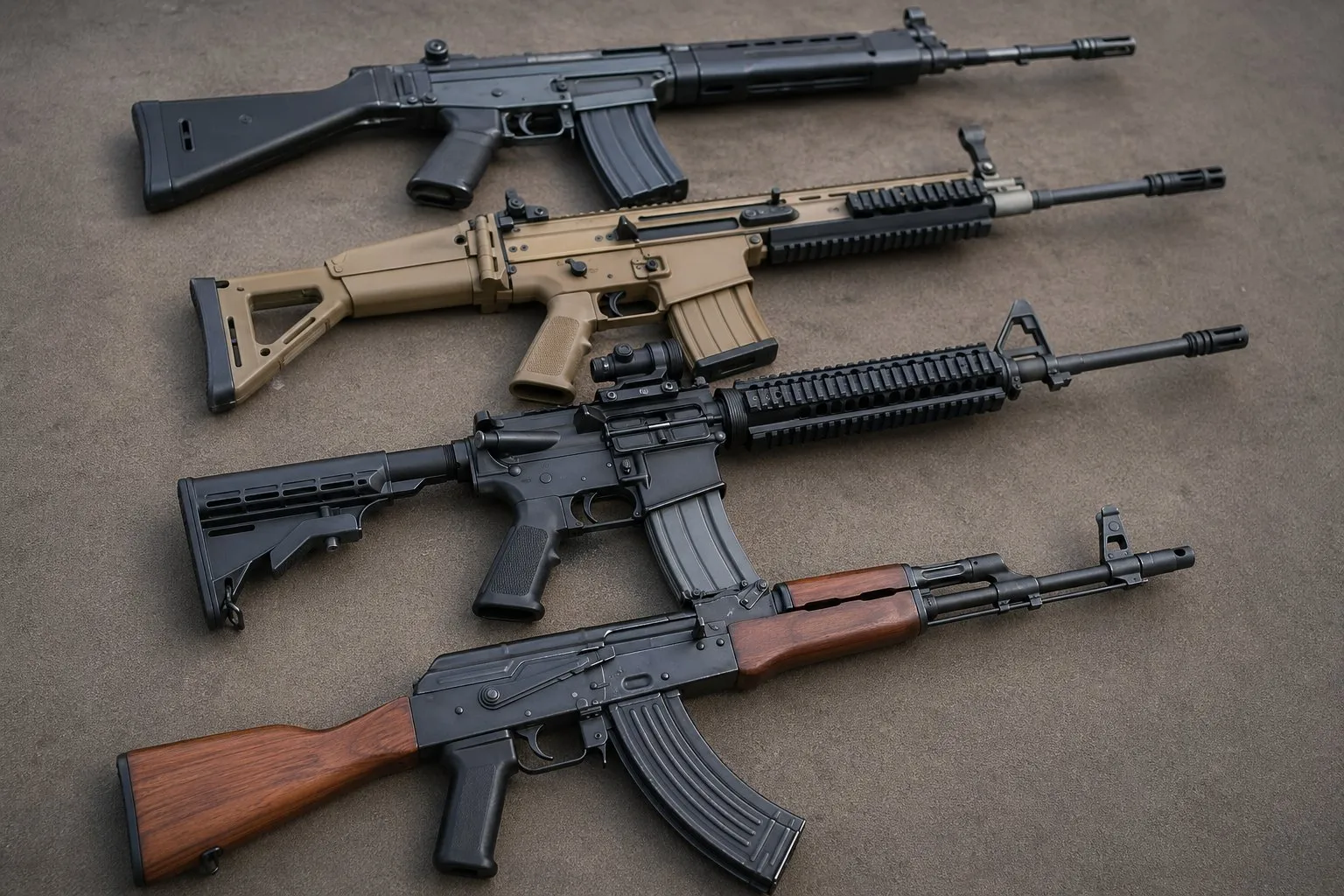
Most Used Assault Rifles in the Modern World: Key Models and Features
Assault rifles have become the standard weapon for military forces across the globe. These firearms are defined by specific features: they must have selective fire capability, use an intermediate-power cartridge, feed from a detachable magazine, and maintain an effective range of at least 300 metres. The most widely used assault rifles in the modern world include the AK-47 and its variants, the M4 Carbine, and newer platforms like the HK416, which together equip millions of soldiers across dozens of nations.
Understanding which assault rifles dominate modern militaries requires looking at both historical significance and current deployment numbers. The Kalashnikov family of rifles remains the most prolific, whilst Western forces have largely standardised around AR-15 derivatives. Regional preferences also play a major role, with European nations often selecting different platforms than Asian or Middle Eastern countries.
The landscape of military small arms continues to evolve with new calibres and modular designs entering service. Recent developments show a shift towards adaptable weapon systems that can be configured for different missions, alongside experiments with new intermediate cartridges that promise better performance than traditional 5.56mm or 7.62mm rounds.
Key Takeaways
- Modern assault rifles must meet strict criteria including selective fire, intermediate cartridges, and detachable magazines
- The AK-47 variants and M4 Carbine remain the most widely deployed assault rifles globally
- New modular platforms and experimental calibres are reshaping military small arms preferences
Essential Characteristics of Modern Assault Rifles
Modern assault rifles share specific technical features that define their role as standard infantry weapons. These rifles combine selective fire capability with intermediate-power ammunition, gas-operated systems, and adaptable designs that accommodate different users and mission requirements.
Selective Fire Capabilities
Selective fire stands as the defining feature separating assault rifles from semi-automatic rifles. This mechanism allows you to switch between firing modes, typically semi-automatic and fully automatic or burst fire.
In semi-automatic mode, the rifle fires one round with each trigger pull. This setting gives you greater accuracy and ammunition conservation during precise engagements. Fully automatic mode enables continuous firing whilst you hold the trigger, delivering suppressive fire in close-quarters combat situations.
The fire selector switch, usually located near the trigger guard, lets you adapt your weapon to different tactical scenarios. Some modern platforms include a three-round burst option as a middle ground between semi-automatic precision and fully automatic volume of fire. This selective fire capability distinguishes true assault rifles from civilian semi-automatic variants that only fire one shot per trigger pull.
Intermediate Cartridges Explained
Intermediate cartridges bridge the gap between pistol rounds and full-power rifle ammunition. These cartridges provide more stopping power than handgun ammunition whilst generating less recoil than battle rifle rounds.
The most common intermediate cartridges include 5.56×45mm NATO and 7.62×39mm. The 5.56mm cartridge offers flatter trajectories and lighter weight, allowing you to carry more ammunition. The 7.62×39mm delivers greater stopping power at shorter ranges.
This ammunition class enables controllable automatic fire, which would be nearly impossible with full-power rifle cartridges. You can maintain accuracy during rapid fire whilst the reduced weight lets you carry sufficient ammunition for extended operations. The effective range typically extends to 300-400 metres, matching most infantry engagement distances.
Gas-Operated Mechanisms
Gas-operated systems power the automatic cycling of modern assault rifles. When you fire, some propellant gas diverts through a port in the barrel to drive the action.
This gas pushes against a piston or directly against the bolt carrier, cycling the action to extract the spent case, cock the hammer, and chamber a new round. The system provides reliable operation across varying environmental conditions and ammunition types.
Direct impingement systems route gas directly into the bolt carrier, whilst piston systems use a separate rod to transmit force. Each approach offers distinct advantages in terms of cleanliness, weight, and reliability. The gas system's adjustable settings let you tune the rifle for different ammunition loads or suppressor use.
Modular Design and Ambidextrous Controls
Modular assault rifle platforms accommodate mission-specific configurations through interchangeable components. You can swap barrels, stocks, handguards, and optics mounting systems to match operational requirements.
Standard modularity features include:
- Picatinny or M-LOK rails for accessories
- Quick-change barrel systems for different lengths
- Adjustable stocks for various body armour configurations
- Convertible calibre options through upper receiver changes
Ambidextrous controls serve both left- and right-handed shooters without modification. Modern designs position magazine releases, charging handles, safety selectors, and bolt catches for access from either side. This design consideration proves essential in close-quarters environments where you might fire from unconventional positions.
Detachable box magazines enable rapid reloading whilst carrying spare ammunition efficiently. Standard capacities range from 20 to 30 rounds, though extended magazines are available for sustained operations.
Iconic and Widely Deployed Assault Rifles by Region
Different regions favour distinct rifle platforms based on historical ties, manufacturing capability, and operational requirements. The Kalashnikov series dominates Eastern Europe and Africa, whilst Western nations primarily field American and German designs alongside innovative bullpup configurations from Austria.
AK-47 and the Kalashnikov Legacy
The AK-47 remains the most widely distributed assault rifle globally, with an estimated 100 million units produced since 1947. Mikhail Kalashnikov's original design prioritised reliability over precision, creating a weapon that functions in extreme conditions with minimal maintenance.
The gas-operated design uses a long-stroke piston system that handles dirt, sand, and moisture better than most competitors. You'll find the AK-47 as the standard service rifle in most modern militaries across former Soviet states and developing nations.
Modern Kalashnikov variants include:
- AK-74 - Chambered in 5.45×39mm for reduced recoil
- AK-103 - Updated 7.62×39mm version with modern furniture
- AK-12 - Current Russian service rifle featuring improved ergonomics and Picatinny rails
The Kalashnikov platform's simplicity allows for low-cost production and field repairs with basic tools. This accessibility explains why you encounter AK variants across Africa, the Middle East, and Southeast Asia more than any other rifle design.
M16 and the M4 Family
The M16 transformed American infantry doctrine when it entered service during the Vietnam War. Eugene Stoner's ArmaLite AR-15 design became the M16A1, featuring a lightweight aluminium receiver and direct impingement gas system that reduced weapon weight significantly.
Your modern M16A2 introduced burst fire mode and improved rear sights in 1982. The rifle fires 5.56×45mm NATO rounds from 30-round detachable magazines with an effective range exceeding 500 metres.
The M4 carbine and M4A1 variant represent the current standard for U.S. forces. These shortened versions maintain the AR-15 operating system whilst offering better manoeuvrability in vehicles and urban environments. The M4A1 provides fully automatic fire capability instead of the three-round burst found on earlier M4 models.
Key advantages of the M4 platform:
- Modular design accepts numerous accessories
- Lower recoil than 7.62mm battle rifles
- Proven reliability when properly maintained
- Extensive aftermarket support
Heckler & Koch Innovations: G36 and HK416
German engineering brought precision manufacturing to assault rifle design through Heckler & Koch. The company's G3 battle rifle established their reputation, but the G36 and HK416 represent their modern contributions to intermediate-calibre platforms.
The Heckler & Koch G36 serves as Germany's standard infantry weapon since 1997. Its polymer construction reduces weight whilst integrated optical sights provide quick target acquisition. You'll notice the G36 features a short-stroke gas piston system that runs cleaner than direct impingement designs.
The Heckler & Koch HK416 improves upon the AR-15 platform by replacing the direct impingement system with a gas piston operating system. This modification reduces carbon fouling in the bolt carrier group and improves reliability in adverse conditions. France, Norway, and numerous special operations units worldwide have adopted the HK416 as their primary rifle.
Both platforms demonstrate how German manufacturers refined existing concepts rather than creating entirely new operating systems.
Steyr AUG and Bullpup Designs
The Steyr AUG introduced bullpup design to mainstream military service in 1977. This bullpup rifle places the action and magazine behind the trigger group, allowing you to maintain a full-length barrel whilst reducing overall weapon length by approximately 25 per cent.
Austria's Steyr AUG A3 remains in service across multiple continents. The compact assault rifle measures just 790mm in length whilst retaining a 508mm barrel - dimensions impossible to achieve with conventional layouts. You gain improved manoeuvrability in vehicles and confined spaces without sacrificing ballistic performance.
Bullpup assault rifle characteristics:
FeatureAdvantageCompact lengthEnhanced urban combat capabilityFull-length barrelMaintained velocity and accuracyBalance pointCentred weight distribution
The bullpup design does present challenges. Your trigger mechanism requires a longer linkage to the action, potentially affecting trigger quality. Magazine changes occur closer to your face, and ejection port location complicates ambidextrous operation on older models.
Recent Advancements and Modular Platforms
Modern assault rifles have embraced modular designs that allow soldiers to adapt weapons for different missions without changing the entire platform. The FN SCAR series delivers battlefield flexibility through interchangeable barrels and calibres, whilst SIG Sauer's MCX platform offers tool-free configuration changes, and Israel Weapon Industries has refined the bullpup concept with the Tavor series.
FN SCAR Series: SCAR-L and SCAR-H
FN Herstal developed the Special Operations Forces Combat Assault Rifle (SCAR) to replace multiple weapon systems with a single adaptable platform. The SCAR-L fires 5.56×45mm NATO rounds for standard infantry operations, whilst the SCAR-H chambers the more powerful 7.62×51mm NATO cartridge for longer-range engagements.
Both variants share approximately 90% of their components, which simplifies logistics and training. You can quickly swap barrels between close-quarters (254mm), standard (355mm), and long-range (508mm) lengths without specialised tools.
The FN SCAR L MK2 represents the latest evolution with improved ergonomics and a lighter profile. The rifle features multiple Picatinny rail sections that let you mount optics, lasers, and grips based on mission requirements. Special operations units worldwide have adopted SCAR variants because they can configure a single weapon system for diverse tactical scenarios.
SIG Sauer: MCX and SIG SG 550
The SIG MCX platform uses a short-stroke gas piston system that reduces recoil and improves reliability in harsh conditions. You can change the MCX's calibre, barrel length, and stock configuration in minutes without any gunsmithing.
The SIG MCX Spear recently won the U.S. Army's Next Generation Squad Weapon programme as the XM7. This variant chambers the new 6.8×51mm round, which provides better performance against body armour at extended ranges.
The earlier SIG SG 550, developed in Switzerland, pioneered modular thinking with its folding stock and integrated bipod. Modern military AR platforms incorporate advanced materials that make these rifles lighter whilst maintaining durability. The MCX line builds on these innovations with ambidextrous controls and suppressor-ready designs that suit both right and left-handed shooters.
Tavor Series and IWI Innovations
Israel Weapon Industries (IWI) produces the Tavor TAR-21 and its successor, the Tavor X95, which place the action behind the trigger in a bullpup configuration. This design gives you a full-length barrel in a package 25% shorter than conventional rifles.
The X95 improved upon the original TAR-21 with relocated controls that work better for soldiers trained on traditional layouts. You'll find the magazine release and charging handle positioned for quicker manipulation under stress.
IWI also modernised the Galil platform with the Galil ACE series, which evolved from the original Galil ARM and Galil AR models. The ACE variants offer improved accuracy and reduced weight whilst maintaining the legendary reliability of the AK-47-derived action. These rifles feature NATO-standard accessory rails and come in 5.56×45mm, 7.62×39mm, and 7.62×51mm chamberings to suit different operational requirements.
Ammunition, Magazine, and Calibre Trends
Modern assault rifles predominantly use intermediate cartridges that balance power, recoil, and ammunition weight, with 5.56×45mm NATO remaining the most common calibre globally. Magazine capacity typically ranges from 20 to 30 rounds, though high-capacity options exist for specific tactical requirements.
Common Assault Rifle Calibres
The 5.56×45 mm NATO dominates Western military forces due to its manageable recoil and lighter weight, allowing soldiers to carry more ammunition. This round achieves high muzzle velocity, making it effective at medium ranges.
Eastern Bloc countries and their export markets favour the 7.62×39mm cartridge, which delivers greater stopping power at shorter distances. The Russian 5.45×39mm represents an intermediate option that reduces recoil whilst maintaining effectiveness.
The 7.62×51 mm serves in designated marksman rifles rather than standard assault rifles. Early assault rifles used full-power rifle cartridges like 7.62×54mmR and .30-06 Springfield, but militaries shifted to intermediate cartridges for better control during automatic fire.
Your choice of calibre depends on operational requirements, with lighter rounds suited for extended patrols and heavier rounds preferred for close-quarters engagements.
Magazine Capacity and Reliability
Assault rifles use detachable box magazines as a defining characteristic, with the 30-round magazine serving as the standard capacity across most platforms. This capacity provides sufficient firepower without excessive weight or bulk.
The detachable magazine system allows rapid reloading under combat conditions. Some specialised applications employ drum magazines like the C-Mag, which holds 100 rounds but adds significant weight and reliability concerns.
Magazine reliability directly affects weapon performance. Metal magazines offer durability, whilst polymer designs reduce weight. Feed lips and springs require proper maintenance to prevent jams during critical moments.
Performance in Urban and Modern Warfare
Urban warfare demands different characteristics than open-field combat. The 5.56×45mm excels in urban combat due to reduced over-penetration risks and lighter ammunition loads that matter when clearing buildings.
Modern warfare scenarios favour rifles with modular designs that accept various magazine types and calibres. Shorter barrels improve manoeuvrability in tight spaces, though this reduces muzzle velocity and effective range.
You'll find that intermediate cartridges perform well at the 50-300 metre engagement distances typical in contemporary conflicts. Higher capacity magazines become valuable during sustained firefights, but standard 30-round magazines remain the practical choice for most operations.
Specialised and Niche Assault Rifle Systems
Some military units require weapons that go beyond standard assault rifle capabilities. These specialised systems include full-power battle rifles for long-range engagements, compact platforms optimised for close-quarters operations, and modular designs that integrate grenade launchers and tactical accessories.
Battle Rifles and Their Role
Battle rifles fire full-power cartridges rather than the intermediate rounds used in assault rifles. These weapons deliver greater range and stopping power at the cost of increased recoil and weight.
The distinction matters in specific combat situations. Whilst assault rifles typically engage targets up to 300 metres, battle rifles remain effective beyond 600 metres. This makes them valuable for designated marksmen who need precision fire without carrying a dedicated sniper rifle.
Modern battle rifles like the FN SCAR-H and HK417 bridge the gap between assault rifles and light machine guns. They provide sustained accurate fire in open terrain where intermediate cartridges lose effectiveness. Some forces issue these weapons to squad marksmen whilst the rest of the unit carries standard assault rifles.
The increased ammunition weight limits the number of rounds soldiers can carry. This trade-off restricts battle rifles to specific roles rather than general infantry use.
Assault Rifles in Close-Quarters Combat
Compact assault rifle variants excel in urban environments and vehicle operations. These shortened platforms maintain the firepower of full-size rifles whilst improving manoeuvrability in confined spaces.
You'll find these weapons differ from submachine guns, which fire pistol cartridges. Short-barrelled assault rifles retain intermediate rifle cartridges for superior penetration and range. The AKS-74U and M4 carbine demonstrate how manufacturers reduce barrel length and stock designs without sacrificing tactical effectiveness.
Key modifications for close-quarters include:
- Collapsible or folding stocks
- Barrels shortened to 250-300mm
- Integrated suppressors for reduced signature
- Rail systems for mounting lights and optics
These compact systems trade some velocity and accuracy at distance for speed in tight environments. Special operations forces favour these variants when clearing buildings or operating from vehicles where a full-length rifle becomes unwieldy.
Integration with Grenade Launchers and Accessories
Modern assault rifles function as modular platforms that accept various attachments. Underbarrel grenade launchers transform standard rifles into dual-purpose weapons without requiring soldiers to carry separate systems.
The M203 and AG36 attach beneath the barrel, allowing you to engage targets behind cover or in defilade. These 40mm launchers add approximately 1.5 kilograms but provide indirect fire capability at squad level. Some designs integrate advanced systems like the South Korean K11, which combines a rifle with a smart grenade launcher in a single unit.
Common integrated accessories include:
- Optical sights and thermal imagers
- Tactical lights and laser designators
- Suppressors for signature reduction
- Bipods for sustained fire
Rail systems on modern rifles let you configure weapons for specific missions. This modularity means the same base rifle serves multiple roles, from close-quarters combat to designated marksman duties, simply by changing attachments.
Global Adoption and Military Impact
Military forces worldwide have standardised assault rifles as their primary infantry weapons, with specific models dominating different regions based on reliability, cost, and tactical requirements. The choice of service rifle shapes how both regular infantry and special forces operate in combat situations.
Assault Rifles as Standard Service Weapons
When you examine military arsenals globally, certain rifles appear repeatedly as standard issue weapons. The US military transitioned from the M16 to primarily using the M4 carbine for frontline units, with approximately 8 million M16 units produced by 2011. In April 2022, the US Army selected the SIG MCX SPEAR as its next-generation platform.
European forces have taken different paths. France ordered 117,000 HK416F rifles to replace the FAMAS, whilst Germany acquired 118,718 HK416A8 rifles designated as the G95A1 and G95KA1 variants. Poland developed the MSBS Grot rifle domestically, ordering 46,000 units with deliveries through 2029.
Sweden and Finland collaborated on the Sako M23 family, with Sweden procuring 37,500 AK24 rifles to replace both the AK5 assault rifle and AK4 battle rifle. This shows how nations balance between importing proven designs and maintaining domestic production capabilities.
Influence on Special Forces and Regular Infantry
You'll find that special forces often adopt different weapons than regular infantry, prioritising modularity and specialised features. The HK416 serves both roles, equipping German Special Forces as the G95 before becoming the standard infantry rifle. Ukrainian forces have received diverse weapons including Belgian FN SCAR-L rifles, Austrian Steyr AUGs, and Polish MSBS Grot systems, demonstrating how modern assault rifle programmes vary between nations.
Carbines like the Colt Canada C7 and C8 have been supplied to Ukraine alongside full-length rifles, giving you insight into how different barrel lengths suit various tactical roles. The conflict revealed that operational wastage from combat damage creates constant demand for replacement weapons, which led Ukraine to begin local assembly of the CZ BREN 2 in December 2024.
Future Trends and Emerging Contenders
The introduction of new calibres represents a significant shift in assault rifle development. The US Army's adoption of the 6.8×51mm round for the XM7 breaks from decades of 5.56×45mm standardisation, though concerns exist about forcing NATO allies to follow suit.
Modular systems are becoming more prevalent. Poland's MSBS platform offers interchangeable components for assault rifle, carbine, and squad automatic weapon variants in both 5.56×45mm and 7.62×39mm calibres. Finland and Sweden's collaborative M23 programme includes assault rifles, designated marksman rifles, and sniper rifles sharing common components.
You're seeing nations choose between domestic production and foreign procurement. Whilst France outsourced to Heckler & Koch, Poland maintained indigenous capabilities with the Grot system. This trend towards either complete self-reliance or full outsourcing marks a departure from previous licensed production arrangements.
Frequently Asked Questions
Modern military forces rely on specific assault rifle platforms based on performance standards, compatibility requirements and proven combat effectiveness. Understanding the distinctions between NATO and Russian systems helps explain global adoption patterns.
Which assault rifles are most commonly issued to modern military forces worldwide?
The AK-47 and its variants remain the most widely used assault rifles globally, with approximately 100 million Kalashnikov-family weapons in circulation worldwide. The M16 and M4 platforms dominate amongst NATO forces and their allies.
You'll find the AK-74M serving as Russia's standard infantry rifle, whilst the Type 56 equips Chinese forces. India's military uses the INSAS rifle alongside imported AK variants.
Special operations units often select the HK416 or similar platforms for enhanced reliability. The FN SCAR has gained adoption amongst multiple countries' elite forces.
How do the M4 Carbine and M16 compare in reliability, accuracy and battlefield performance?
The M4 Carbine offers superior manoeuvrability with its shorter 14.5-inch barrel compared to the M16's 20-inch barrel. You'll experience easier handling in close-quarters combat and vehicle operations with the M4.
Both rifles share the same direct impingement gas system and fire 5.56×45mm NATO ammunition. The M16 provides better accuracy at extended ranges beyond 300 metres due to its longer sight radius and barrel length.
The M4's compact design makes it 10 centimetres shorter and approximately 0.7 kilograms lighter than the M16. You sacrifice some muzzle velocity with the M4, reducing effective range slightly.
Combat experience shows both platforms perform reliably when properly maintained. The M4 has largely replaced the M16 in frontline service whilst retaining the same operational principles.
Why has the HK416 been adopted by so many armed forces and special units?
The HK416 uses a short-stroke gas piston system instead of direct impingement, reducing fouling in the bolt carrier group. You get improved reliability in adverse conditions without constant cleaning requirements.
Elite military units including the U.S. Navy SEALs, French special forces and Norwegian Armed Forces have adopted the HK416. The rifle maintains M16/M4 ergonomics whilst addressing reliability concerns.
German engineering standards ensure tight manufacturing tolerances and consistent performance. You'll find the HK416 operates effectively in extreme temperatures, sandy environments and after water immersion.
The free-floating barrel design enhances accuracy compared to standard M4 platforms. Special operations forces value this precision for engagements requiring first-round hits.
What factors determine whether an assault rifle becomes widely used internationally?
Manufacturing costs significantly influence adoption rates, as countries need to equip large numbers of infantry soldiers. The AK-47's simple stamped-steel construction allowed mass production at lower expense than machined rifles.
Political alliances and military aid programmes spread specific platforms to allied nations. You'll notice former Soviet states predominantly use Kalashnikov variants, whilst NATO members standardise on 5.56mm platforms.
Proven combat performance builds confidence in specific designs. The reliability demonstrated by both AK and M16 families during decades of conflicts established their dominance.
Licensing agreements and domestic production capability affect adoption decisions. Countries often select rifles they can manufacture locally rather than importing finished weapons.
Ammunition standardisation within military alliances requires compatible chamberings. Your choice of rifle platform often depends on existing logistics infrastructure and stockpiled ammunition.
Which modern assault rifles are considered the most effective overall, and why?
The AK-47 and M16 designs and their derivatives represent the two most successful assault rifle platforms in history. These systems dominate global military service due to proven reliability and widespread support infrastructure.
The HK416 combines M4 familiarity with enhanced reliability through its piston system. You get improved durability without retraining soldiers accustomed to AR-15 pattern controls.
The FN SCAR offers true multi-calibre capability, allowing conversion between 5.56mm and 7.62mm configurations. This versatility suits special operations requiring different engagement ranges.
Israel's Tavor provides bullpup compactness without sacrificing barrel length. You maintain rifle-calibre performance in a package shorter than traditional carbines.
Effectiveness depends on your operational requirements rather than absolute superiority. Cold-weather operations favour piston-driven systems, whilst desert environments demand different maintenance protocols.
What are the key differences between NATO-standard and Russian-pattern assault rifles in current service?
NATO assault rifles predominantly chamber 5.56×45mm ammunition, emphasising lighter weight and higher velocity. You carry more rounds for the same load compared to larger calibres.
Russian-pattern rifles use 7.62×39mm or 5.45×39mm cartridges with different ballistic characteristics. The 7.62mm round delivers greater mass and penetration at shorter ranges.
Gas operation systems differ fundamentally between platforms. AK variants use long-stroke gas pistons, whilst many NATO rifles employ direct impingement or short-stroke systems.
Manufacturing philosophy separates the two approaches. You'll find looser tolerances in Kalashnikov rifles, allowing reliable function when dirty but reducing precision potential.
Ergonomic layouts reflect different design priorities. NATO rifles typically feature straight-line stocks reducing muzzle climb, whilst AK patterns use angled stocks and separate pistol grips.
Magazine compatibility creates logistical barriers between systems. You cannot interchange ammunition or spare parts between NATO and Russian platforms without modification.