MP5 Submachine Gun Explained: History, Specs & Famous Variants
From elite military units to Hollywood fame, this guide breaks down the MP5’s history, features, and most iconic variants in simple terms.
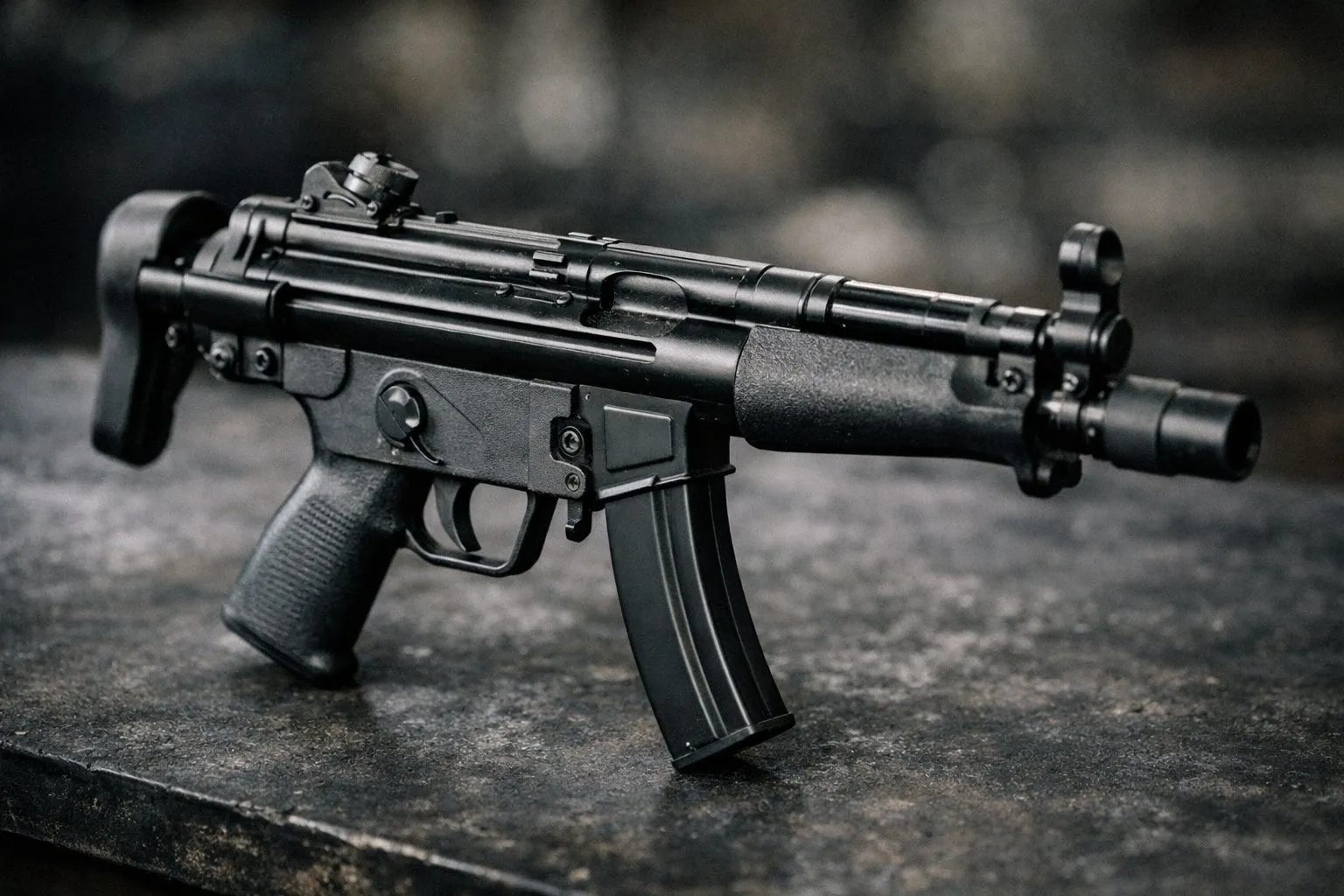
MP5 Submachine Gun: Features, History, and Variants Explained
The Heckler & Koch MP5 stands out as one of the most recognisable firearms in modern history. Developed in the 1960s, this German-made submachine gun quickly became the weapon of choice for elite military and police units worldwide.
The MP5's reputation for reliability, accuracy, and compact design made it the go-to close-quarters weapon for special forces for decades.
What really sets the MP5 apart? Its unique roller-delayed blowback system and modular construction. You can configure it for almost any tactical situation.
The 9mm submachine gun fires from a closed bolt, offering precision that rivals some rifles. From the compact MP5K to the suppressed SD variants, this weapon system has proven itself in countless real-world operations.
If you’ve ever wanted to see what makes this firearm so effective, you can actually fire the MP5 yourself at Churchill Shooting Budapest. Understanding why special operations units from the US Navy SEALs to Germany’s GSG9 still trust this weapon means looking at its technical design, operational history, and the many variants that make it so adaptable.
Key Takeaways
- The MP5's roller-delayed blowback system and closed bolt design deliver exceptional accuracy and reliability in close-quarters combat.
- There are over 100 variants, from compact personal defence weapons to suppressed models, making it adaptable to almost any tactical need.
- Special forces and police units in more than 50 countries still use the MP5.
MP5 Submachine Gun Overview
The MP5 submachine gun came out of German engineering in the 1960s and quickly became the world’s most recognised 9mm automatic weapon. Its development combined proven rifle technology with a compact frame, and a handful of engineers really changed the game for military small arms design.
Origins and Development
Heckler & Koch started developing the MP5 in 1964, spotting a chance to adapt their roller-delayed blowback system into a submachine gun. This mechanism already worked well in the G3 battle rifle, so it brought reliability and precision to the new weapon.
The first prototype was called the HK54. By 1966, the weapon got its official name: Maschinenpistole 5. Production kicked off that same year under the Heckler & Koch brand.
The company built the MP5 out of steel and plastic. This mix kept the weapon lightweight and compact, yet still tough enough for hard use.
The roller-delayed blowback system worked with a closed bolt, giving the MP5 accuracy that was rare for submachine guns back then.
Role and Classification
The MP5 works as a 9x19mm Parabellum submachine gun, built for close-quarters combat. Law enforcement, military, and special operations units use it worldwide for hostage rescue, counter-terrorism, and tactical operations.
Its compact size makes it perfect for tight spaces. The weapon's low recoil lets you fire rapid follow-up shots and still stay on target.
Over time, more than 100 variants and clones have popped up. These include selective fire models, semi-auto versions, suppressed types, and compact forms. More than forty nations have adopted the MP5 for military or law enforcement.
Key Designers
Four engineers, Tilo Moller, Manfred Guhring, Georg Seidl, and Helmut Baureter, officially developed the MP5. They worked together to create the HK54 prototype, which became the MP5A1.
They adapted automatic rifle components into a submachine gun format, which sped up development and kept things reliable. Their choice to use the roller-delayed system gave the weapon its smooth operation and accuracy.
Technical Design and Operation
The MP5's reliability really comes from its roller-delayed blowback system (borrowed from the G3 rifle) and its closed-bolt firing mechanism. These work together with a well-made barrel to make a weapon that's accurate and easy to control.
Roller-Delayed Blowback Mechanism
The roller-delayed blowback system is the core of the MP5. When you fire, two cylindrical rollers lock the bolt to the barrel extension for a split second before letting it move back.
This delay cuts down the bolt’s rearward speed. It slows the breech opening until the chamber pressure drops, which makes shooting smoother than with simple blowback designs.
The roller setup lets the MP5 use a lighter bolt but still stay reliable. You’ll feel less recoil than with other submachine guns in its class. The delayed blowback also helps the MP5 stay accurate whether you’re firing semi-auto or full-auto.
Closed Bolt Firing System
The MP5 fires from a closed-bolt position, which isn’t the norm for most submachine guns. The bolt stays forward and the round sits in the chamber before you pull the trigger.
This design eliminates the forward bolt movement you get in open-bolt guns. You get better accuracy because there’s no heavy mass moving inside the weapon at the instant of firing.
The barrel stays steadier, so your shots land closer to where you want them.
Key advantages of closed-bolt operation:
- Better first-round accuracy
- Improved balance and handling
- Less barrel movement when you pull the trigger
- More consistent firing
Special forces around the world love this feature. The MP5 has become standard for elite teams like the US Navy SEALs and British SAS. You can even try firing the MP5 at Churchill Shooting Budapest.
Barrel and Chamber Design
The MP5 uses a cold hammer-forged barrel that’s 225mm long. This process makes it tough and accurate, even after lots of rounds.
The chamber has fluting—those are grooves cut into the metal. They let a thin layer of gas form between the cartridge case and chamber wall, which helps spent cases extract more reliably.
The barrel’s quality is a big reason for the MP5’s accuracy. The 9x19mm Parabellum chambering gives you a muzzle velocity of about 400 metres per second. The combination of a good barrel and the delayed blowback system keeps your shot groups tight, even when you’re firing fast.
Core Specifications and Performance
The MP5's specs explain why it’s the weapon of choice for counter-terrorist units everywhere. Its calibre options, controllable rate of fire, and flexible magazine sizes make it fit a lot of different roles.
Calibre and Ammunition
The MP5 usually fires the 9x19mm Parabellum cartridge. That round balances stopping power and controllability in close-quarters fights. You get around 1,300 feet per second muzzle velocity in standard models.
Some variants use other rounds. The MP5/10 fires 10mm Auto, which packs more punch for certain missions. Some models take .40 S&W too.
Still, the 9mm Parabellum is most common. It keeps recoil manageable and performance solid. Special operations teams often load subsonic ammo in suppressed MP5s to keep things quiet on covert jobs.
Rate of Fire and Muzzle Velocity
The MP5 fires at a cyclic rate of 800 rounds per minute. That’s fast enough for full-auto work but not so fast you lose control.
Muzzle velocity is about 1,300 feet per second (396 metres per second) with standard ammo. That’s enough power for close-quarters work, and the gun still stays easy to handle.
The roller-delayed blowback system and closed bolt make it more accurate than most open-bolt designs. That’s a big reason why elite teams pick it for precision work.
Magazine Capacity Options
You can run your MP5 with several detachable box magazines. The usual choices are 15, 30, or 40 rounds.
The 30-round mag is the most popular—enough ammo without making the gun unwieldy. The 15-rounder works for concealed carry, and the 40-rounder gives you more firepower if you don’t mind the extra weight.
If you really need to keep shooting, there’s the Beta C-Mag drum, which holds 100 rounds. That’s a lot, but it does make the gun heavier and bulkier.
Variants of the MP5
The MP5 family has over 100 different versions for all sorts of tactical needs. The main types include the standard A-series with different stocks, the SD versions with built-in suppressors, compact K variants for close protection, and specialised models for specific units or calibres.
MP5A Series
The MP5A series covers the standard configurations. They mainly differ in stock designs and firing modes.
The MP5A1 comes in a basic setup without a stock. The MP5A2 adds a fixed buttstock, giving you better stability when aiming.
The MP5A3 stands out as one of the most popular variants. Its retractable stock lets you adjust the weapon’s length for different situations.
This flexibility really helps if you’re working in vehicles or tight spaces. The MP5A4 is like the A2 but adds a three-round burst mode alongside semi-auto and full-auto settings.
The MP5A5 combines the retractable stock of the A3 with the burst-fire option from the A4. All these variants use the same roller-delayed blowback system, but you get to pick between folding, fixed, or no stock depending on your needs.
MP5SD Suppressed Models
The MP5SD is different from other suppressed submachine guns because of its built-in suppressor. This design slows down standard ammunition to subsonic speeds—below 340 metres per second.
You don’t have to hunt for special ammo to keep things quiet, which really makes life easier for special forces. The SD series uses a numbering system kind of like the A-series.
The MP5SD1 skips the stock, the SD2 has a fixed stock, and the SD3 goes with a retractable one. The SD4, SD5, and SD6 follow the same stock setups but add a burst-fire trigger group.
This variant still delivers solid accuracy even with the suppressor attached. Special operations units all over the world lean on these models when they need to keep things quiet.
MP5K and Compact Variants
The MP5K is the smallest member of the MP5 family. Heck, it was built for bodyguards and special forces who need something they can hide under a jacket or stuff in a small bag.
The MP5K-PDW adds a folding stock and threaded barrel to the basic K. That gives you better accuracy if you need to take a more deliberate shot.
The MP5KA1 features a smooth upper receiver without any rail attachments. The MP5KA4 and KA5 bring in the three-round burst function you see in other A4 and A5 variants.
Sure, these compact models give up a bit of accuracy and range compared to the full-sized MP5s. But their tiny size makes them a go-to for close protection and tight spaces where a bigger weapon would just get in the way.
Other Specialised Versions
Heckler & Koch didn’t stop at the main models—they built a few special versions for particular needs. The MP5/40 and MP5/10 chamber the beefier .40 S&W and 10mm Auto rounds, so you get more stopping power than the classic 9×19mm.
The MP5-N (Navy) was made for the U.S. Navy SEALs, packing corrosion resistance and ambidextrous controls. The MP5F was tweaked for French special forces, while the MP5SF, SFA2, and SFA3 are semi-auto only for law enforcement in places where full-auto is a no-go.
If you’re curious about how the MP5 actually feels in your hands, you can try it at Churchill Shooting Budapest. You’ll quickly see why special forces love its controllability and precision.
Operational Use and Users
The MP5 shows up in nearly 90 countries, serving military, police, and special ops units. Its closed-bolt design and roller-delayed blowback system give you sharp accuracy in high-stakes situations, whether it’s hostage rescue or sneaking around on covert jobs.
Military and Counter-Terrorism
Military and counter-terror units everywhere count on the MP5 for its precision and reliability. The British SAS made it famous during Operation Nimrod in 1980, putting it on the world stage.
German GSG-9 used it in Operation Feuerzauber, showing just how well it works in hostage rescues. Navy SEALs and Delta Force took the MP5 for boarding and counter-terror missions, especially in tight spaces like ships and planes.
Factories in Turkey (MKE), Greece (MIC), and Mexico (SEDENA) all produce licensed MP5s. Iran, Pakistan, Saudi Arabia, and Sudan make their own versions too. That kind of global production says a lot about its reputation and value.
Law Enforcement Adoption
Cops went for the MP5 because it’s accurate and packs enough punch. German police and border guards were first in 1966, and other countries followed suit.
SWAT teams across the U.S. added the MP5 to their tactical kits in the ‘70s and ‘80s. The FBI and Secret Service picked it for protection and high-risk operations, counting on the closed-bolt system for that crucial first-shot accuracy.
If you want to give it a try, Churchill Shooting Budapest offers a chance to fire the MP5 with instructors who know their stuff. Military police units worldwide still use it, even with newer guns like the HK UMP on the market.
Special Forces and Tactical Teams
Special forces love the MP5 for missions where you need to stay quiet and hit your mark. The MP5SD—with its built-in suppressor—really shines in covert work where noise is a problem.
Tactical teams like how modular the MP5 is, letting them set it up for whatever the job demands. The weapon shares its roller-delayed system with the HK G3 battle rifle, so it feels familiar if you’ve used both.
Elite units can swap out trigger groups, stocks, and accessories to fit the mission.
Key user groups include:
- Counter-terror teams who need to clear rooms fast
- VIP protection details using the tiny MP5K
- Maritime special ops teams boarding ships
- Hostage rescue squads who can’t afford malfunctions up close
Features, Accessories, and Modularity
The MP5’s long-lasting success comes from its adaptable design. You can tweak it for all sorts of missions with interchangeable trigger groups, sights, stocks, and suppressors.
This flexibility keeps the MP5 in the game for military, law enforcement, and even civilian shooters.
Fire Control and Trigger Groups
You can fit your MP5 with different trigger groups based on what you need. The Navy trigger group offers four settings: safe, semi-auto, three-round burst, and full auto.
That setup gives you real control over your rate of fire. Other options like the 0-1-F configuration skip the burst and just offer safe, semi-auto, and full auto.
The 0-1-3-F group gives you all four modes for the most flexibility. For civilian shooters, there are semi-auto only trigger groups, like on the SP89, to keep things legal in stricter places.
Sighting Systems and Optics
The MP5 comes standard with iron sights—a hooded front post and a rear drum that you can adjust for range. They’re simple, rugged, and honestly, they just work.
You get four range settings on the rear drum. But let’s face it—modern tactical work often calls for optics.
Many MP5s now have Picatinny rails on the receiver or aftermarket handguards. That lets you slap on red dot sights, holographic sights, or tactical lights if you want.
Optics make it easier to find targets fast in close quarters. You can also add laser modules to the rails for low-light work.
Stocks, Grips, and Rails
With the MP5, you can pick fixed stocks for stability or retractable ones for portability. The A4s use fixed stocks, while the A5s have retractable designs.
The telescoping stock collapses for carrying and extends when you’re ready to shoot. Grip styles have changed over time—early models had narrow grips, but newer ones use wide “tropical” grips that don’t slip when your hands are sweaty or gloved up.
Forearms with built-in lights are handy for low-light jobs. You can swap out the standard handguard for modular rails, adding vertical grips, pressure switches, or more lights as needed.
Suppressors and Sound Reduction
The MP5SD packs an integral suppressor that keeps things seriously quiet. It uses a ported barrel to vent gases before the bullet leaves, dropping velocity to subsonic levels.
This means you don’t get the sharp crack of a supersonic round. Standard MP5s can take detachable suppressors too, screwing onto the threaded barrel.
That cuts noise and muzzle flash while still letting you use full-power ammo. Sure, a suppressor adds some bulk, but you gain a real edge in stealthy operations.
It’s no wonder special forces keep reaching for the MP5 for hostage rescue and counter-terror work. And if you’re ever in Budapest, you can try one out yourself at Churchill Shooting—it’s easy to see why elite teams still trust it.
Legacy and Global Impact
The MP5’s impact goes way beyond the technical details. It’s shaped modern submachine gun design and become a cultural icon—one you’ll spot in movies, games, and news footage.
Elite units worldwide still use it, and it’s honestly set the standard other SMGs have to live up to.
Influence on Submachine Gun Development
The MP5's revolutionary design and engineering set a new bar for submachine gun performance. Heckler & Koch borrowed the roller-delayed blowback system from their G3 rifle, which gave the MP5 accuracy and control you just didn't see before.
This mechanism inspired a wave of later designs. Manufacturers started rethinking SMG versatility after the MP5's modular approach hit the scene.
Look at the hundreds of variants and clones—each tweaked for a different job. The HK94 semi-auto version brought the platform to civilians, while the MP5K changed the game for concealed carry and protection details.
Other companies studied how the MP5 balanced stopping power with controllability. They realized a 9x19mm SMG could actually pull off rifle-like precision at close and even medium ranges, which shifted tactical doctrine for counter-terrorism units.
Cultural Significance and Media
The MP5 shot to iconic status thanks to its starring role in both real-life operations and entertainment. The 1980 Iranian Embassy siege in London showed off what the MP5 could do, and suddenly, everyone associated it with elite counter-terrorism.
You've probably seen the MP5 in dozens of films, TV shows, and games—always representing top-tier military or police. That kind of media spotlight cemented its reputation and made its silhouette instantly recognizable.
Special forces around the world still pick the MP5 when the stakes are high. If you're curious, you can actually try one at Churchill Shooting Budapest and see firsthand why it's still the world's most popular submachine gun among tactical professionals.
Modern Alternatives and Successors
Heckler & Koch rolled out the UMP as a cheaper, polymer-framed follow-up to the MP5. The UMP gives you more caliber options and easier maintenance, but plenty of folks still swear by the MP5's accuracy and track record.
Other options out there include the FN P90, CZ Scorpion EVO 3, and B&T APC9. These newer guns use modern materials and manufacturing to cut down on weight and cost.
Even with all these alternatives, the MP5 remains the gold standard for military and police everywhere. Newer doesn't always mean better, right? Elite units still rely on the MP5 for its reliability, precision, and decades of proven success.
Frequently Asked Questions
The MP5 gives you an effective range of 200 meters and is still widely used, even with newer guns around. Legal ownership is all over the map—rules change depending on where you live and whether it's a civilian or law enforcement version.
What is the typical effective range of an MP5 submachine gun?
The MP5 has an effective firing range of 200 metres. That makes it a solid choice for close to medium-range situations where accuracy really counts.
The gun fires 9×19mm Parabellum rounds at about 400 metres per second. Its roller-delayed blowback system and cold hammer-forged barrel keep it accurate at those distances.
How does the MP5 compare to newer submachine gun models in terms of performance?
The MP5 actually outperformed its intended successor, the UMP, even though it's pricier to make. That roller-delayed action gives it less recoil than the UMP's straight blowback system.
Newer guns often use rifle calibres or personal defense cartridges, but the MP5's global popularity, familiar design, and reliability keep it in service everywhere.
Special forces still pick the MP5 for its accuracy and dependability. If you want, you can try firing one at Churchill Shooting Budapest—it's pretty clear why elite operators trust it.
What are the legal requirements for owning an MP5 in different regions?
Semi-automatic MP5s are legal in most US states, but full-auto versions are tightly regulated. Full-auto models need special licensing and registration under the National Firearms Act.
In the UK, only law enforcement and the military can have the MP5. Civilians can't own any automatic or semi-auto centrefire weapon there.
Every country has its own rules for firearms. It's always smart to check your local laws before trying to buy or own any MP5 variant.
Can you explain the various models and configurations of the MP5 available on the market?
The MP5 comes in over 100 variants and clones—you'll find selective fire, semi-auto, suppressed, compact, and even marksman versions. The main one is the MP5A2, which has a fixed stock.
The MP5A3 swaps in a retractable stock for easier carry. The MP5K is a compact model from 1976 with a 115mm barrel and a total length of just 325mm.
The MP5SD has an integral suppressor and fires at 700 rounds per minute. There are also the MP5/10 in 10mm Auto and the MP5/40 in .40 S&W.
Main types like the MP5, MP5 SD, and MP5 K show just how adaptable the platform is. Each setup fits a different tactical need, from area defense to close-quarters work.
What modifications and accessories are commonly used with an MP5?
The MP5 takes 15-, 30-, 40-, or 50-round detachable box magazines. Some folks use 50-round drums or 100-round Beta C-Mag drums for longer firefights.
People often swap out the iron sights for optical or red dot sights. The rear diopter drum gives you four apertures, so you can adjust for different lighting or just personal taste.
Tactical flashlights mount right onto the frame or handguard. The 1980 Iranian Embassy siege made top-mounted lights famous when the British SAS used them during their rescue.
Suppressors screw onto threaded barrels on certain models. The MP5 also fits different sling setups and handguard styles like the "Slimline" or "Tropical" versions.
What type of maintenance and care is needed for an MP5 to ensure its longevity and reliability?
If you want your MP5 to stay reliable, you've got to clean the bolt group and barrel pretty regularly. That roller-delayed blowback system? It won't run well unless you keep the bolt carrier and locking piece well-lubricated.
After a long day at the range, take a look at the rollers and their contact surfaces. They can wear out over time, and that's not something you want to ignore.
Don't mess with the tungsten granules inside the bolt carrier. They're there to prevent bolt bounce, and swapping them out or removing them is just asking for trouble.
Magazines are often the culprit when things go wrong. Check the springs and feed lips—if they're worn, you'll probably start seeing feeding issues.
Make sure you clean the chamber and barrel extension after every use. Carbon build-up sneaks up on you and can really mess with performance.
The hammer and trigger group need a quick inspection and a bit of lube now and then. And don't forget to swap out recoil springs as the manufacturer suggests, based on how many rounds you've put through it.