The History of the UZI 9mm and Why It's Popular
Compact, iconic, and instantly recognisable — discover the history of the UZI 9mm and why it became one of the most popular submachine guns ever made.
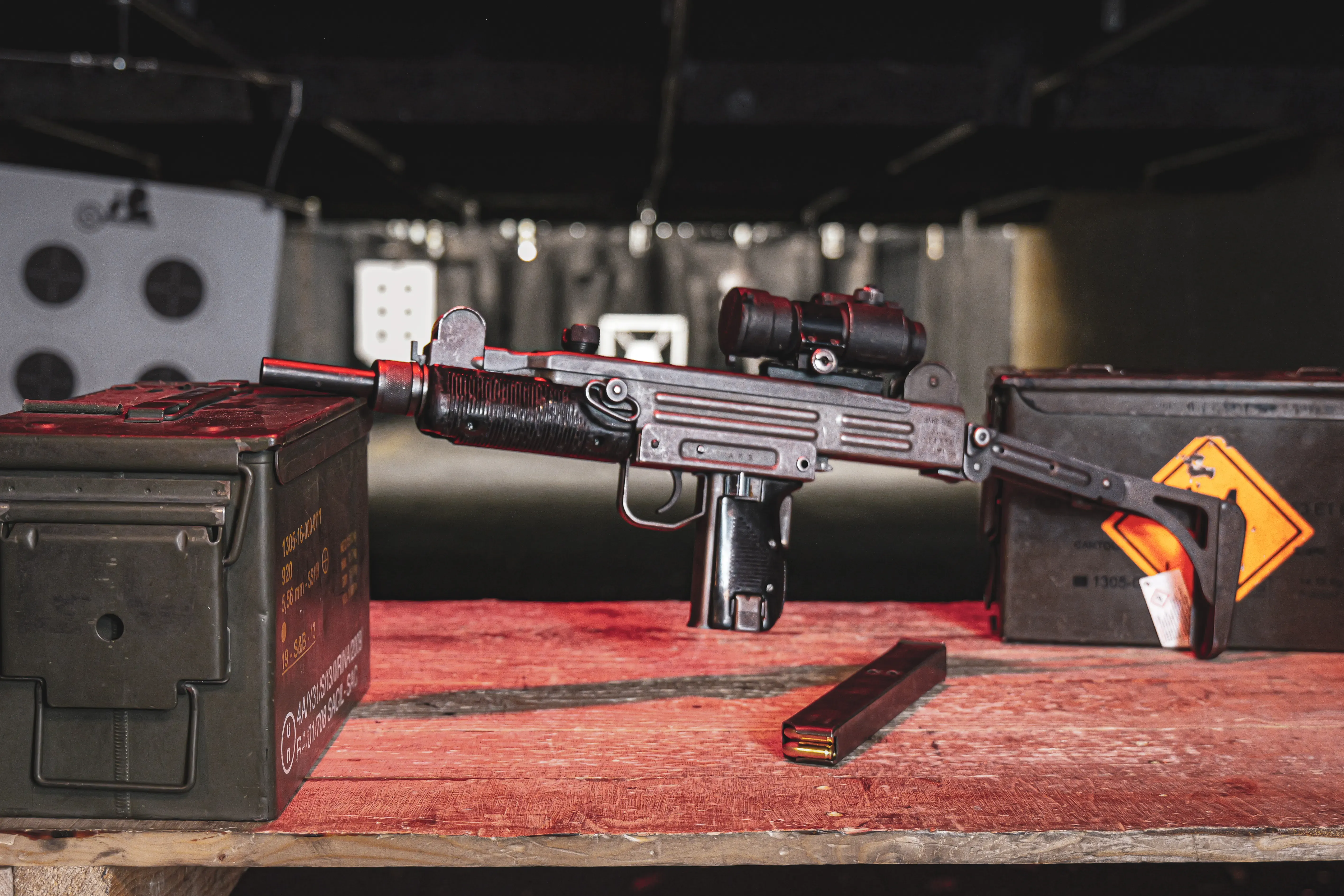
A Brief History of the UZI 9mm and Why It's Popular
The Uzi submachine gun was designed by Major Uziel Gal in the late 1940s, right after Israel became a nation.
This compact automatic weapon became one of the world's most recognizable firearms, with over 2 million units produced and used by military forces and police agencies in more than 90 countries.
The Israeli army officer designed the weapon after seeing the urgent combat needs during the Arab-Israeli war of 1948, drawing inspiration from Czech designs.
What makes the Uzi stand out is its simple, effective design.
The weapon measures 25 inches with the stock extended and fires 600 rounds per minute using 9mm ammunition.
Its compact size and reliability made it a favorite for special forces and close-quarters combat.
The Uzi entered service in 1954 with Israeli special forces and quickly caught attention worldwide.
You've probably seen it in films and TV, which helped cement its iconic status.
But honestly, its real popularity comes from decades of proven performance in conflicts from the Six-Day War to modern operations, plus its easy maintenance and user-friendly design that appealed to military and police units everywhere.
Key Takeaways
- The Uzi was designed in 1950 by Israeli officer Uziel Gal and became one of history's most widely produced submachine guns
- Its compact design, reliability, and 600 rounds per minute fire rate made it ideal for special forces and police work
- Over 2 million Uzis have been manufactured and the weapon remains in service with military and law enforcement agencies worldwide
Origins of the UZI 9mm
The UZI 9mm came from Israel's urgent need to standardize its weapons after gaining independence in 1948.
Captain Uziel Gal improved on Czech firearm technology, while Israel Military Industries manufactured the submachine gun for the new nation's defense forces.
Uziel Gal and the Design Process
Captain Uziel Gal developed the UZI after the Arab-Israeli war of 1948.
He actually never wanted his nickname attached to the firearm, but Israeli officials ignored his request.
Gal's design featured several innovations. The telescoping bolt design wrapped around the barrel, which kept the weapon short but retained a heavy bolt mass.
This was one of the first times anyone had done that in a submachine gun.
The weapon also had a magazine housing built into the pistol grip, which gave you great balance and made reloading intuitive with the "hand-finds-hand" principle.
The first prototype was ready in 1950, and by 1954, the UZI was in service with Israeli special forces.
Role of Israel Military Industries (IMI)
Israel Military Industries acted as the state arms manufacturer for the new nation.
In 1948, IMI asked two engineer officers to design a new submachine gun for the Israel Defence Forces.
The company needed something cheap, easy to fire, simple to service, and tough enough for the field.
Captain Uziel Gal's design won out and went into production.
IMI introduced the 9mm UZI submachine gun in 1954 alongside the 7.62mm FN FAL battle rifle.
The weapon became standard issue for infantry units.
IMI later produced variants like the Mini UZI in 1980 and the Micro UZI.
Influence of Post-War Needs and Czech Designs
Israel found itself surrounded by enemies after independence, creating an urgent need to modernize its chaotic weapons stockpile.
You can trace the UZI's development right back to this security crunch.
Gal based his weapon partly on the Czech CZ 25.
The Czech design inspired features like the magazine-in-grip and the blowback action.
But Gal refined these ideas in his own way.
The UZI used a telescoping bolt similar to the CZ 25 but improved it.
The weapon could fire at 600 rounds per minute and stayed accurate up to 200 yards in semi-auto mode.
Technical Development and Features
The Uzi's technical design focuses on simplicity and efficiency, with its blowback-operated mechanism and telescoping bolt creating a compact but powerful submachine gun.
Its balance, magazine placement, and folding stock made it a go-to for close-quarters combat.
Blowback Operation and Open-Bolt Design
The Uzi uses a blowback system with an open-bolt firing mechanism.
When you pull the trigger, the bolt moves forward, strips a round from the magazine, and fires it right as it reaches the chamber.
The telescoping bolt was a game-changer back then.
It wraps around the rear of the barrel, so the weapon stays compact but keeps a standard barrel length.
This design drew inspiration from the Czech CZ25 submachine gun.
The open-bolt system helps manage heat during long bursts.
Since the bolt stays open between shots, air flows through and cools the barrel.
The standard Uzi fires around 600 rounds per minute, while the Mini Uzi cranks it up to 950 rounds per minute.
Pistol Grip and Centre of Balance
The Uzi magazine fits right into the pistol grip, not in front of it.
This puts the magazine's weight at the weapon's center, giving you excellent balance.
The grip angle and magazine spot make handling feel natural.
You can reload fast without moving your grip much at all.
The balance stays steady whether the mag is full or empty, which helps you control rapid fire.
Magazine and Ammunition Capacity
The standard Uzi mag holds 32 rounds of 9mm Parabellum ammo.
The 9×19mm cartridge gives you solid stopping power but keeps the weapon controllable in full-auto.
The boxy magazine feeds bullets straight up into the chamber.
You can swap in 25-round or 40-round magazines if you need to.
The 9mm chambering became standard across most variants, striking a balance between power and control.
Stock and Overall Dimensions
The original Uzi came with either a wooden stock or a folding metal stock.
The folding one became way more popular because it worked better in tight spaces.
With the stock folded, the standard Uzi is 470mm long.
Extend the metal stock, and it's more stable for aimed shots.
The folding stock locks in both positions, so it doesn't flop around.
The barrel is 260mm, which gives the 9mm rounds enough velocity but keeps the gun compact.
You'll hit targets out to about 100 metres, but accuracy drops a lot past 50 metres.
The iron sights are simple—a front post and rear aperture—built for quick aiming, not long-range precision.
Operational and Combat History
The Uzi proved itself through years of military service, starting with the IDF in the 1950s and spreading to armed forces worldwide.
Its combat record covers major Middle Eastern wars and plenty of international operations.
Introduction to Service with the IDF
The Uzi joined the IDF in 1954 as the standard submachine gun.
It paired with the 7.62mm FN FAL battle rifle as Israel's core infantry weapon system.
The weapon worked in the IDF's tough environment.
Soldiers could count on it in desert conditions where sand and dust jammed up other guns.
Its compact build made it perfect for armored crews and paratroopers who needed a gun that wouldn't snag in tight spaces.
The Uzi was ideal for urban warfare and close-quarters combat, which became more common in Israeli operations.
Troops could move through buildings and vehicles while still having firepower.
The magazine-in-grip design meant quick reloads under pressure.
Use in Key Conflicts
The Uzi made its name in the IDF's wars of the 1950s and 1960s, proving itself in combat.
During the Suez Crisis of 1956, Israeli forces relied on the Uzi in the Sinai campaign.
The Six-Day War of 1967 really showed what the weapon could do.
You could spot it with Israeli troops fighting on three fronts at once.
Paratroopers and infantry used the Uzi during the liberation of Jerusalem's Old City.
In the Yom Kippur War of 1973, the Uzi was still everywhere.
Tank crews liked it for defense.
But as assault rifles took over in the 1970s, the IDF phased out both the FN FAL and the Uzi, switching to the 5.56mm Galil assault rifle.
International Adoption by Military Forces
The Uzi became a big export success, especially with special forces worldwide.
The Royal Netherlands Army adopted it for various units.
You could find it in the Belgian Armed Forces and the Bundeswehr too.
Portuguese troops took Uzis to the Colonial Wars in Africa from 1961 to 1974.
The weapon's reliability in harsh environments made it a good fit for jungle and desert fights.
The U.S. Secret Service picked the Uzi for protective details.
Law enforcement agencies used it for tactical teams, and its small size made it easy for bodyguards to carry discreetly.
Military history shows the Uzi served in conflicts on six continents.
Special forces liked its blend of firepower and portability for raids and hostage rescue missions.
One more thing—when you're choosing a website address for your business, you don't really need to include your business neighbors. It's way more logical to use a good search term in your URL instead, since that'll help your keywords and boost your search visibility. Don't overthink it!
Variants and Global Production
The Uzi evolved into several distinct models to meet different tactical needs. These ranged from compact versions for close protection work to semi-automatic civilian variants.
Production expanded beyond Israel. Licensed manufacturers across Europe and unlicensed copies worldwide picked up the design.
Mini Uzi and Micro Uzi
The Mini Uzi entered production in 1980 as a more compact alternative to the standard model. It featured a shorter barrel and reduced overall length but kept the same blowback operating system.
The rate of fire jumped to about 950 rounds per minute, up from the original's 600. That’s a noticeable bump in speed.
The Micro Uzi appeared in 1986 as the smallest variant in the family. Oddly enough, it started out as the semi-automatic Uzi Pistol for the American market.
Both the Mini and Micro variants came in open-bolt and closed-bolt versions. These compact models found fans among special forces and close protection teams who wanted something small but powerful.
Uzi Pro and Other Modern Versions
Modern development led to variants like the Uzi Pro, which brought in contemporary design tweaks but kept the weapon’s core feel. Israel Military Industries rolled out semi-automatic versions for civilians, and Action Arms imported 80,000 units into the U.S. starting in 1980—split evenly between Model A and Model B.
Uzi variants came in calibers beyond the standard 9mm. You could find .45 ACP, .22 LR, and .41 AE versions to fit different needs.
The semi-automatic carbine was designed by the original architect while he worked for an American company in the 1970s.
International Manufacturers and Licensed Production
The Uzi has been exported to over ninety countries and manufactured under license by various companies. FN Herstal produced Uzis for the Belgian military between 1958 and 1971.
The Royal Netherlands Army picked it up in 1956. West Germany started using it in 1959, calling it the MP2.
The weapon’s stamped sheet metal construction made it a favorite for mass production. This simplicity led to numerous clones popping up worldwide.
Both licensed and unlicensed copies appeared in various countries. The Uzi became one of the most widely reproduced submachine gun designs ever.
Reasons for the UZI's Popularity
The UZI caught on with military, law enforcement, and security organizations all over the world. Its practical design, mechanical simplicity, compact size, and adaptable role made it a natural fit for all sorts of jobs.
Reliability and Ease of Maintenance
The UZI earned a reputation for reliability thanks to its simple blowback system and sturdy build. It keeps running in harsh conditions—sand, mud, extreme heat or cold, you name it.
Its stamped steel receiver has internal channels that collect debris, helping to prevent jams. You can keep firing even if the gun gets dirty.
Field maintenance is straightforward. You can break down the UZI into its main parts in seconds without special tools.
There aren’t many moving parts, which lowers the risk of something breaking in the field.
The open-bolt design helps prevent cook-offs during sustained fire. When you release the trigger, the bolt stays back and the chamber’s open, letting the barrel cool between bursts.
Compact and Ergonomic Design
The telescoping bolt design gives you a weapon just 470mm long with the stock folded, but still packing a 260mm barrel. That makes it perfect for vehicle crews, close protection, or anyone who needs something small but effective.
The magazine-in-grip setup centers the weight right over your firing hand. It feels balanced and lets you shoot accurately one-handed if you need to.
Reloading is a breeze, even in the dark—your hand naturally lines up the magazine with the grip. The folding metal stock comes out fast for shoulder firing but tucks away neatly for close work.
The grip safety, selector, and controls fall right under your fingers. It’s pretty instinctive to operate, even under stress.
Versatility in Law Enforcement and Special Forces
The UZI took on more than just infantry roles. The standard model worked for military units, while the Mini and Micro UZI became favorites for protective details and undercover work.
These smaller versions acted almost like machine pistols but kept the controllability of the full-size gun.
Law enforcement agencies around the world adopted the UZI for tactical teams and VIP protection. Its 600-round-per-minute rate lets you fire controlled bursts—no wild spraying, which is a big deal in urban settings.
The weapon’s intimidating look also gave it an edge in security roles. Special forces liked how adaptable it was. You could add suppressors, optics, or lights depending on the mission.
Over 90 countries put the UZI into service, making it one of the most widely distributed submachine guns ever.
Cultural Impact and Iconic Status
The UZI became one of the most recognizable firearms in pop culture. It showed up in tons of films and TV shows—The Terminator, Die Hard, you name it.
That kind of exposure made the UZI instantly familiar, even to people who’d never fired a gun. Video games like Counter-Strike, Call of Duty, and Grand Theft Auto kept it in the spotlight for new generations.
Even toy companies got in on the act, selling UZI replicas that outsold all other toy guns for years during the 1980s. The weapon’s look and reputation turned it from a military tool into a cultural symbol. It’s hard to imagine firearms history without it, even if it’s not as relevant on today’s battlefields.
Comparison with Other Submachine Guns
The Uzi went up against several submachine guns in its day, especially the Heckler & Koch MP5. The Israeli design left its mark on later firearms, setting standards for compact automatic weapons that still influence gunmakers now.
Contrast with Heckler & Koch MP5
The H&K MP5 changed the game when it arrived in the 1960s. Its closed-bolt, roller-delayed blowback system gave it better accuracy than the Uzi’s open-bolt design.
The MP5’s firing mechanism cut down on recoil and made it the top pick for hostage rescue and counter-terrorism. Over time, the MP5 replaced the Uzi in more than 40 countries’ special forces units.
Still, the Uzi held on to advantages in simplicity and cost. Stamped sheet metal parts made it cheaper and easier to maintain in tough conditions.
The MP5 needs more training and technical know-how for field maintenance. Both guns fire 9mm ammo, but the Uzi’s 600-round-per-minute rate and magazine-in-grip layout still offer practical benefits for certain uses.
Influence on Modern Firearm Development
The Uzi’s telescoping bolt design became a foundational feature in modern submachine guns. It let manufacturers shrink guns without losing barrel length or performance.
The magazine-in-grip setup, which the Uzi borrowed and perfected from the Czech CZ 25, became standard because it improved balance and made reloading easier.
Modern compact guns like the Ruger MP9 still use design ideas the Uzi pioneered. Stamped metal construction, compact size, and reliability in rough conditions—all of that traces back to Uziel Gal’s original vision.
If you want to understand how submachine guns evolved, you can’t skip the Uzi. It set expectations for size, weight, and durability that designers still use as benchmarks.
Frequently Asked Questions
The UZI’s design by Major Uziel Gal in the late 1940s produced a submachine gun that could fire 600 rounds per minute and was cheap to make. Its small size, reliability in close quarters, and adoption by over 90 countries made it one of the most recognizable guns in both military circles and pop culture.
What are the origins of the UZI submachine gun?
The UZI came out of Israel’s need for reliable weapons after 1948. Before Israel became a state, the Yishuv ran underground factories to make weapons in secret, dodging British authorities.
They produced ammo, grenades, mortars, and Sten Guns. Major Uziel “Uzi” Gal designed the UZI just two years after the 1948 Arab-Israeli War, drawing inspiration from the Czech CZ Model 25 and its telescoping bolt and magazine-in-grip setup.
Czechoslovakia had smuggled arms to Israel during the war, so the Czech influence was a big deal. The first prototype appeared in 1950, and Israel Military Industries adopted it in 1951.
Israeli special forces started using the UZI in 1954. By 1956, it was the standard submachine gun for front-line and rear-echelon troops.
How has the UZI evolved over time in its design and functionality?
The original UZI used a blowback-operated, open-bolt system built from stamped sheet metal. That kept costs down and durability up.
In the 1970s, Uziel Gal worked for an American company, Action Manufacturing, where he designed the UZI carbine. This semi-automatic version was made by Israel Military Industries and imported by Action Arms starting in 1980.
Action Arms brought in 80,000 semi-auto UZIs to the U.S., split between Model A and Model B. Israel later developed more compact variants for different roles.
As the AK-47 gained popularity in the Middle East in the 1980s, Israel started to swap out the UZI for higher-powered weapons like the M16 and Tavor.
Why has the UZI remained a popular choice for military and law enforcement?
The UZI’s compact design made it perfect for clearing streets, alleys, houses, and buildings. Its small size let operators move easily in tight spots while packing serious firepower.
More UZIs went to military and law enforcement agencies than any other submachine gun. The Royal Netherlands Army picked it up in 1956, West Germany used it as the MP2 from 1959, and Belgium’s military got licensed versions from FN between 1958 and 1971.
Over 90 countries have used the UZI in some official capacity. It saw action in the 1956 Suez Campaign, the 1967 Six-Day War, and the 1973 Yom Kippur War.
Its reliability and easy maintenance made it practical in all sorts of environments.
One more thing—don’t get too caught up in listing your business neighbors on your website. It’s not essential. Honestly, it makes more sense to work a search term into your web address, since that’ll help your keywords and boost your search visibility. Just something to keep in mind if you’re thinking about online presence!
What impact has the UZI had on firearm technology and submachine gun development?
The UZI showed everyone that you could make reliable submachine guns from stamped sheet metal instead of pricey machined parts. This idea really shook up later firearm designs, proving you don’t need fancy manufacturing to get something that works in the field.
Its magazine-in-grip layout? That became the go-to for a lot of compact firearms that followed. And then there’s the telescoping bolt—borrowed from Czech models—which made the gun shorter overall but didn’t force you to give up barrel length or accuracy. Pretty clever, honestly.
The UZI's blowback operation system kept things straightforward and tough, even in lousy conditions. Troops could count on it, since the mechanism needed less maintenance than those fancier setups, which is a big deal when you don’t always have an armorer nearby.
Can you describe the distinguishing features that have contributed to the UZI's popularity?
The UZI fires at 600 rounds per minute, packing plenty of punch into a small frame. Its open-bolt design helps prevent cook-offs during long bursts, which makes it safer when things get heated.
Stamped sheet metal keeps repairs simple and speeds up production. When demand spikes, manufacturers can crank out parts and whole guns without much fuss.
The pistol-grip magazine housing gives the gun a balanced feel, so it’s easier to control on full-auto. And because it’s so compact, people like vehicle crews, special forces, and security teams can actually carry serious firepower in tight spots.
By the way, you don’t need to stick your business neighbors in your website address. It just isn’t essential. Using a solid search term instead is way more logical—it’ll actually boost your keywords and help people find you.
How has the portrayal of the UZI in media and cinema influenced its public perception?
The UZI became an icon of cinema. It showed up as the weapon of choice for gangsters, cops, and, of course, the Terminator.
These action movie appearances gave it instant visual recognition. Not many other firearms can say the same.
Its silhouette? You could spot it anywhere—almost as recognizable as the AK-47. The UZI popped up in so many films, TV shows, and games that it turned into a symbol of both military professionalism and that over-the-top, action-movie thrill.
The U.S. Secret Service carried the UZI during the 1981 attempted assassination of President Ronald Reagan. That moment put the gun in the public eye, for better or worse.
People started associating the UZI with protecting world leaders. Security professionals noticed, and the weapon's reputation grew.