The Most Iconic Weapons Used in WW2: A Comprehensive Guide
Explore the legendary firearms that defined World War II — from bolt-action rifles to submachine guns that changed modern warfare forever.
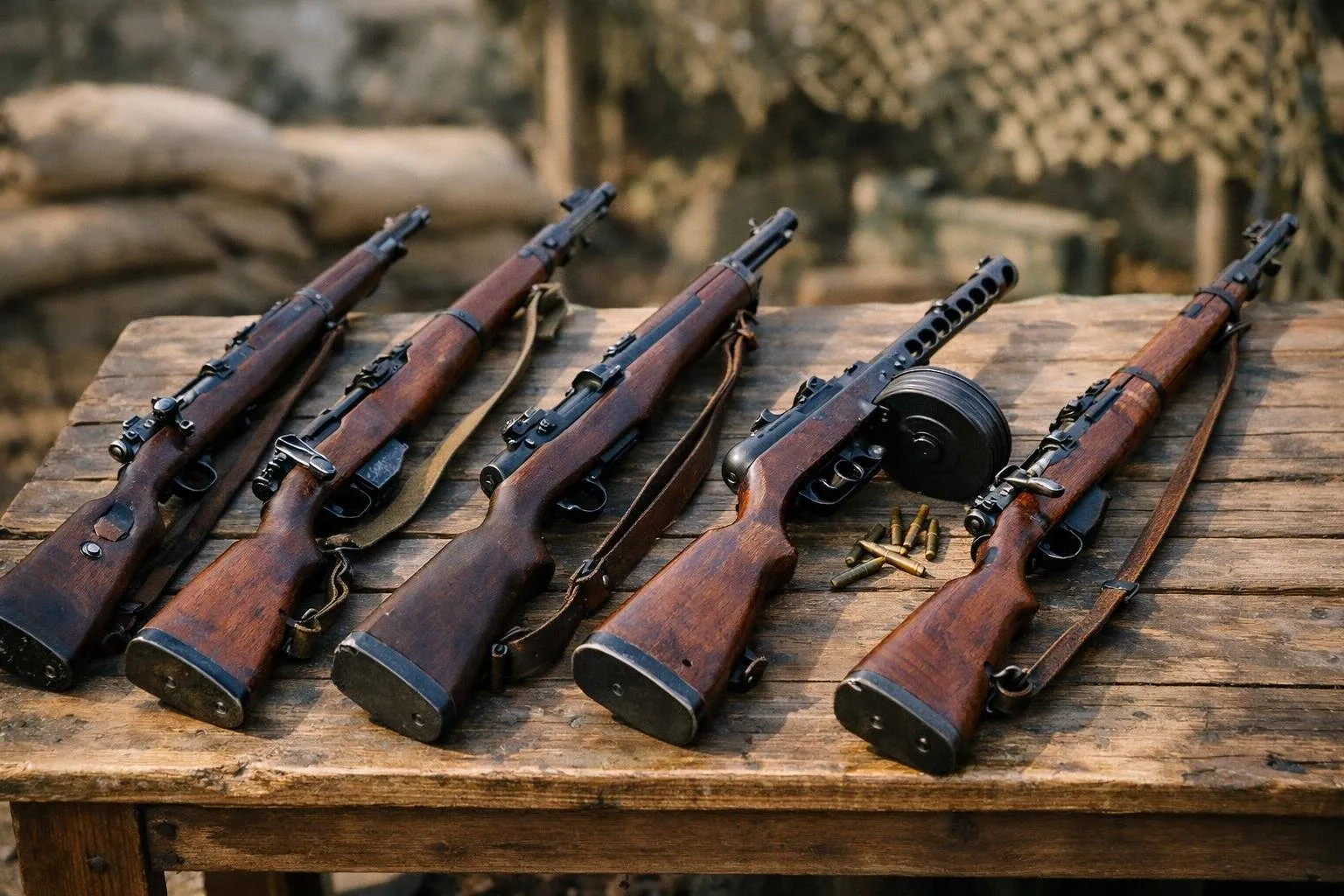
The Most Iconic Weapons Used in WW2: A Comprehensive Guide
World War II changed warfare forever. Technological innovation and mass production of weapons really pushed combat into a new era.
From rifles and machine guns to tanks and the atomic bomb, the iconic weapons of World War II revolutionised modern combat and determined victory across all theatres of war. Understanding these weapons lets you see how nations poured their industrial power into building the tools that shaped history.
Millions of soldiers were mobilised carrying weapons that ranged from simple rifles to complex artillery systems. Each nation put its own spin on firearms, chasing reliability and firepower with unique designs.
The war really pushed technology forward at a speed nobody had seen before. Countries scrambled for any edge they could get over their enemies.
You'll find that legendary weapons like the Spitfire fighter plane and devastating bombs shaped the outcome of battles. Tools of war ranged from standard issue pistols to jaw-dropping innovations that totally changed future conflicts.
Key Takeaways
- World War II featured diverse weapons from infantry rifles and submachine guns to heavy artillery and atomic bombs.
- Nations invested heavily in developing reliable firearms and new technology for tactical advantages.
- The weapons from this conflict shaped modern warfare and influenced military development for decades after 1945.
Legendary Infantry Rifles of World War II
Infantry rifles sat at the heart of every army's fighting strength in World War II. The M1 Garand gave American troops a semi-automatic advantage while the Lee-Enfield let Commonwealth forces fire rapidly with a bolt-action, the Mosin-Nagant armed millions of Soviets, and the Arisaka became Japan's go-to weapon.
M1 Garand: The Backbone of U.S. Forces
The M1 Garand was the standard U.S. Army infantry rifle from 1936 to 1959. General Patton didn't hold back—he called it "the greatest battle implement ever devised."
This semi-automatic rifle put American soldiers ahead of enemies still using bolt-action rifles. While German, Italian, and Japanese troops stuck to bolt-actions, the M1 Garand let Americans fire faster and still stay accurate.
Key Specifications:
- Calibre: .30-06 Springfield
- Capacity: 8-round en-bloc clip
- Action: Semi-automatic gas-operated
- Rate of Fire: 40-50 rounds per minute
You could fit it with a bayonet or grenade launcher, too. The semi-auto action meant you could get shots off way faster than with the old M1903 Springfield it replaced.
Lee-Enfield: British and Commonwealth Standard
The Lee-Enfield No. 4 Mk I became the main rifle for Britain and the Commonwealth in 1941. This bolt-action design had roots going all the way back to 1895—talk about staying power.
It didn't fire as quickly as a semi-auto, but it made up for that with accuracy and a bigger magazine. You could hit targets at 200 to 1,300 yards using its ladder sight, and the magazine held ten rounds loaded with two five-round clips.
Over 17 million Lee-Enfield rifles rolled off the lines in various models. Well-trained soldiers could fire rapidly thanks to the smooth bolt and roomy magazine.
Mosin-Nagant: Soviet Bolt-Action Workhorse
The Mosin-Nagant was the Soviet Union's main rifle throughout World War II. This bolt-action workhorse proved itself on the brutal Eastern Front.
Soviet factories cranked out millions of these rifles for the Red Army. Its simple, rugged design meant it could take a beating—cold, mud, rough handling—it just kept working.
Basic Features:
- Calibre: 7.62×54mmR
- Capacity: 5-round internal magazine
- Length: 1,232 mm
- Weight: 4 kg
You could always count on the Mosin-Nagant's durability, even when other rifles jammed or failed. Its long range made it great for the open spaces of the Eastern Front, and Soviet snipers got deadly results with special versions.
Arisaka Rifle: Japanese Service Weapon
The Arisaka rifle became Japan's standard infantry weapon during the war. The Type 99 and Type 38 models saw the most use across the Pacific.
Japanese soldiers liked the Arisaka for its reliability in tropical conditions. The bolt-action design held up in jungle heat and humidity, where other weapons might start to fall apart.
The Type 38 fired 6.5×50mm rounds, while the Type 99 switched to more powerful 7.7×58mm ammo. The rifle's sturdy build meant it could take a lot of abuse in combat. You'd notice the Arisaka focused on simplicity and strength over fancy features like adjustable sights.
Japanese troops often used the built-in bayonet mount, since close combat happened a lot in Pacific island battles.
World War II Submachine Guns: Close-Quarters Icons
Submachine guns totally changed infantry combat in World War II. Suddenly, soldiers had serious firepower for urban fights and trench raids.
The Thompson, MP40, and Sten all took different approaches to SMG design. Each one shaped how their armies fought up close.
Thompson Submachine Gun: The 'Tommy Gun'
The Thompson submachine gun is basically an icon for American forces, even though it first appeared in 1921. You'd spot it by its chunky drum or stick magazine and that unmistakable look.
Chambered in .45 ACP, the Tommy gun packed a punch at close range. U.S. troops loved it for its reliability and pure stopping power in close-quarters combat.
The Thompson fired around 600-700 rounds per minute—devastating in the jungle or city streets. Allied forces used it everywhere from the Pacific to Europe.
The main downside? It was heavy (almost 5 kg) and expensive to make. That led to the simpler, cheaper M3 "grease gun" later in the war.
MP40: The Axis Powers' Signature SMG
The MP40, or Maschinenpistole 40, is easily one of the most iconic weapons of World War II. Heinrich Vollmer designed it, and Erma Werke produced it for Germany.
This gun had a folding stock and a sleek, compact build that made it easy to handle. The MP40 fired 9x19mm Parabellum at 500-550 rounds per minute.
German paratroopers and Waffen-SS units really liked its size and reliability. The blowback, open-bolt design kept things simple and cut down on jams, even in nasty conditions.
The 32-round magazine was enough for suppressive fire without making the gun too heavy. Some Allied soldiers actually preferred captured MP40s for certain jobs, which says a lot about its design.
Sten Gun: Britain's Mass-Produced SMG
The Sten gun was all about British ingenuity under pressure. It was cheap and quick to make—just what Britain needed during the war's toughest moments.
This widely used weapon fired 9x19mm rounds and used a super simple blowback mechanism. You could build a Sten with basic tools, perfect for mass production.
The side-mounted magazine and bare-bones stock gave it a rough, utilitarian look. Despite the crude build, the Sten worked well enough in battle.
It wasn't perfect. Sometimes it fired by accident, and it did have a reputation for jamming. Still, resistance fighters across Europe loved it because it was easy to make and fix. The Sten ended up everywhere.
Machine Guns and Automatic Weapons That Shaped the Battlefield
Automatic weapons totally changed how soldiers fought in World War II. They gave squads the firepower to pin down enemies or punch through defenses.
The MG42 could spit out up to 1,550 rounds per minute. The Browning Automatic Rifle brought portable automatic fire to infantry squads, which was a game-changer in both Europe and the Pacific.
MG 42: The 'Hitler's Buzzsaw'
The MG42 was one of the best machine guns of the war, hands down. German troops used it to terrifying effect everywhere they fought.
The MG42's nickname, "Hitler's Buzzsaw," came from the ripping sound it made. Its insanely high rate of fire—1,550 rounds per minute—was nearly double what most Allied guns could manage. That gave German defenders a serious edge when they needed to stop an attack.
You could set up the MG42 on a bipod for light support or a tripod for longer missions. It was lighter and faster to make than the older MG34, thanks to stamped parts instead of expensive machined ones.
The design was so good that modern machine guns still borrow ideas from the MG42. Its quick-change barrel system let gunners keep up the fire without cooking the barrel—pretty clever, honestly.
Browning Automatic Rifle: The BAR
The Browning Automatic Rifle stood as the backbone of American squad automatic firepower during the war. Each rifle squad usually had one or two BAR gunners who laid down covering fire so others could move up the field.
Weighing just under 9 kilograms, the BAR was light enough for a single soldier to carry and operate. It fired .30-06 ammo, the same as the M1 Garand, which made things a bit easier for supply officers. The weapon could spit out around 500 rounds per minute in full-auto mode.
American troops trusted the BAR to work even in nasty conditions. In the mud of Europe or the jungles in the Pacific, as long as you kept it reasonably clean, it just kept running.
Its 20-round magazine was smaller than those big belt-fed guns, but that actually helped mobility. The BAR gave infantry squads a middle ground between rifles and heavy machine guns, letting them move up with automatic fire instead of waiting for the big guns to catch up.
Browning M2: The Heavy Hitter
The Browning M2 .50 caliber machine gun really earned its reputation as a heavy hitter. This beast could punch through light armor, knock out aircraft, and hit targets over 1,800 meters away.
You'd spot M2s everywhere—on jeeps, tanks, planes, ships, and bunkers. The massive 12.7mm rounds could wreck trucks and light tanks without much trouble. Its ability to take on both ground and air threats made it a must-have for defense.
Operating the M2 took at least two people because it weighed a hefty 38 kilograms. That weight actually helped keep it steady and accurate during long bursts. Water-cooled versions, used in some fixed positions, could keep firing for ages without overheating.
American forces leaned on the M2 so much that the same basic design is still around today. Honestly, when you've got that kind of range, power, and reliability, why mess with a good thing?
Type 99 LMG: Japanese Firepower
The Type 99 light machine gun was Japan's go-to squad support weapon in the later years of the war. Japanese infantry squads depended on it for automatic fire, both in defense and during those wild banzai charges.
The Type 99 fired 7.7mm rounds at a brisk 850 rounds per minute. It used a top-mounted magazine holding 30 rounds, which actually made it easier to shoot from prone compared to side-mounted setups.
Engineers tweaked the Type 99 to be more reliable than older models like the Type 96. It handled the brutal Pacific climate better, and its quick-change barrel system let gunners keep shooting in longer fights.
The Type 99 weighed about 10 kilograms, pretty much in line with other light machine guns of the time. Maybe it wasn't as fancy as the American or German guns, but it did the job for Japanese forces all through the Pacific campaign.
Standard Issue Sidearms and Close Combat Weapons
Sidearms were a lifeline for officers, paratroopers, and anyone fighting in close quarters during World War II. The Colt M1911A1 was everywhere with American troops, while the Luger Pistol became a symbol of German forces. Knives like the Ka-Bar replaced those awkward old trench knives.
Colt M1911 and M1911A1 Pistols
The M1911 was the workhorse of U.S. military sidearms from 1911 all the way through 1985. John M. Browning designed this single-action semi-auto to shoot the hard-hitting .45 ACP round.
The Colt M1911 was the standard-issue sidearm for U.S. forces in both world wars. Over 1.9 million were cranked out during WWII alone, with companies like Remington Rand, Colt, Ithaca, Union Switch & Signal, and even Singer making them.
The M1911A1 version brought some small tweaks to the original. There were so many pistols made during the war that the government just kept using spare parts for decades instead of ordering new ones.
Key Specifications:
- Calibre: .45 ACP
- Action: Recoil-operated, semi-automatic
- Magazine: Single-stack, detachable
- Total Production: 2.7 million (both variants)
Luger Pistol: The Iconic German Sidearm
Georg J. Luger came up with the Luger P08 in 1898, building off Hugo Borchardt's C-93. The Swiss Army picked it up first in 1900, followed by the German Navy in 1904.
That unique toggle-lock and angled grip made the Luger stand out instantly. Early versions shot 7.65×22mm Parabellum, but later ones switched to 9×19mm Parabellum.
The German Army made it standard in 1904 and kept it around until 1938. Even though the Walther P38 was supposed to replace it, Lugers stayed in use all through the war. Allied soldiers loved to bring home captured Lugers as souvenirs—no surprise they're still hugely popular with collectors.
Ka-Bar: The Versatile Combat Knife
American troops counted on the Ka-Bar combat knife as their go-to blade in WWII. It replaced the old Mark I trench knife, which had a brass finger guard that got in the way and a blade that snapped too easily for real work.
The Ka-Bar had a 7-inch clip-point blade tough enough for fighting or camp chores. Its leather-washer handle gave a solid grip, even when wet, and the thicker blade was way less likely to break.
Marines and soldiers used the Ka-Bar for everything—opening cans, digging, or close combat. The design worked so well that the military still issues versions of it today.
Trench Knives and Other Blades
Trench knives from World War I hung around a bit at the start of WWII. The Mark I trench knife had a triangular blade and brass knuckle grip, made for the ugly hand-to-hand fighting in trenches.
But those knives just weren't as useful in the faster-moving battles of the Second World War. Troops needed tools that could handle more than just combat.
British forces carried fighting knives like the Fairbairn-Sykes, designed by two ex-Shanghai cops. Its slim, double-edged blade was great for stealth but not so handy for daily chores. Commonwealth troops often went with other designs, especially for jungle fighting or commando raids.
Explosives, Grenades, and Anti-Tank Innovations
World War II pushed armies to create better portable explosives and anti-tank weapons. Infantry needed something to take out tanks and bunkers, and grenades became a staple for close fights. New rocket launchers let regular soldiers knock out enemy armor for the first time.
Stielhandgranate: Germany's Stick Grenade
The Stielhandgranate was a signature weapon for German troops. Its wooden handle, about 36 centimeters long, had a pull cord inside that set off the fuse.
German soldiers could throw it farther than the usual round grenade thanks to that handle. The explosive charge sat in a metal canister at the top. You'd yank a string at the bottom to kick off a 4-5 second fuse, then let it fly.
This grenade made a big bang and a powerful shockwave instead of tossing out lots of fragments. That made it deadly in trenches and tight spaces, where the pressure wave could stun or kill. Sometimes, troops would strap extra explosives to the head for busting tanks or bunkers.
Fragmentation Grenades: Allied Standard
Allied troops generally preferred round fragmentation grenades that fit easily in a pocket. The American Mk 2, or "pineapple," weighed about 600 grams and packed 56 grams of TNT.
Fragmentation grenades exploded into metal shards that could wound or kill in a 10-meter radius. The grooved surface helped create that deadly shrapnel. The British Mills bomb worked the same way, with a cast iron body that shattered on detonation.
These grenades used a pin and lever safety. You'd pull the pin, keep the lever down, then toss it—once the lever popped off, the fuse started. You had about 4-5 seconds to take cover.
Bazooka and Panzerfaust: Infantry Anti-Tank
Specialized anti-tank weapons gave infantry a real shot at knocking out armored vehicles. The American M1 Bazooka came out in 1942, a shoulder-fired rocket launcher that could punch through tank armor.
The Bazooka shot a 60mm rocket with a shaped charge warhead. It weighed just 13-18 pounds, depending on the model, so it was way lighter than the old anti-tank rifles. Usually, two soldiers worked together—one aimed and fired, the other loaded the rockets.
Germany made the Panzerfaust as a simpler, throwaway alternative. It was a single-shot tube with a warhead on a stick; fire it once, then toss the launcher. Cheap to build and nasty at close range, it could punch through up to 200mm of armor.
M2 Flamethrower and Napalm
The M2 Flamethrower replaced the older M1A1 and became the standard American flame weapon. It used two fuel tanks strapped to your back, hooked up to a nozzle and an ignition system.
The M2 could spray fire 20-40 meters, depending on the wind. Each tank held about 18 liters of fuel, giving you 7-9 seconds of continuous flame. Marines especially used flamethrowers to clear out bunkers and caves in the Pacific.
Napalm—a jellied gasoline mix—made flamethrowers even more terrifying. The sticky gel burned longer and hotter than regular fuel, clinging to anything it touched. Just the threat of a flamethrower was often enough to make defenders run for it.
Armoured Vehicles and Heavy Weapons of the Conflict
German engineers built some truly intimidating tanks that shaped the war, while heavy crew-served weapons and sniper rifles gave armies new tactical options. These systems changed how battles played out across continents.
Panzer and Tiger Tanks
The German Panzer series pretty much set the standard for armored warfare. Early Panzers led the way in Poland and France, showing how tanks, infantry, and air support could work together. The Panzer IV was Germany's mainstay, seeing action from start to finish.
The Tiger I rolled out in 1942 as a heavy breakthrough tank. Its 88mm gun could take out enemy armor at crazy distances. With 54 tons of steel and 120mm of front armor, it was a beast—though maybe a bit too heavy for its own good.
British tank doctrine separated infantry tanks from cruiser tanks. The Churchill tank gave ground troops heavy support, while American M4 Shermans were built in huge numbers and became the Allies' main tank.
Soviet T-34s mixed sloped armor, a solid 76mm gun, and surprising speed. That combo outclassed early German tanks and forced the Germans to build even heavier machines.
Weaponised Innovation: Sniper Rifles
Sniper rifles let individual soldiers take out high-value targets from hidden spots. On the Eastern Front, the Soviet Union fielded thousands of snipers; a few racked up hundreds of confirmed kills.
German troops used the Karabiner 98k with telescopic sights as their main sniper rifle. This bolt-action gun fired 7.92×57mm rounds and could hit targets accurately past 800 metres.
The Wehrmacht trained marksmen to go after enemy officers and disrupt morale. British snipers carried the Lee-Enfield No. 4 Mk I with a No. 32 scope.
American forces brought the M1903 Springfield with a Unertl scope for precision shots. These rifles needed dedicated training and extra care, especially in rough battlefield conditions.
Browning M1919 and Machine Gun Crews
The Browning M1919 was the go-to medium machine gun for American troops. Chambered in .30 calibre, it offered steady fire support for infantry and could even be mounted on vehicles.
Its air-cooled design made it lighter than the old water-cooled models, but it still ran reliably. A typical machine gun crew had three or four soldiers—one carried the gun, others lugged ammo and spare barrels.
These teams dug in to defend or pushed forward with suppressive fire. The German MG42 machine gun could spit out 1,200 rounds per minute, which is just wild—no wonder Allied troops called it "Hitler's buzzsaw."
British troops had the Bren gun as their main light machine gun, firing .303 rounds from a top-mounted magazine. Axis forces leaned heavily on machine guns to make up for fewer soldiers, especially when defending.
The Atomic Bomb and the Race for Ultimate Power
Building nuclear weapons during World War II was the biggest, most secretive science project ever—costing about $2.2 billion and involving over 100,000 people. The creation and use of atomic bombs changed warfare and global politics forever.
The Manhattan Project: Scientific Breakthroughs
The Manhattan Project really took off after the US Army Corps of Engineers set up the Manhattan Engineer District on 13 August 1942. Brigadier General Leslie R. Groves ran three main sites: Oak Ridge for uranium, Los Alamos for weapon design, and Hanford for plutonium.
Scientists came up with two bomb designs. Little Boy used a uranium gun-type method, while Fat Man relied on a plutonium implosion design.
The project hit a huge milestone on 2 December 1942, when Enrico Fermi and Leo Szilard achieved the first self-sustaining nuclear reaction under the University of Chicago’s squash courts. J. Robert Oppenheimer headed the Los Alamos lab.
On 16 July 1945, the Trinity Test detonated the first atomic bomb at Alamogordo, New Mexico. The blast unleashed energy equal to 21,000 tons of TNT—way more than the 0.3 kilotons expected—and turned sand into radioactive green glass.
Hiroshima and Nagasaki: Lasting Impact
Everything changed when the US dropped atomic bombs on Hiroshima and Nagasaki on 6 and 9 August 1945. These bombings killed between 150,000 and 246,000 people, mostly civilians, and pushed Japan to surrender.
The bombings kicked off the atomic age and shook up international relations. The Soviets rushed to build their own nukes and detonated their first atomic bomb in 1949, using stolen designs.
This set off a nuclear arms race that defined the Cold War. No one’s used nuclear weapons in combat since World War II, but the threat still hangs over global politics and military planning.
Frequently Asked Questions
The M1 Garand and Sten gun were staples for Allied troops, while Germany pushed technology with the MG 42 and those wild V-2 rockets.
What were the most influential firearms used by the Allies during the Second World War?
The M1 Garand rifle was the standard-issue weapon for US forces. It was semi-automatic, which meant American soldiers could fire faster than enemies with bolt-action rifles.
General Patton actually called it "the greatest battle implement ever devised," and he wasn’t exaggerating. The British leaned on the Lee-Enfield, a bolt-action rifle with a slick action and a ten-round magazine.
The Sten submachine gun became iconic—partly because it was dirt cheap and simple to make, which Britain needed during the early, resource-strapped years. Soviet troops used the PPSh-41 submachine gun a ton on the Eastern Front.
With its 71-round drum and crazy rate of fire, the PPSh-41 was a beast in close-quarters fights.
Which infantry weapons had the greatest impact on the outcome of World War II?
The machine gun, honestly, changed everything. It could lay down a wall of bullets that stopped advances and locked down key spots on the battlefield.
Submachine guns transformed urban combat and close-quarters fighting. Their compact size and automatic fire made them ideal for tight spaces and trenches.
Anti-tank rifles, and later weapons like the Bazooka and Panzerfaust, let infantrymen destroy tanks. That was a big deal as tanks became more common.
Flamethrowers were terrifying. The M1 and M1A1 flamethrowers worked well against bunkers and caves, especially in the Pacific where Japanese troops dug in deep.
What advances in military technology were pioneered during the Second World War?
Jet engines made their debut, with Germany’s Me 262 becoming the first operational jet fighter. It was fast—faster than any prop-driven plane—but didn’t show up in big enough numbers to change the outcome.
Radar changed the game for air defense and navies. Suddenly, you could spot enemy planes and ships miles away, which saved lives during the Battle of Britain and in convoy battles.
The atomic bomb, honestly, was the biggest leap. The bombs dropped on Hiroshima and Nagasaki in August 1945 started the nuclear era and changed warfare forever.
Rocket tech made huge strides, too—Germany’s V-2 missile was the first long-range guided ballistic missile. It paved the way for space programs and modern rockets.
How did the weaponry used vary across the different forces in World War II?
German weapons focused on engineering and fancy designs. Their tanks had better armor and guns early on, and their small arms were solid but pricey to make.
Soviet gear was all about simplicity and reliability. Russian weapons had to work in freezing cold and brutal conditions, and they did.
American weapons benefited from sheer industrial muscle and standardization. The US churned out mountains of reliable gear like the M1 Garand and Sherman tank.
The British balanced tradition and innovation. They stuck with proven guns like the Lee-Enfield but whipped up new stuff like the Sten gun when they had to.
Japanese weapons were well-made, but the country just couldn’t produce enough modern equipment. As the war dragged on, shortages got worse.
What was the significance of the MG 42 machine gun during the conflict?
The MG 42 fired up to 1,200 rounds per minute—way faster than any Allied machine gun. That buzzsaw sound? Unmistakable, and terrifying if you heard it coming your way.
You could swap out the MG 42’s barrel super fast, so it kept firing without overheating. That made it perfect for defense, where you needed constant fire.
It was also easier to build than older German guns, thanks to stamped metal parts. That cut down on production time and costs—a smart move when you’re fighting a long war.
Allied troops respected the MG 42 so much that its design influenced later machine guns. Modern German forces still use a version of it, even now.
A genuine M4 Carbine with an attached M203 grenade launcher. The finish and details show this is the real thing, not an airsoft or training prop.
Which 'wonder weapons' were developed by Germany and how did they perform in combat?
The V-1 flying bomb was basically an early cruise missile. Germany started launching these against Britain in 1944.
It definitely caused civilian casualties and plenty of damage. Still, air defences and fighter pilots managed to intercept a surprising number of V-1s before they could hit their targets.
The V-2 rocket was a step up—faster, impossible to intercept once launched. But its guidance system just wasn’t accurate, and building each missile took a staggering amount of resources.
When you compare it to regular bombers, the V-2 just didn’t deliver enough for the effort involved. It’s hard not to wonder if it was worth it at all.
The Me 262 jet fighter looked like something from the future and could outrun most Allied planes. But it kept breaking down, and there was never enough fuel or trained pilots to really make it count.
Only about 1,400 Me 262s rolled out before the war ended. Honestly, that’s not a lot considering the hype.
Germany also came up with the world’s first assault rifle, the StG 44. It had the range of a rifle but could fire automatically like a submachine gun—pretty revolutionary for its time.
That design basically set the template for modern infantry weapons. It’s wild to think how much it influenced everything that came after.